Species details
Fool’s webcap
Cortinarius orellanus
Deadly poisonous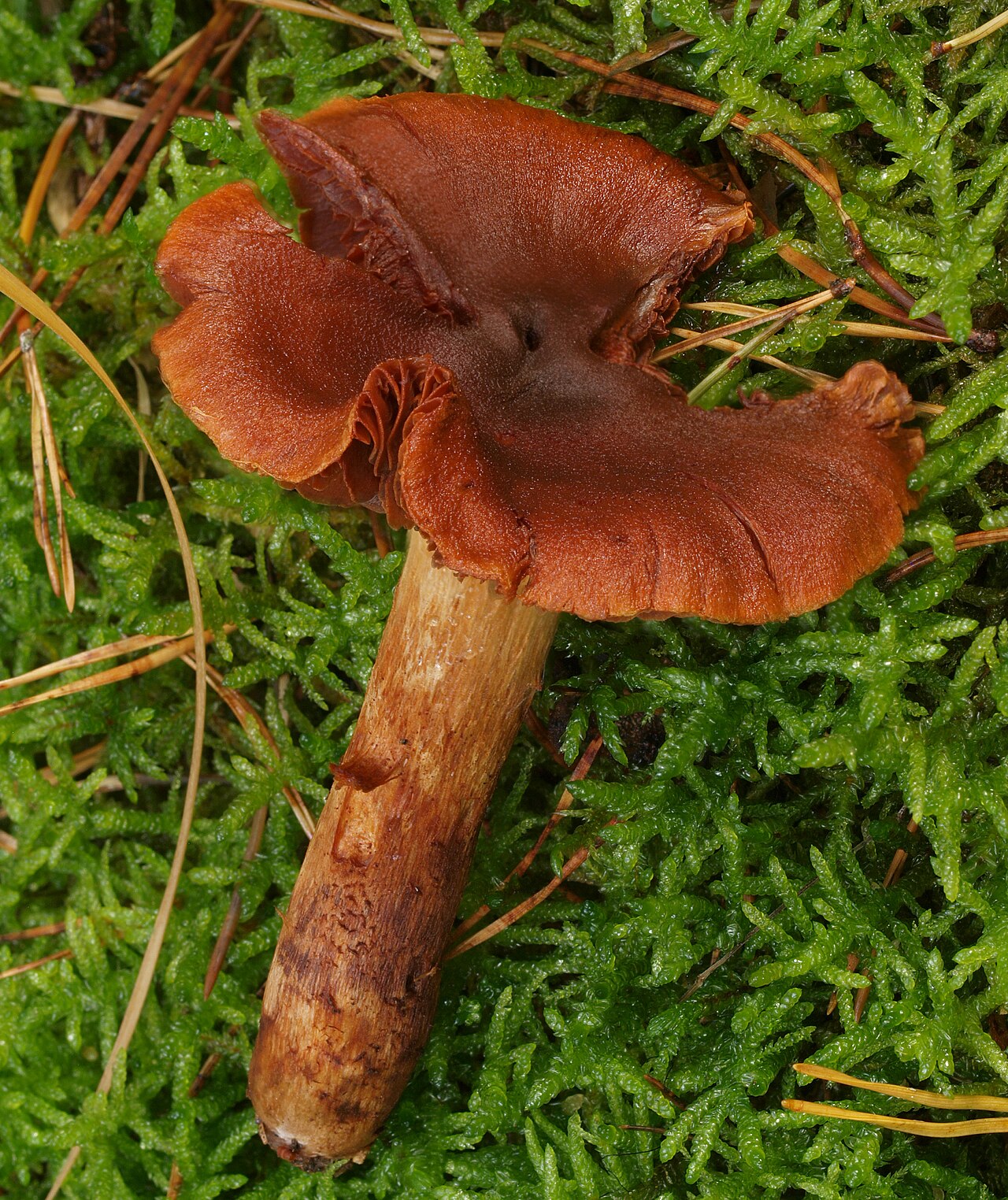
Photo: Andreas Kunze · CC BY-SA 3.0 · Photo source · License

Description
A deadly orange to brown-yellow webcap with a fibrous cap and rusty-brown gills.
Identification features
The stem is yellowish to orange-brown and ringless; cortina remnants are faint in mature specimens.
Identification checklist
Check the entire fruitbody for identification. A deadly orange to brown-yellow webcap with a fibrous cap and rusty-brown gills. The stem is yellowish to orange-brown and ringless; cortina remnants are faint in mature specimens. Typical habitat: Warm deciduous woodland, mainly under oak, beech, and hornbeam.
Detailed features
- Cap
- 3–8 cm, fox- to cinnamon-brown, always dry, initially hemispherical, later expanded with a broad umbo; finely granular to scaly.
- Hymenophore
- Gills broad, spaced, and similarly cinnamon- to rusty-brown; young specimens have a slight cortina.
- Stem
- 4–8 × 0.5–1 cm, relatively slender, yellowish to brown and fibrous; the cortina may be barely visible.
- Flesh
- Yellowish to brownish, more rusty beneath the cap skin.
- Smell
- Radish-like.
- Taste
- Do not taste.
- Spore print
- Reddish-brown.
Size
- Cap diameter
- 3–8 cm
- Stem height
- 4–8 cm
- Stem diameter
- 0,5–1 cm
Habitat
Warm deciduous woodland, mainly under oak, beech, and hornbeam.
Fruiting period
July, August, September, October
Ecology
- Trophic mode
- Mycorrhizal
- Substrate
- Forest soil
- Notes
- A mycorrhizal species of warm deciduous and mixed woodland; fruits in late summer and autumn.
How to separate similar species
Compare especially with these similar species: Cortinarius rubellus, Cortinarius limonius, Cortinarius cinnamomeus. Check the combination of cap shape and colour, spore-bearing surface, stem, flesh changes and habitat. A single feature or photograph is not enough; if the key characters do not match the description, do not treat the identification as confirmed.
Similar species
- Deadly webcap (Cortinarius rubellus) DANGEROUS
Also deadly; usually with a sharper umbo and often associated with coniferous woodland.
- Cortinarius cinnamomeus
Can be similar in colour; reliable Cortinarius identification often requires microscopic and ecological characters.