Species details
Brown webcap
Cortinarius brunneus
Inedible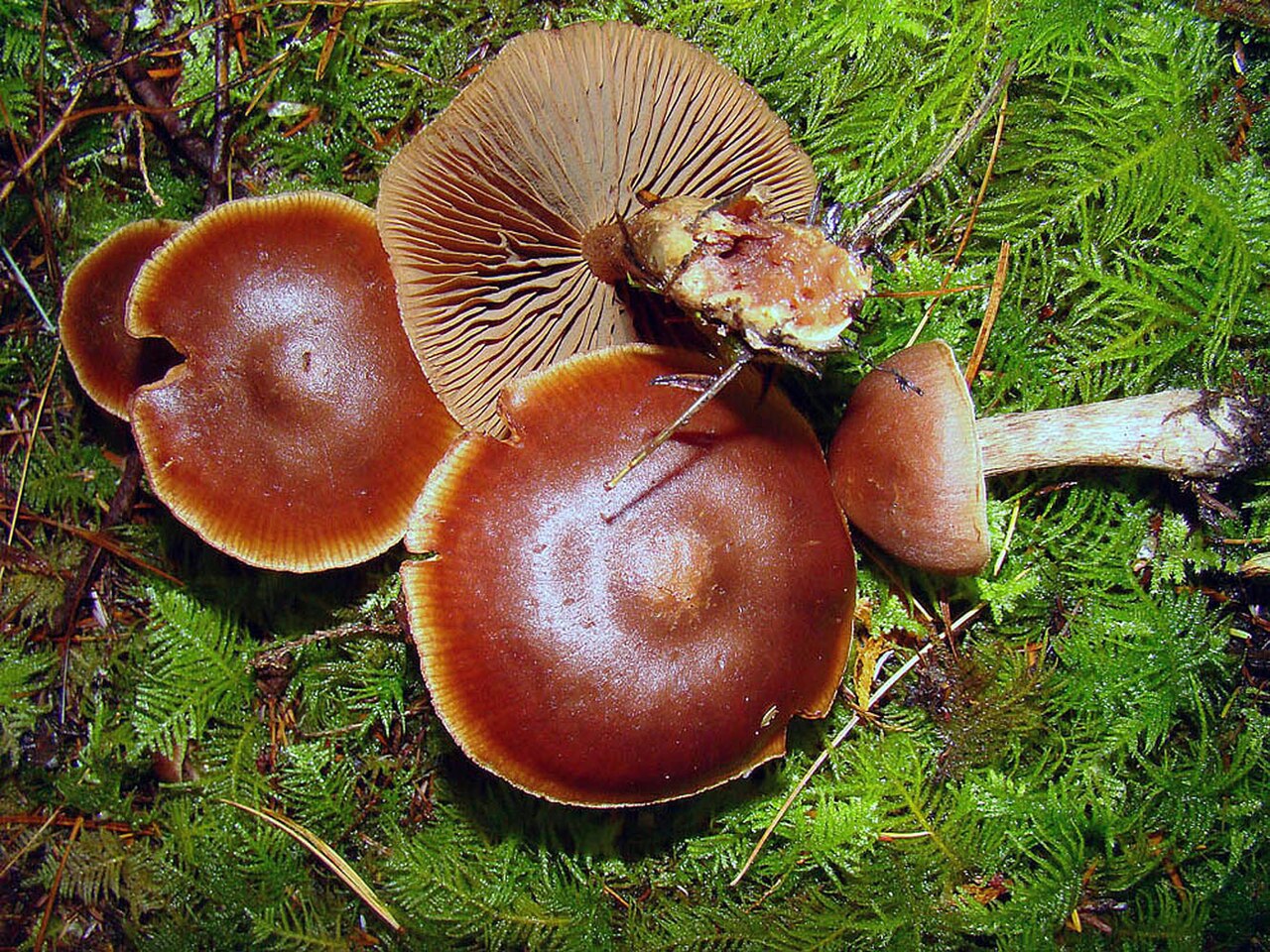
Photo: Dick Culbert from Gibsons, B.C., Canada · CC BY 2.0 · Photo source · License
.jpg)
Description
A dark brown to chestnut webcap with a hygrophanous cap, relatively widely spaced brown gills and a brownish stem.
Identification features
The young cap is bell-shaped to conical, later convex or flatter, dark brown when moist and paler when dry. The stem is slender to club-shaped with fibrous veil remnants; the spore print is rusty brown.
Identification checklist
Check the hygrophanous dark-brown cap, spaced brownish gills, slender-to-clavate stem with fibrous zones and rusty-brown spore print. Species-level identification in this group often needs microscopic characters.
Detailed features
- Cap
- A dark-brown to chestnut webcap with a hygrophanous cap, rather widely spaced brown gills and a brownish stem.
- Hymenophore
- The gills are brown and rather widely spaced; the spore print is rusty-brown.
- Stem
- The stem is slender to club-shaped with fibrous veil remnants; the spore print is rusty brown.
- Flesh
- Brownish to grey-brown and relatively thin.
- Smell
- The smell is not distinctive enough for reliable identification.
- Spore print
- Rust-brown.
Habitat
Mycorrhizal mainly in moist coniferous and mixed woodland, often with spruce and pine; summer and autumn.
Fruiting period
July, August, September, October
Ecology
- Trophic mode
- Mycorrhizal
- Host trees
- Spruce (Picea), Pine (Pinus)
- Substrate
- Forest soil
- Soil
- Moist
- Notes
- Mycorrhizal species. Mycorrhizal mainly in moist coniferous and mixed woodland, often with spruce and pine; summer and autumn.
How to separate similar species
Many brown webcaps are extremely similar. Photographs lacking gills, stem, base, habitat and mature spore colour are insufficient for reliable identification.
Similar species
- Cortinarius glandicolor
- Cortinarius obtusus
- Cortinarius species
Interesting facts
Did you know? The hygrophanous cap changes colour markedly with moisture, so colour alone is not reliable.