Species details
Lurid bolete
Suillellus luridus
Conditional / expert preparation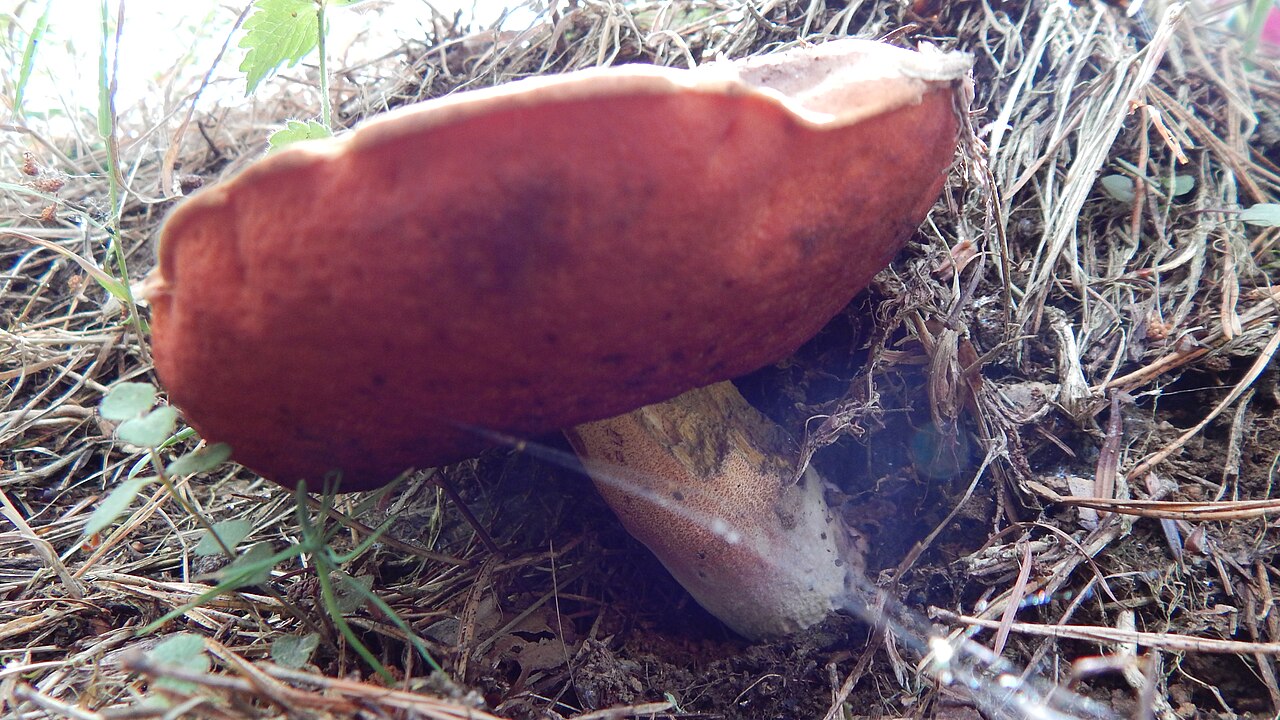
Photo: JovanaKoturov · CC BY-SA 4.0 · Photo source · License

Description
An olive-brown bolete with orange-red pores and a distinct reddish net on the stem.
Identification features
The flesh turns blue when cut, and a reddish layer often lies beneath the tubes. It is harmful raw or undercooked, and red-pored bolete lookalikes are difficult.
Identification checklist
Check the entire fruitbody for identification. An olive-brown bolete with orange-red pores and a distinct reddish net on the stem. The flesh turns blue when cut, and a reddish layer often lies beneath the tubes. It is harmful raw or undercooked, and red-pored bolete lookalikes are difficult. Typical habitat: In warm deciduous woodland and parks, often on calcareous soil with oak or beech.
Detailed features
- Cap
- 8–20 cm, olive-brown, yellow-brown to brown, initially velvety and later smoother.
- Hymenophore
- Tubes are yellow; pores are orange-red to red and bruise rapidly blue.
- Stem
- 5–15 × 2–5 cm, stout to club-shaped, yellow to orange-red, with a conspicuous elongated red reticulum.
- Flesh
- Yellowish to greyish; turns blue to blue-green very quickly when cut.
- Smell
- Mild mushroom-like smell.
- Spore print
- Brownish olive.
Size
- Cap diameter
- 8–20 cm
- Stem height
- 5–15 cm
- Stem diameter
- 2–5 cm
Habitat
In warm deciduous woodland and parks, often on calcareous soil with oak or beech.
Fruiting period
May, June, July, August, September, October
Ecology
- Trophic mode
- Mycorrhizal
- Host trees
- Oak (Quercus), Beech (Fagus)
- Substrate
- Forest soil
- Soil
- Calcareous
- Notes
- A mycorrhizal species of warm deciduous woodland, parks and woodland edges, often on calcareous soils with oak and beech.
Distribution
- Notes
- Distributed in Europe mainly in warmer deciduous habitats and on base-rich soils.
How to separate similar species
Compare especially with these similar species: Neoboletus luridiformis, Rubroboletus satanas. Check the combination of cap shape and colour, spore-bearing surface, stem, flesh changes and habitat. A single feature or photograph is not enough; if the key characters do not match the description, do not treat the identification as confirmed.
Similar species
- Scarletina bolete (Neoboletus luridiformis) DANGEROUS
Scarletina bolete has dense fine red dots on the stem rather than a conspicuous reticulum.
- Satan's bolete (Rubroboletus satanas) DANGEROUS
Satan’s bolete usually has a much paler cap and very stout stem; both groups require careful identification.
Interesting facts
Did you know? The red stem reticulum is an important character separating it from some other blueing red-pored boletes.