Species details
Satan's bolete
Rubroboletus satanas
Poisonous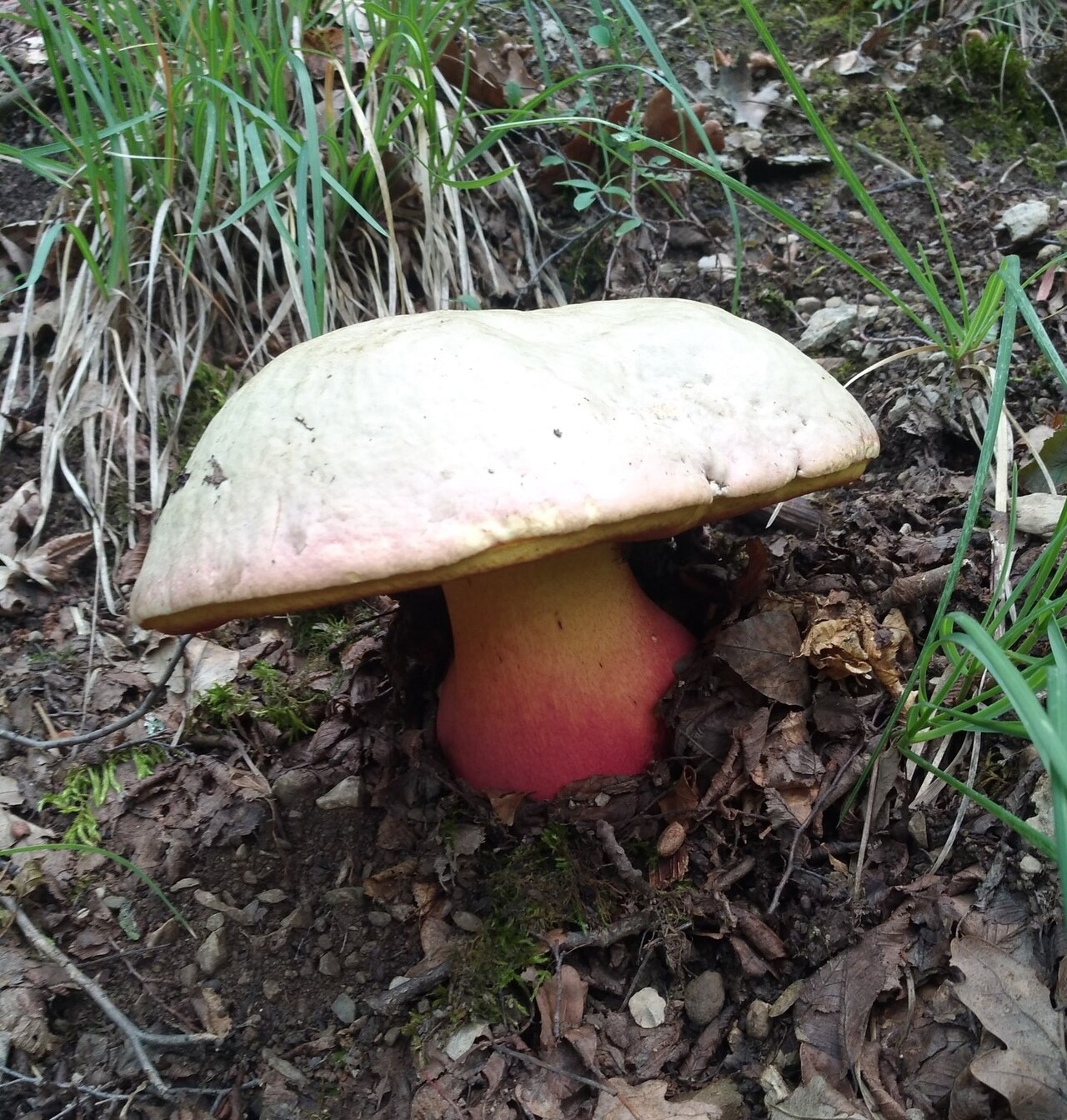
Photo: harukano · CC0 · Photo source · License

Description
A large bolete with a pale cap, red pores, and a stout yellow-red netted stem.
Identification features
The flesh usually turns blue when cut, and old specimens may smell unpleasant. Colour features are variable.
Identification checklist
A large, stout bolete with a pale grey to chalk-white cap, yellow tubes with orange-red pores, and a very swollen stem bearing a red net on a yellow background. The flesh usually blues moderately when cut.
Detailed features
- Cap
- 8–20 cm, very fleshy, whitish to pale grey or olive-grey, initially hemispherical, later cushion-shaped.
- Hymenophore
- Tubes are yellow to yellow-green; pores become orange-red to red with age.
- Stem
- 4–15 cm, very stout to swollen, yellow with a conspicuous red reticulum.
- Flesh
- White to yellowish, usually blueing when cut; older specimens may smell unpleasant.
- Spore print
- Olive-brown.
Size
- Cap diameter
- 8–20 cm
- Stem height
- 4–15 cm
- Stem diameter
- 3–8 cm
Habitat
In warm deciduous woodland on calcareous soil, especially with oak and beech.
Fruiting period
June, July, August, September, October
Ecology
- Trophic mode
- Mycorrhizal
- Host trees
- Oak (Quercus), Beech (Fagus)
- Soil
- Calcareous
Distribution
- Notes
- A warmth-loving European species, mainly on calcareous soils in deciduous woodland.
How to separate similar species
Lurid bolete has a red stem net but usually a darker cap and stronger bluing. Scarletina bolete has fine red dots rather than a net. Red pores alone are not enough for identification.
Similar species
Conservation
- Protected species
- Yes
- Red list
- R – rare species
- Notes
- The species is legally protected in Slovenia under the regulation on protected wild fungi. On the Slovenian Red List: R – rare species. In the 2011 Slovenian regulation the species is listed as Boletus satanas; FungiTrail uses the more recent name Rubroboletus satanas.
Interesting facts
Did you know? Strong blueing alone does not tell whether a bolete is edible or poisonous; the full combination of characters must be assessed.