Species details
Lilac bonnet
Mycena pura
Poisonous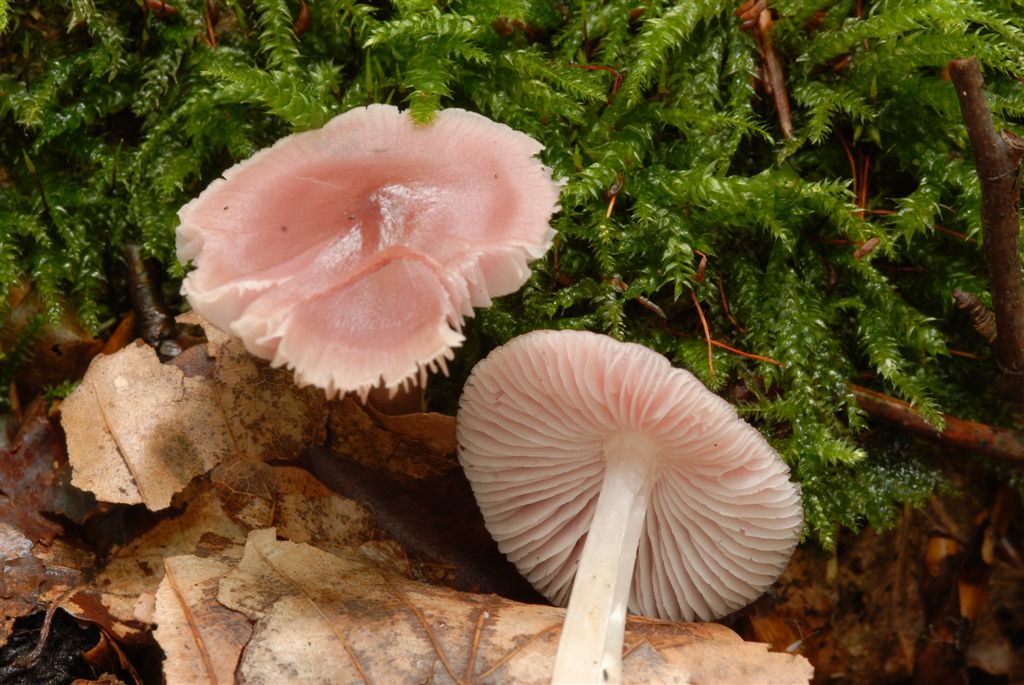
Photo: Dr. Hans-Günter Wagner · CC BY-SA 2.0 · Photo source · License
.jpg)
Description
A small pink to violet bonnet mushroom with a characteristic radish smell.
Identification features
The cap is thin and striate, gills pale, stem slender and brittle; not for consumption.
Identification checklist
Check the entire fruitbody for identification. A small pink to violet bonnet mushroom with a characteristic radish smell. The cap is thin and striate, gills pale, stem slender and brittle; not for consumption. Typical habitat: Deciduous and coniferous woodland among litter, needles and moss.
Detailed features
- Cap
- 2–6 cm, bell-shaped to quickly expanded with a broad blunt umbo, violet, pink or pale, distinctly striate at the margin.
- Hymenophore
- Gills paler than the cap, broad and notched at the stem, becoming more widely spaced with age.
- Stem
- 2–7 × 0.4–0.8 cm, cylindrical, brittle, hollow and roughly cap-coloured.
- Flesh
- Watery, thin and very brittle.
- Smell
- Strong radish smell.
- Spore print
- White.
Size
- Cap diameter
- 2–6 cm
- Stem height
- 2–7 cm
- Stem diameter
- 0,4–0,8 cm
Habitat
Deciduous and coniferous woodland among litter, needles and moss.
Fruiting period
May, June, July, August, September, October, November
Ecology
- Trophic mode
- Saprotrophic
- Substrate
- Leaf litter, Forest soil
- Notes
- A saprotroph of forest soil and plant litter, widespread in broadleaved and coniferous woodland.
How to separate similar species
Compare especially with these similar species: Mycena rosea, Laccaria amethystina. Check the combination of cap shape and colour, spore-bearing surface, stem, flesh changes and habitat. A single feature or photograph is not enough; if the key characters do not match the description, do not treat the identification as confirmed.
Similar species
- Rosy bonnet (Mycena rosea) DANGEROUS
Rosy bonnet is usually larger and more strongly pink, but is likewise unsuitable for eating.
- Amethyst deceiver (Laccaria amethystina)
Amethyst deceiver is firmer, with thicker, more widely spaced gills and no strong radish smell.
Interesting facts
Did you know? The strong radish smell is important; the species is poisonous and not suitable for eating.