Species details
Rosy bonnet
Mycena rosea
Poisonous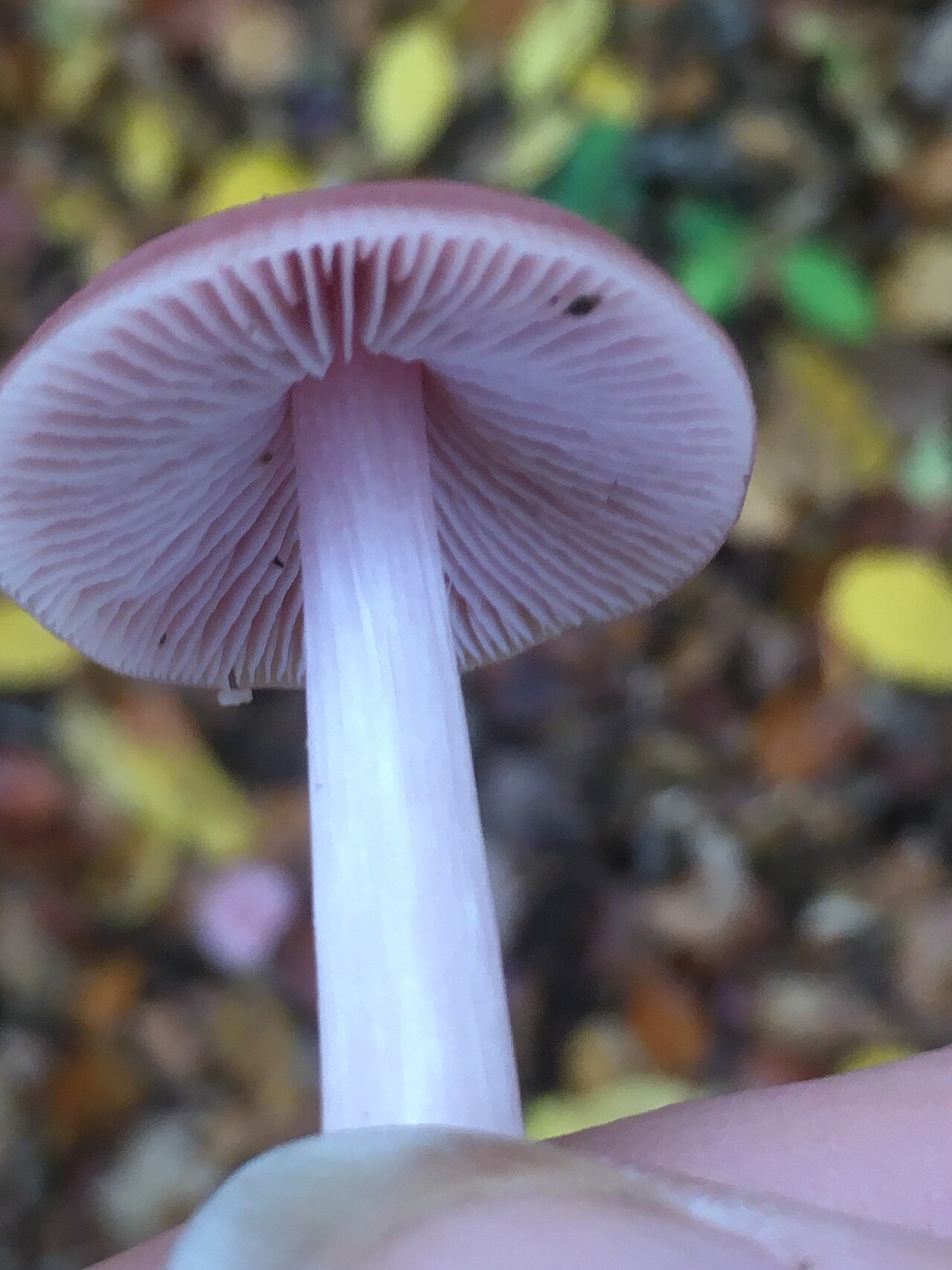
Photo: mangoblatt · CC0 · Photo source · License

Description
A medium-sized pink bonnet with a bell-shaped to expanded cap and radish smell.
Identification features
Gills are pale, the stem whitish to pink and hollow, and it contains muscarine-like toxins.
Identification checklist
Check the entire fruitbody for identification. A medium-sized pink bonnet with a bell-shaped to expanded cap and radish smell. Gills are pale, the stem whitish to pink and hollow, and it contains muscarine-like toxins. Typical habitat: Deciduous woodland, mainly among beech litter on rich soil.
Detailed features
- Cap
- Up to 6 cm, smooth and pink, initially hemispherical then expanded; may become translucently striate when moist and fades strongly when dry.
- Hymenophore
- Gills pink, broad and relatively spaced, with shorter intermediate gills.
- Stem
- Up to 7 cm tall and about 1 cm thick at the base, pink, smooth and widening downward; base surrounded by white mycelium.
- Flesh
- Pinkish, watery, thin and brittle.
- Smell
- Strongly radish-like.
- Taste
- Do not taste.
- Spore print
- White.
Size
- Cap diameter
- 1–6 cm
- Stem height
- 3–7 cm
- Stem diameter
- 0,2–1 cm
Habitat
Deciduous woodland, mainly among beech litter on rich soil.
Fruiting period
July, August, September, October, November
Ecology
- Trophic mode
- Saprotrophic
- Substrate
- Forest soil
- Notes
- Grows among decaying leaf litter in deciduous and mixed woodland, often in groups.
How to separate similar species
Compare especially with these similar species: Mycena pura, Laccaria amethystina, Mycena pelianthina. Check the combination of cap shape and colour, spore-bearing surface, stem, flesh changes and habitat. A single feature or photograph is not enough; if the key characters do not match the description, do not treat the identification as confirmed.
Similar species
- Lilac bonnet (Mycena pura) DANGEROUS
Often more violet to lilac and somewhat more slender; it also smells of radish and is poisonous.
- Amethyst deceiver (Laccaria amethystina)
The amethyst deceiver has tough flesh and very widely spaced thick gills rather than the typical brittle bonnet habit.