Species details
Amethyst deceiver
Laccaria amethystina
Extra caution required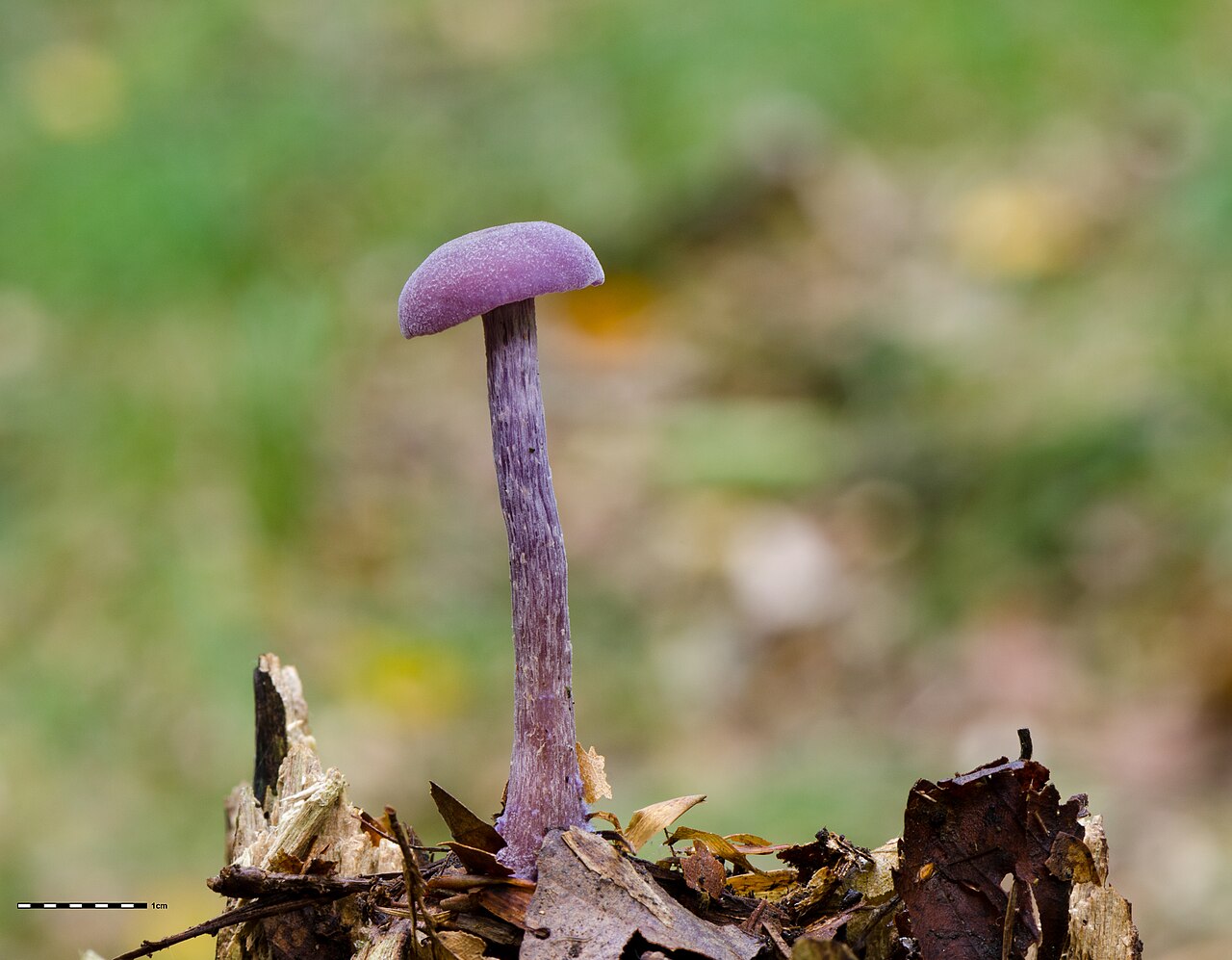
Photo: Norbert Nagel · CC BY-SA 3.0 · Photo source · License

Description
A small to medium entirely violet mushroom that fades strongly with age and drying.
Identification features
The gills are thick and widely spaced, and the stem is fibrous and cap-coloured.
Identification checklist
Check the entire fruitbody for identification. A small to medium entirely violet mushroom that fades strongly with age and drying. The gills are thick and widely spaced, and the stem is fibrous and cap-coloured. Typical habitat: Deciduous and conifer woodland, often among leaf litter and moss, especially with beech.
Detailed features
- Cap
- 1–5 cm, intensely violet when young, fading strongly with age; initially convex, later flat and often slightly depressed.
- Hymenophore
- Gills violet, broad, thick, and widely spaced.
- Stem
- 4–10 cm tall and 0.4–0.7 cm thick, violet, fibrous, tough and flexible.
- Flesh
- Violet, thin, and tough.
- Smell
- Pleasant, indistinct.
- Spore print
- Whitish.
Size
- Cap diameter
- 1–5 cm
- Stem height
- 4–10 cm
- Stem diameter
- 0,4–0,7 cm
Habitat
Deciduous and conifer woodland, often among leaf litter and moss, especially with beech.
Fruiting period
July, August, September, October, November
Ecology
- Trophic mode
- Mycorrhizal
- Substrate
- Forest soil
- Notes
- A mycorrhizal species of deciduous, coniferous and mixed woodland; often in larger groups.
How to separate similar species
Compare especially with these similar species: Mycena pura, Cortinarius violaceus, Laccaria laccata. Check the combination of cap shape and colour, spore-bearing surface, stem, flesh changes and habitat. A single feature or photograph is not enough; if the key characters do not match the description, do not treat the identification as confirmed.
Similar species
- Lilac bonnet (Mycena pura) DANGEROUS
The poisonous bonnet is more brittle, has closer gills, and a characteristic radish smell.
- Violet webcap (Cortinarius violaceus)
Larger and more robust, with closer gills and a rusty-brown spore print.