Species details
Indigo pinkgill
Entoloma chalybeum
Inedible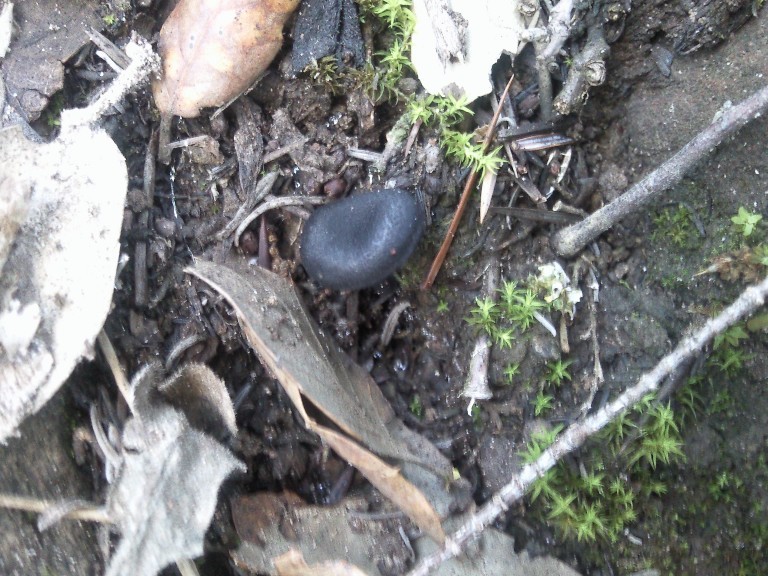
Photo: Souhila Aouali · CC BY-SA 3.0 · Photo source · License
_Zerova_(as_%E2%80%98chalybaeum%E2%80%99)_363707.jpg)
Description
A small almost entirely blue grassland pinkgill with an indigo-blue cap and stem and a pink tinge to mature gills.
Identification features
Cap about 1–4 cm, initially bell- to cone-shaped, later convex, indigo to dark blue and partly hygrophanous. Gills are grey-blue at first, later pink-tinged. Stem is thin, dark blue to green-blue, whitish at the base.
Identification checklist
Check the almost entirely blue coloration, dark-blue slender stem and gills that shift from grey-blue to pink-tinged with maturity.
Detailed features
- Cap
- Cap about 1–4 cm, initially bell- to cone-shaped, later convex, indigo to dark blue and partly hygrophanous.
- Hymenophore
- The gills are initially grey-blue and later develop a pinkish tint.
- Stem
- Stem is thin, dark blue to green-blue, whitish at the base.
Size
- Cap diameter
- 1–4 cm
Habitat
Grows on lawns and meadows in summer and autumn.
Fruiting period
August, September, October
Ecology
- Substrate
- Grassland
- Notes
- Grows on lawns and meadows in summer and autumn.
How to separate similar species
Entoloma serrulatum has characteristically blackish-blue serrated gill edges. Blue pinkgills are difficult; a photo is insufficient for atypical specimens.
Similar species
- Blue-edge pinkgill (Entoloma serrulatum) DANGEROUS
- Mousepee pinkgill (Entoloma incanum)
- Entoloma species