Species details
Honey fungus
Armillaria mellea
Conditional / expert preparation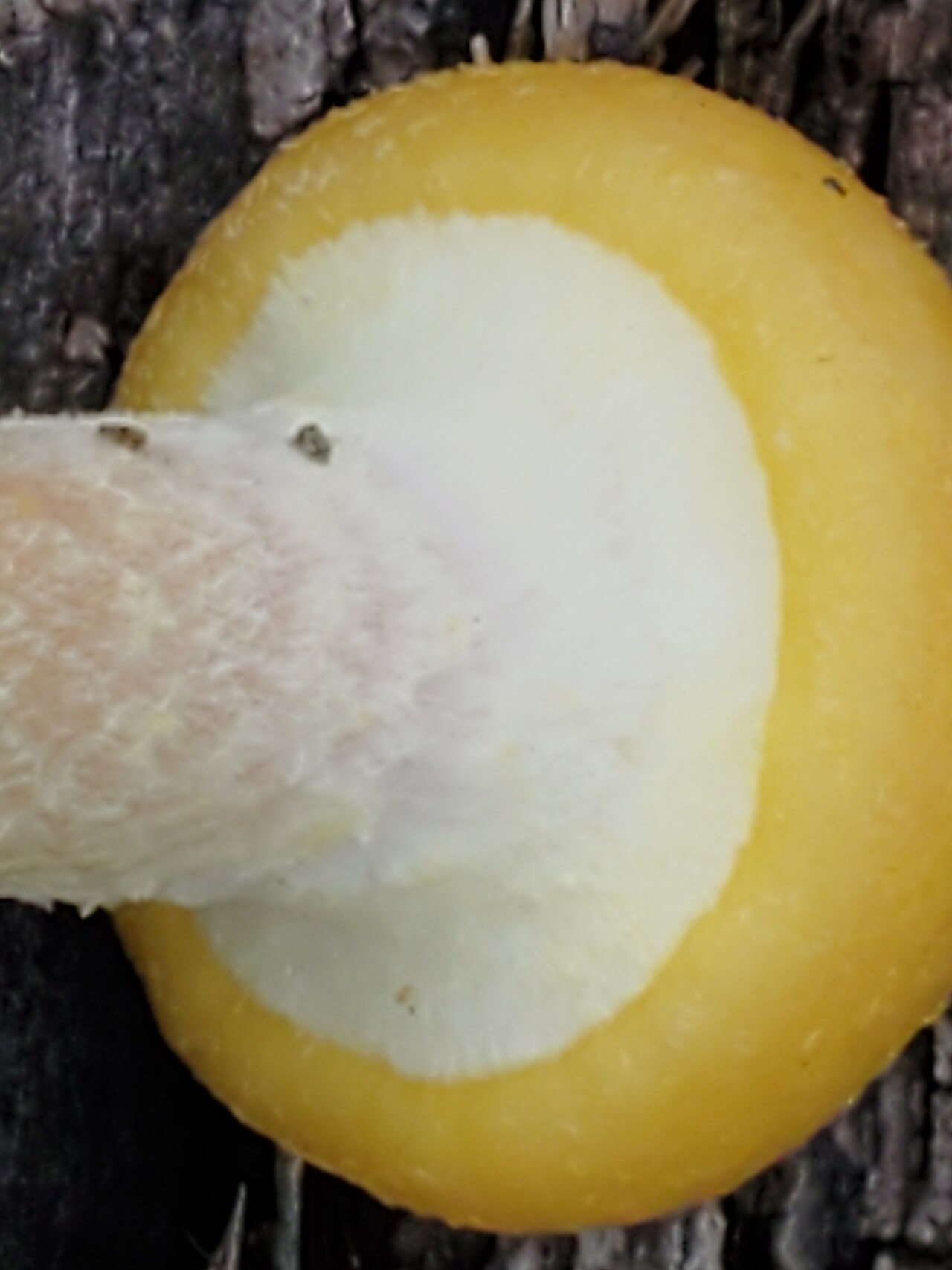
Photo: Tom Zucker-Scharff · CC BY 4.0 · Photo source · License

Description
A honey-yellow to brownish clustered mushroom with a ring, growing on wood or buried roots.
Identification features
The cap has fine scales, the gills are pale, and the spore print is white. Armillaria is taxonomically difficult and may cause gastrointestinal illness.
Identification checklist
It appears in large clusters on roots, stumps, or at the base of mainly broadleaf trees. The cap is honey-yellow to brownish with fine darker scales; gills are pale and later develop rusty spots. The stem usually has a persistent yellowish ring, and the spore print is white.
Detailed features
- Cap
- About 3–10 cm, honey-yellow to brown, initially convex then flattening; the surface usually bears small darker scales.
- Hymenophore
- Gills are initially pale to whitish, later sometimes yellowish or brown-spotted.
- Stem
- Up to about 12 × 1–2 cm, fibrous, darker toward the base; with a conspicuous persistent ring, and clustered stems often joined at the base.
- Flesh
- Whitish, firmer in the cap; the stem becomes tough, especially in older fruitbodies.
- Smell
- Mushroom-like, sometimes rather strong.
- Spore print
- White.
Size
- Cap diameter
- 3–10 cm
- Stem height
- ≤ 12 cm
- Stem diameter
- 1–2 cm
Habitat
On living or dead hardwood, often in large clusters at the base of trees.
Fruiting period
August, September, October, November
Ecology
- Trophic mode
- Parasitic
- Substrate
- Wood, Roots, Stumps
- Notes
- A parasite and later saprotroph on roots, stem bases, stumps and wood of many broadleaved trees; often forms large dense clusters.
Distribution
- Notes
- Widespread in Europe, mainly associated with trees and wood in woodland, parks and orchards.
How to separate similar species
Shaggy scalycap has coarser scales and a brown spore print. Funeral bell is smaller, brown-spored, and deadly poisonous. Several Armillaria species are difficult to separate from one another.
Similar species
- Sulphur tuft (Hypholoma fasciculare) DANGEROUS
Sulphur tuft lacks a true ring, has sulphur-yellow to greenish gills and dark purplish-brown spore deposit.
- Funeral bell (Galerina marginata) DANGEROUS
Funeral bell is deadly poisonous, usually smaller, and has brown spore deposit; any uncertain identification of clustered wood fungi is hazardous.
Interesting facts
Did you know? Honey fungi can form extensive mycelial structures under bark and in wood and are important causes of root rot.