Species details
Funeral bell
Galerina marginata
Deadly poisonous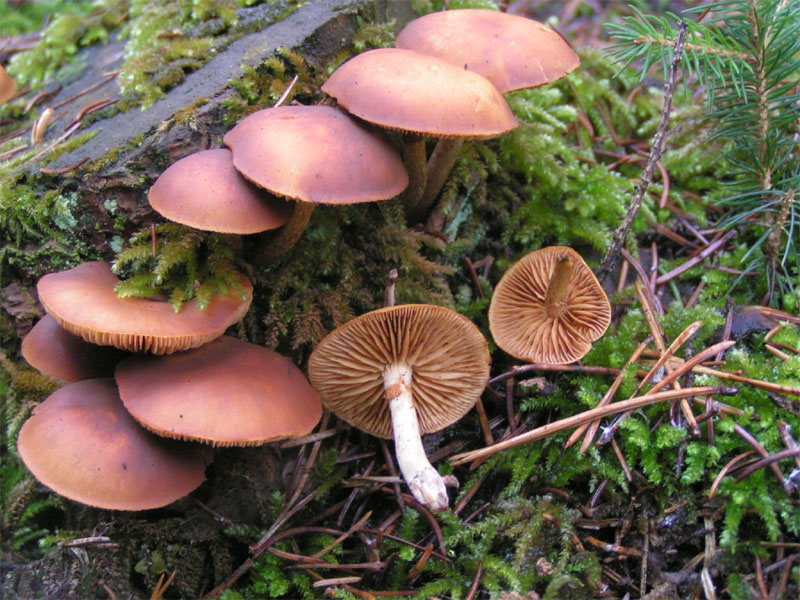
Photo: Eric Steinert · CC BY-SA 3.0 · Photo source · License

Description
A small brown, deadly wood-growing mushroom with a hygrophanous cap, brown spore print, and often a ring.
Identification features
The moist cap margin may be translucently striate. Below the ring, the stem is fibrous and darker.
Identification checklist
A small brown mushroom growing singly or in clusters on dead wood, especially conifers. The hygrophanous cap becomes paler as it dries; the stem may have a ring or ring zone, and the spore print is rusty brown.
Detailed features
- Cap
- 2–5 cm, ochre to orange-brown, hygrophanous; when moist the margin is often translucently striate.
- Hymenophore
- Gills are pale at first, later becoming brownish to rusty.
- Stem
- 2–7 cm, slender and fibrous, darker towards the base; the small ring may disappear.
- Flesh
- Thin and watery brownish.
- Smell
- Mealy.
- Spore print
- Ochre to rusty-brown.
Size
- Cap diameter
- 2–5 cm
- Stem height
- 2–7 cm
- Stem diameter
- 0,2–0,6 cm
Habitat
On dead coniferous and deciduous wood, singly or in small groups.
Fruiting period
April, May, June, July, August, September, October, November
Ecology
- Trophic mode
- Saprotrophic
- Host trees
- Spruce (Picea)
- Substrate
- Dead wood, Stumps
Distribution
- Notes
- Widespread in Europe on dead wood, often conifer stumps.
How to separate similar species
Sheathed woodtuft can be so similar that reliable separation may require microscopy. Honey fungi and sulphur tufts may also look similar. Never collect small brown wood-growing mushrooms for food without expert confirmation.
Similar species
- Sheathed woodtuft (Kuehneromyces mutabilis)
- Armillaria species
- Hypholoma species
Interesting facts
Did you know? The small ring can disappear, so its absence does not rule out the species; confusion with edible wood-growing mushrooms is very dangerous.