Species details
Sulphur tuft
Hypholoma fasciculare
Poisonous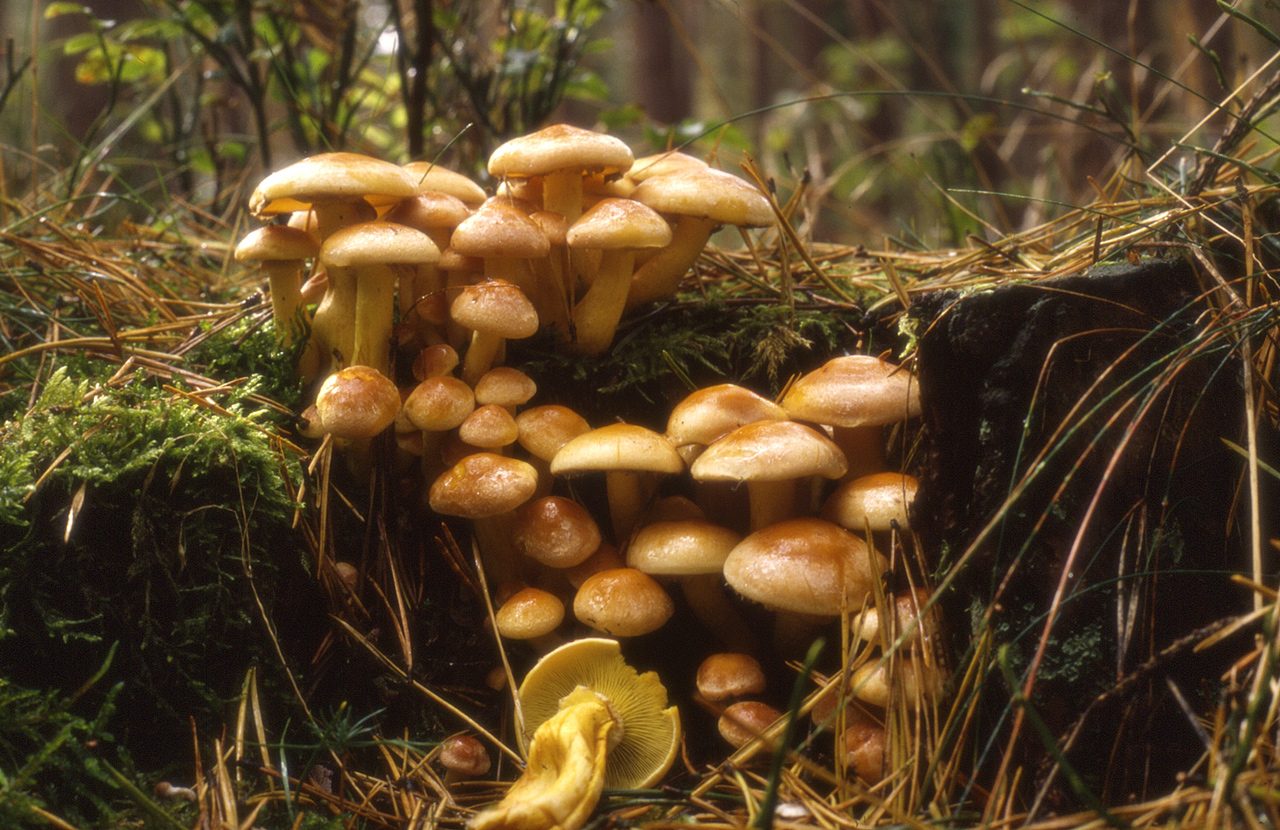
Photo: Thomas Jäger · CC BY-SA 3.0 · Photo source · License

Description
A sulphur-yellow mushroom growing in dense clusters on wood; the gills become greenish and then dark.
Identification features
The cap centre is often orange-brown. The taste is bitter, but tasting unknown mushrooms is not a safe identification method.
Identification checklist
It grows in dense clusters on stumps, roots, and buried wood. Caps are sulphur-yellow with an orange-brown centre; gills start yellow, become greenish, and finally dark olive-brown.
Detailed features
- Cap
- 2–7 cm, sulphur-yellow, often browner or orange at the centre, convex to slightly umbonate.
- Hymenophore
- Crowded gills are initially sulphur-yellow, then olive-green and darken with age.
- Stem
- 5–12 cm, slender, often curved, yellowish and browner towards the base.
- Flesh
- Yellowish and firm; intensely bitter.
- Spore print
- Purplish-brown.
Size
- Cap diameter
- 2–7 cm
- Stem height
- 5–12 cm
- Stem diameter
- 0,5–1 cm
Habitat
On stumps, roots, and buried wood of deciduous and coniferous trees.
Fruiting period
April, May, June, July, August, September, October, November, December
Ecology
- Trophic mode
- Saprotrophic
- Substrate
- Dead wood, Stumps, Buried wood
Distribution
- Notes
- A very common wood-rotting species across much of Europe.
How to separate similar species
Sheathed woodtuft has a ring, a paler upper and dark scaly lower stem, and a rusty-brown spore print. Deadly funeral bell can be very similar; small brown wood-growing mushrooms often require microscopic confirmation.
Similar species
Interesting facts
Did you know? It often forms very dense clusters on stumps or buried wood; olive-green gills are an important warning feature.