Species details
Brick cap
Hypholoma lateritium
Conditional / expert preparation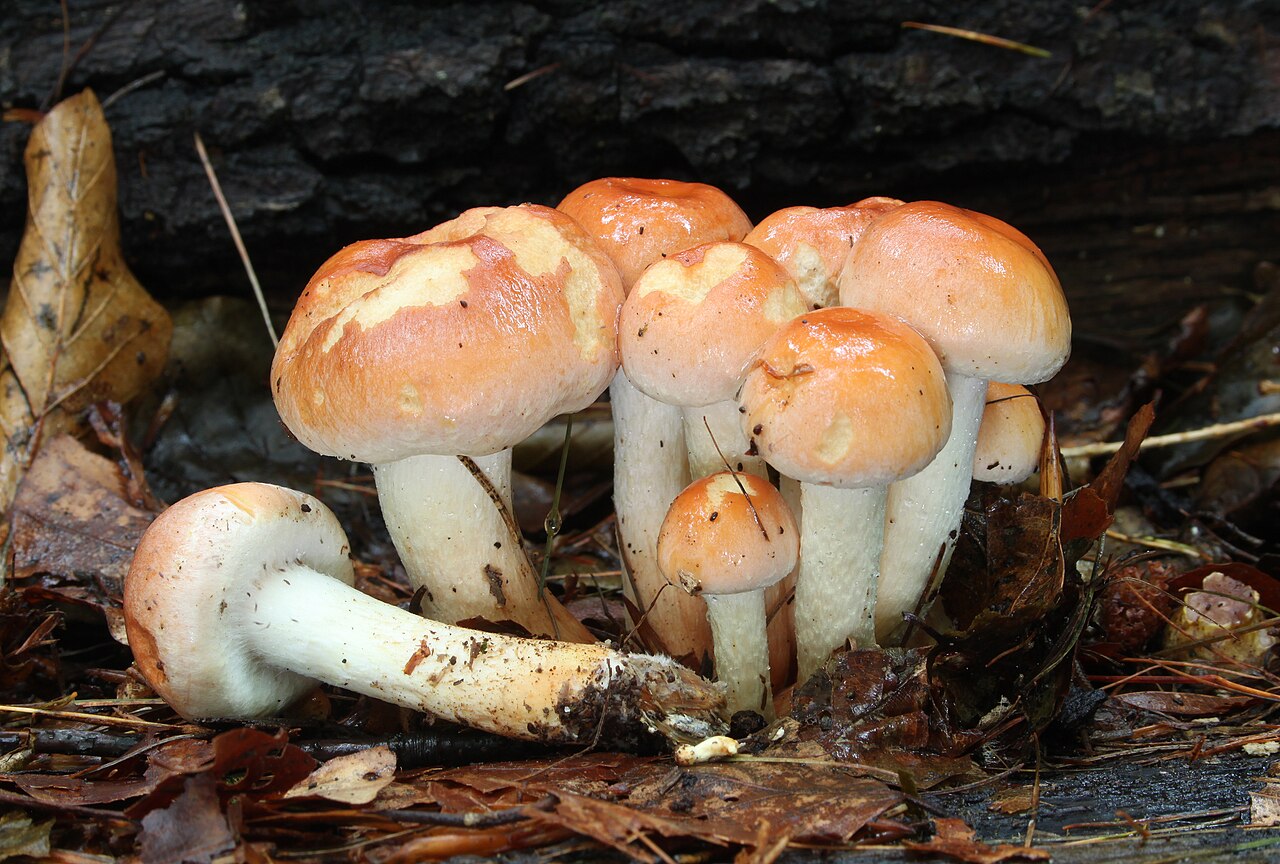
Photo: Holger Krisp · CC BY 3.0 · Photo source · License

Description
A clustered wood mushroom with a brick-red to reddish-brown cap centre and paler margin, lacking the strong green-yellow tones of sulphur tuft.
Identification features
Gills are pale when young, later grey-olive and dark; the stem is yellowish above, reddish-brown toward the base, and lacks a ring.
Identification checklist
Check the entire fruitbody for identification. A clustered wood mushroom with a brick-red to reddish-brown cap centre and paler margin, lacking the strong green-yellow tones of sulphur tuft. Gills are pale when young, later grey-olive and dark; the stem is yellowish above, reddish-brown toward the base, and lacks a ring. Typical habitat: In dense clusters on stumps, roots and dead hardwood, from late summer into late autumn.
Detailed features
- Cap
- A clustered wood-growing mushroom with a brick-red to reddish-brown cap centre and paler margin, lacking the pronounced greenish-yellow tones of sulphur tuft.
- Hymenophore
- The gills are pale when young, later grey-olive and dark; the stem is yellowish above, reddish-brown toward the base, and lacks a ring.
- Flesh
- Yellowish, firm to tough and bitter.
- Smell
- No distinctive smell.
- Spore print
- Very dark to nearly black.
Size
- Cap diameter
- 5–8 cm
- Stem height
- 6–12 cm
- Stem diameter
- 0,5–1 cm
Habitat
In dense clusters on stumps, roots and dead hardwood, from late summer into late autumn.
Fruiting period
August, September, October, November
Ecology
- Trophic mode
- Saprotrophic
- Substrate
- Stumps, Dead hardwood, Roots
- Notes
- Saprotrophic species. In dense clusters on stumps, roots and dead hardwood, from late summer into late autumn.
How to separate similar species
Compare especially with these similar species: Hypholoma fasciculare, Kuehneromyces mutabilis, Galerina marginata. Check the entire fruitbody, spore-bearing surface, stem, texture, changes after bruising and habitat. A single feature or photograph is not enough for reliable identification.
Similar species
- Sulphur tuft (Hypholoma fasciculare) DANGEROUS
H. fasciculare is more sulphur-yellow and develops greenish gills; H. lateritium has a characteristic brick-red cap centre.
- Sheathed woodtuft (Kuehneromyces mutabilis)
- Funeral bell (Galerina marginata) DANGEROUS
G. marginata can be deadly poisonous; it typically has a brown spore print and a distinct stem ring. Never identify wood-growing agarics by cap colour alone.
Interesting facts
Did you know? The brick-red cap centre is useful only together with gill colour and growth on wood; avoid confusion with dangerous wood-growing agarics.