Species details
Goatcheese webcap
Cortinarius camphoratus
Inedible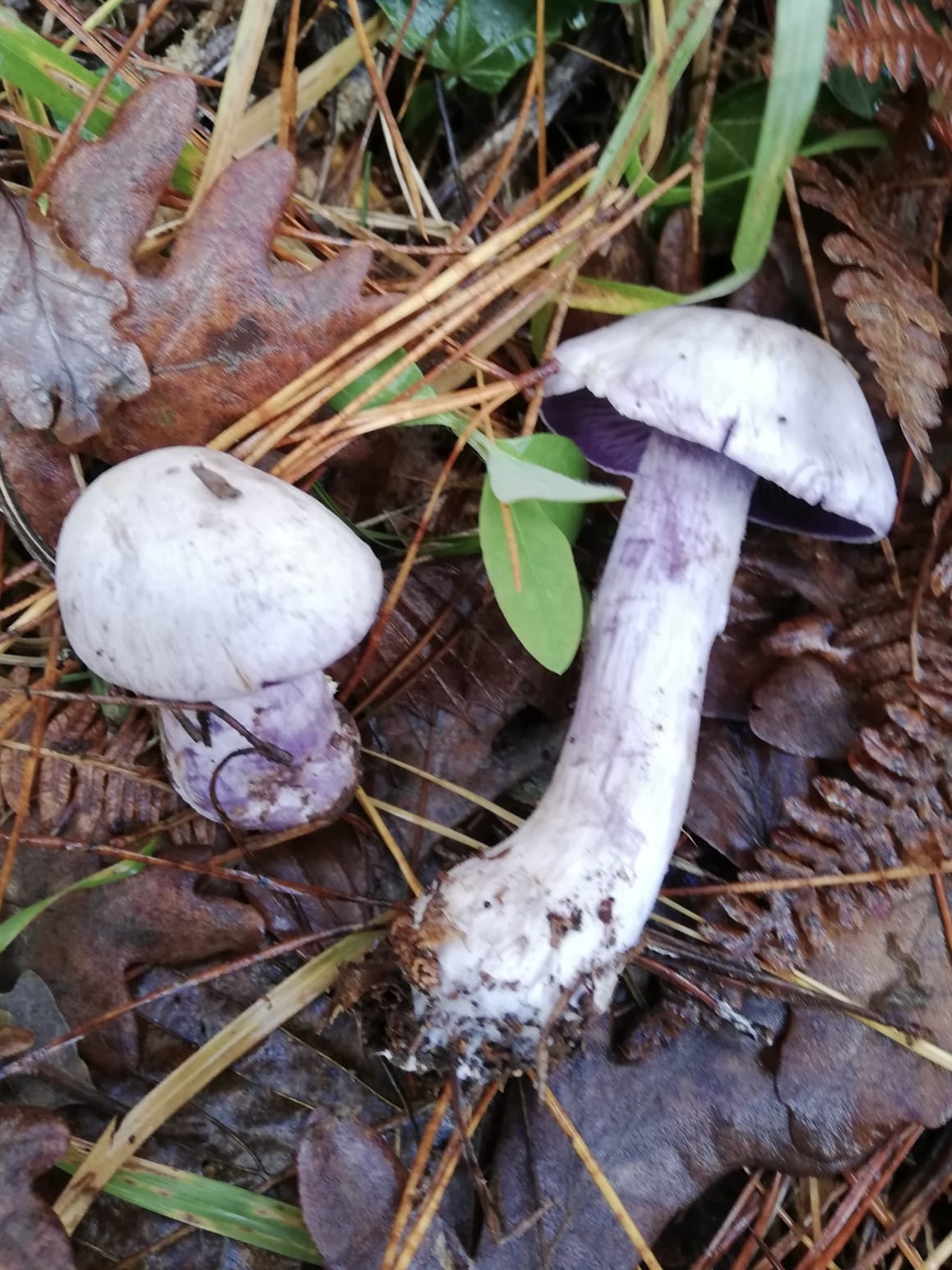
Photo: Jose Angel Urquia Goitia · CC BY-SA 4.0 · Photo source · License

Description
A pale to amethyst-violet webcap with violet young gills and a very strong unpleasant smell.
Identification features
The cap is dry and silky-fibrillose. Gills start blue-violet and become cinnamon to rusty brown. The stem is pale violet; cortina remnants are sparse.
Identification checklist
Check the entire fruitbody for identification. A pale to amethyst-violet webcap with violet young gills and a very strong unpleasant smell. The cap is dry and silky-fibrillose. Gills start blue-violet and become cinnamon to rusty brown. The stem is pale violet; cortina remnants are sparse. Mainly in acidic coniferous woodland, less often deciduous woodland; late summer to autumn.
Detailed features
- Cap
- A pale to amethyst-violet webcap with violet young gills and a very strong unpleasant smell.
- Hymenophore
- The cap is dry and silky-fibrous. The gills are initially blue-violet, later cinnamon to rusty-brown. The stem is pale violet and veil remnants are sparse.
- Flesh
- Violet to pale brownish.
- Smell
- Strong unpleasant smell.
- Spore print
- Rust-brown.
Size
- Cap diameter
- 5–9 cm
- Stem height
- 5–10 cm
- Stem diameter
- 1–2 cm
Habitat
Mainly in acidic coniferous woodland, less often deciduous woodland; late summer to autumn.
Fruiting period
August, September, October
Ecology
- Trophic mode
- Mycorrhizal
- Host trees
- Spruce (Picea)
- Substrate
- Forest soil
- Soil
- Acidic
- Notes
- Mycorrhizal species. Mainly in acidic coniferous woodland, less often deciduous woodland; late summer to autumn.
How to separate similar species
Compare especially with: Cortinarius traganus, Cortinarius alboviolaceus, Cortinarius violaceus. A single feature or photograph is not sufficient for reliable identification.
Similar species
Interesting facts
Did you know? The strong unpleasant smell is more diagnostic than the violet colour alone, which occurs in other webcaps too.