Species details
False death cap
Amanita citrina
Poisonous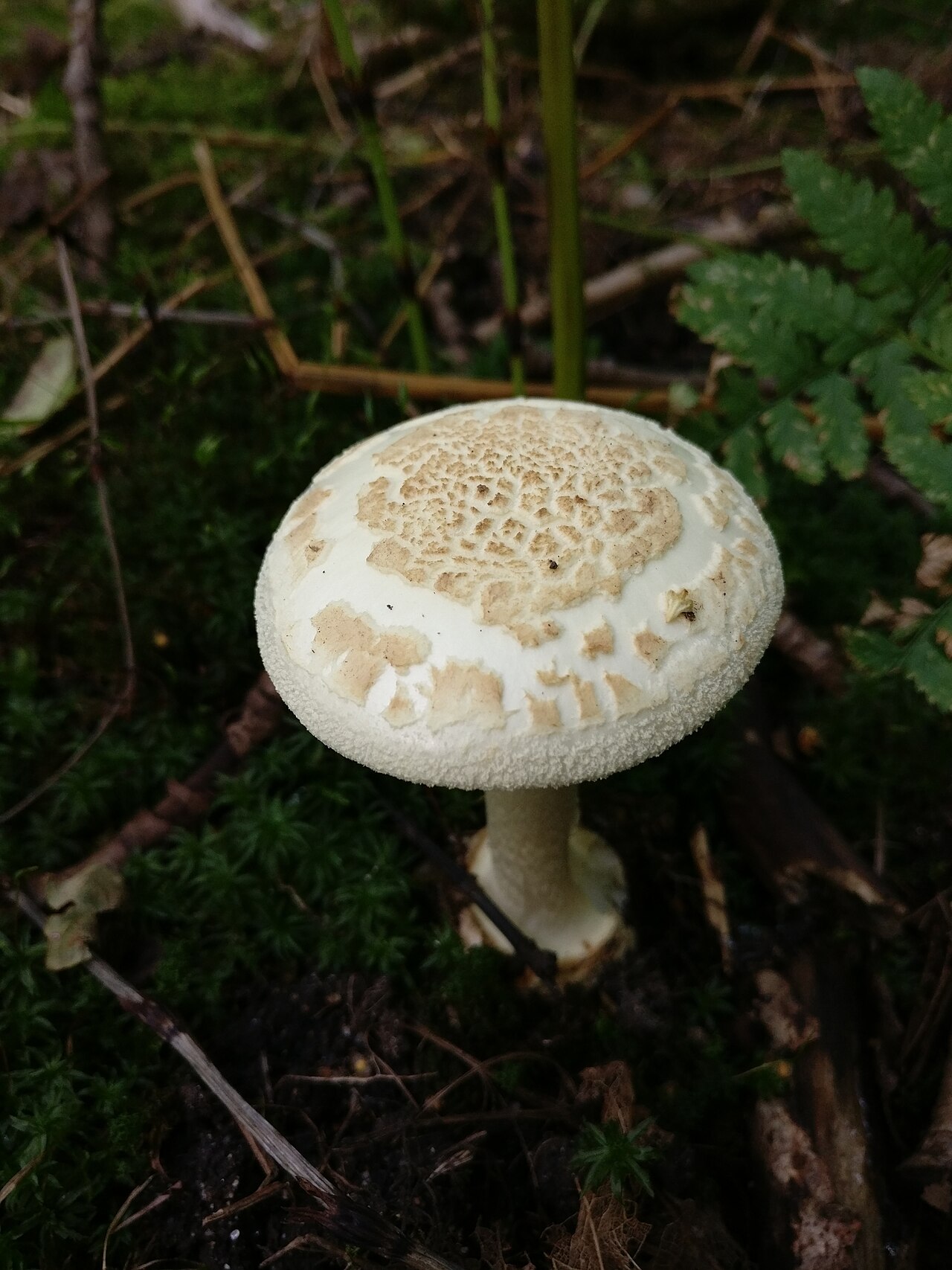
Photo: muukalainen · CC0 · Photo source · License

Description
A pale yellowish to whitish amanita with a ring, veil patches on the cap, and a sharply bulbous base.
Identification features
It often smells of raw potatoes. Because it resembles more dangerous white and greenish amanitas, it should not be used as food.
Identification checklist
The cap is pale yellow, yellow-green, or almost white, often with whitish to ochre patches. Gills, stem, and ring are white; the base is strongly bulbous with a distinct rim. The smell often resembles raw potatoes.
Detailed features
- Cap
- 4–10 cm, lemon-yellow to pale yellowish or whitish, with whitish to brownish veil patches; margin smooth.
- Hymenophore
- Gills white to slightly yellowish, crowded, and free from the stem.
- Stem
- 6–12 × 0.8–1.5 cm, white to yellowish, with a hanging ring; base a large bulb with a sharp rim rather than a free sac-like volva.
- Flesh
- White and firm, without a conspicuous colour change.
- Smell
- Characteristic smell of raw potato or radish.
- Spore print
- White.
Size
- Cap diameter
- 4–10 cm
- Stem height
- 6–12 cm
- Stem diameter
- 0,8–1,5 cm
Habitat
In deciduous, coniferous, and mixed woodland, often on acidic soil.
Fruiting period
July, August, September, October, November
Ecology
- Trophic mode
- Mycorrhizal
- Host trees
- Pine (Pinus), Beech (Fagus), Oak (Quercus)
- Soil
- Acidic
- Notes
- Most frequent on acidic soils in pine and mixed woodland.
Distribution
- Notes
- A widespread European woodland species where suitable mycorrhizal trees occur.
How to separate similar species
Death cap usually has a sac-like volva rather than a rimmed bulb and lacks the typical potato smell. Destroying angel is pure white with a large sac-like volva. No single character is sufficient.
Similar species
- Death cap (Amanita phalloides) DANGEROUS
Death cap usually has a free sac-like volva and lacks the characteristic potato-like smell.
- Destroying angel (Amanita virosa) DANGEROUS
Destroying angel is white and has a large free sac-like volva; it is deadly poisonous.
Interesting facts
Did you know? The raw-potato smell is a useful supporting character, but with amanitas it must never replace examination of the entire stem base.