Species details
Death cap
Amanita phalloides
Deadly poisonous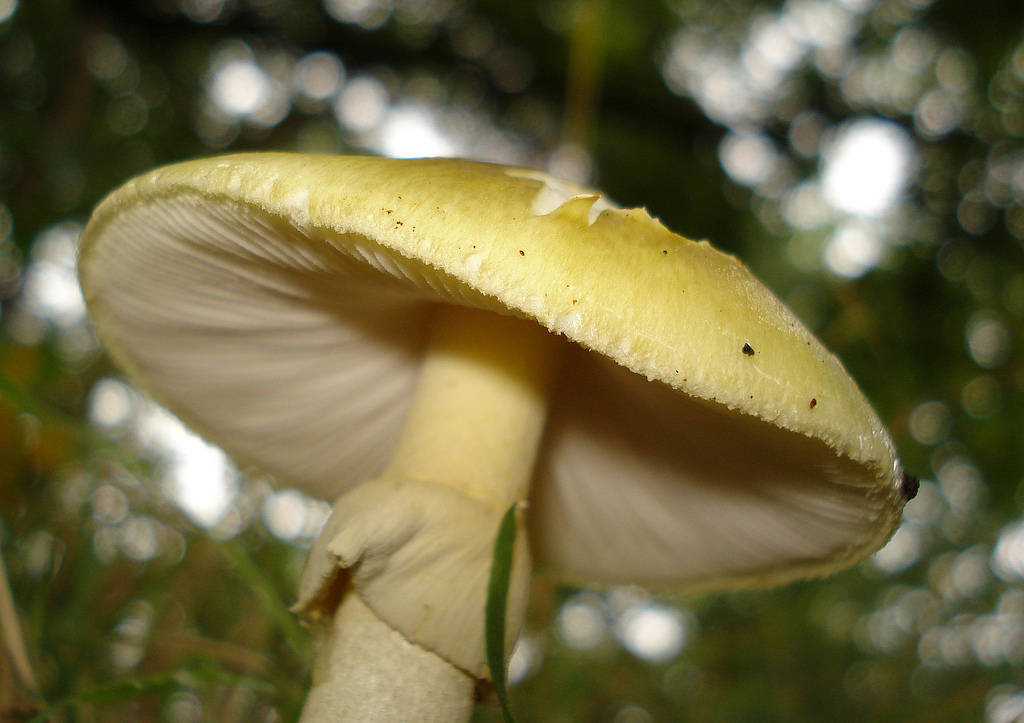
Photo: Mick E. Talbot · CC BY-SA 3.0 · Photo source · License

Description
A deadly poisonous amanita with white gills, a ring, and a sac-like volva around the bulbous stem base.
Identification features
The cap may be olive green, yellowish, brownish, or almost white. The whole base must be recovered because the volva is critical.
Identification checklist
Cap colour varies from yellow-green and olive to brownish. Gills, stem, and spore print are white; the stem has a ring and a large sack-like white volva at the base, which may be hidden in soil or leaf litter.
Detailed features
- Cap
- 5–15 cm, whitish, yellowish to olive green or brownish, smooth with innate fibres.
- Hymenophore
- Gills are white to slightly greenish, crowded and free from the stem.
- Stem
- Whitish with a hanging ring; the bulbous base is enclosed by a conspicuous free sac-like volva.
- Flesh
- White and generally unchanging; older specimens may develop a sweetish unpleasant smell.
- Spore print
- White.
Size
- Cap diameter
- 5–15 cm
- Stem height
- 5–15 cm
- Stem diameter
- 1–2 cm
Habitat
Mostly with oak, beech, and other deciduous trees; also in parks.
Fruiting period
July, August, September, October, November
Ecology
- Trophic mode
- Mycorrhizal
- Host trees
- Oak (Quercus), Sweet chestnut (Castanea)
Distribution
- Notes
- Widespread in Europe, especially in deciduous woodland and parks with suitable host trees.
How to separate similar species
Young specimens may be mistaken for Agaricus or green Russula species, which lack a sack-like volva. Caesar’s mushroom has an orange-red cap with yellow gills and stem. Always excavate and inspect the entire base.
Similar species
- Agaricus species
- Russula species
- Caesar's mushroom (Amanita caesarea)
Interesting facts
Did you know? For safe separation the entire stem base must be checked: the combination of ring and sac-like volva is critical.