Species details
Common earthball
Scleroderma citrinum
Poisonous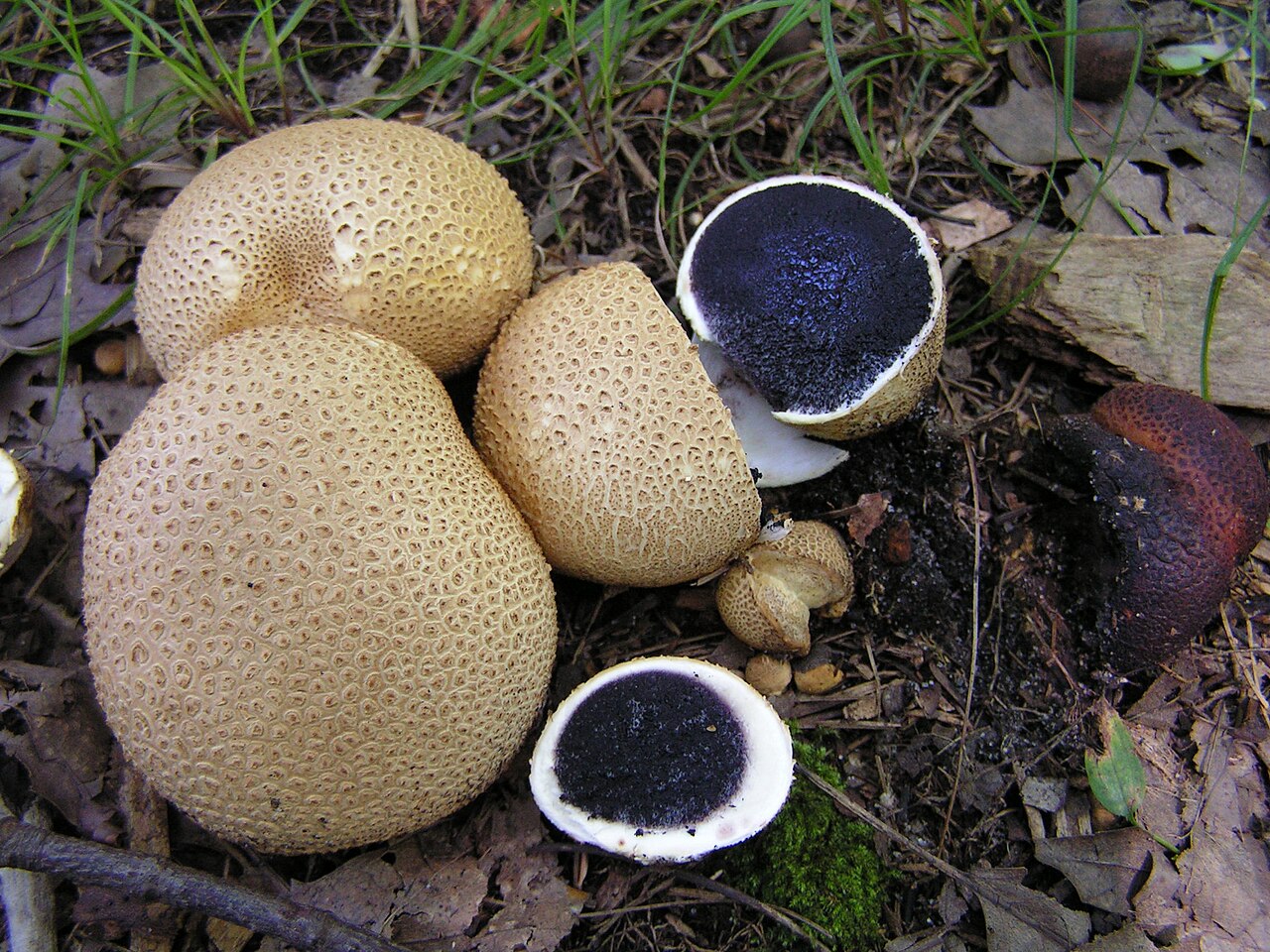
Photo: Herbert Baker · CC BY-SA 3.0 · Photo source · License

Description
A round yellow-brown earthball with a thick rough skin and dark interior.
Identification features
Even when young the interior is grey to violet-black, never uniformly white like edible puffballs.
Identification checklist
Check the entire fruitbody for identification. A round yellow-brown earthball with a thick rough skin and dark interior. Even when young the interior is grey to violet-black, never uniformly white like edible puffballs. Typical habitat: Acid woodland soil, heath, path edges, and rotten wood, often partly buried.
Detailed features
- Cap
- Fruitbody 3–10 cm, spherical to somewhat flattened, yellow-brown, with a very thick, tough, coarsely cracked scaly outer skin.
- Hymenophore
- The fertile tissue is the internal gleba: pale when young, soon violet-black, and powdery at maturity; spores escape through an opening at the top.
- Stem
- No true stem; the fruitbody is connected to the mycelium by strong rhizomorphs.
- Flesh
- Young gleba is firm and pale, becoming dark violet-black and finally powdery.
- Smell
- Distinct and unpleasant in mature specimens.
- Taste
- Do not taste.
- Spore print
- Black-brown.
Size
- Cap diameter
- 3–10 cm
Habitat
Acid woodland soil, heath, path edges, and rotten wood, often partly buried.
Fruiting period
June, July, August, September, October, November
Ecology
- Trophic mode
- Mycorrhizal
- Host trees
- Oak (Quercus), Beech (Fagus), Spruce (Picea)
- Substrate
- Forest soil
- Notes
- An ectomycorrhizal species of varied woodland habitats; it can associate with several tree species including oak, beech and spruce.
How to separate similar species
Compare especially with these similar species: Lycoperdon perlatum, Calvatia gigantea, Scleroderma areolatum. Check the combination of cap shape and colour, spore-bearing surface, stem, flesh changes and habitat. A single feature or photograph is not enough; if the key characters do not match the description, do not treat the identification as confirmed.
Similar species
- Common puffball (Lycoperdon perlatum)
The common puffball has a thinner skin and a homogeneously white interior when young; the earthball has a very thick tough skin and the gleba darkens early.
- Giant puffball (Calvatia gigantea)
The giant puffball is very large, white and smooth; its young interior is uniformly white and lacks a thick yellow-brown skin.