Species details
Common puffball
Lycoperdon perlatum
Conditional / expert preparation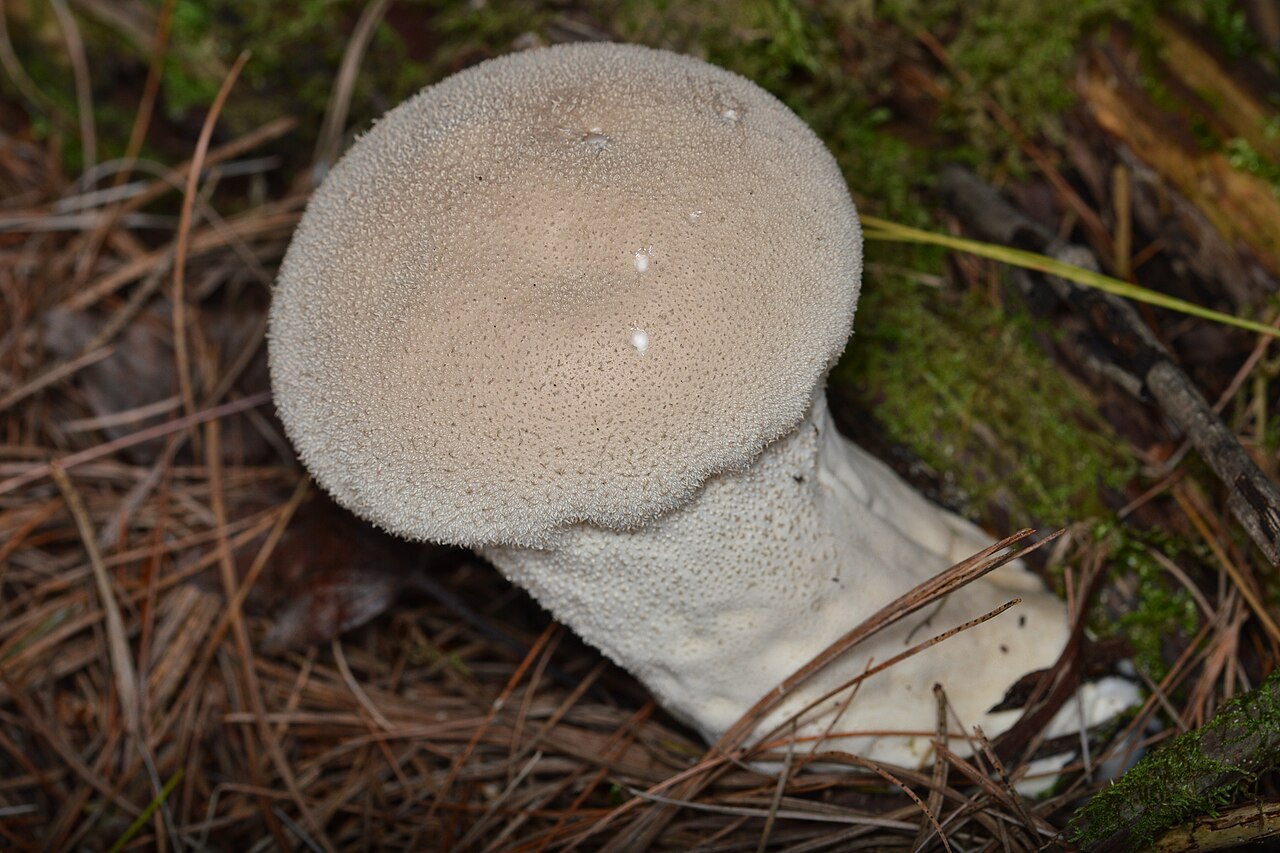
Photo: Ryan Hodnett · CC BY-SA 4.0 · Photo source · License
_-_La_P%C3%AAche,_Qu%C3%A9bec_2016-09-20_(01).jpg)
Description
A pear- to club-shaped puffball covered with small conical spines that leave a net-like pattern.
Identification features
When young the interior is uniformly white; it later turns yellow-olive and becomes spore dust.
Identification checklist
Check the entire fruitbody for identification. A pear- to club-shaped puffball covered with small conical spines that leave a net-like pattern. When young the interior is uniformly white; it later turns yellow-olive and becomes spore dust. Typical habitat: On woodland soil among leaves and needles, singly or in groups.
Detailed features
- Cap
- Fruitbody 2–5 cm tall and 2–4 cm wide, club- to pear-shaped, white when young and covered in characteristic brittle conical spines.
- Hymenophore
- The fertile tissue is the internal gleba: initially completely white, later yellowish, olive, then brown spore powder released through an apical pore.
- Stem
- The lower sterile part forms a stem-like section about 1–4 × 1.5–3 cm.
- Flesh
- Young gleba is white and brittle; as it matures it becomes yellowish, olive, and finally brown spore powder.
- Smell
- Pleasant when young, later indistinct.
- Spore print
- Brown.
Habitat
On woodland soil among leaves and needles, singly or in groups.
Fruiting period
June, July, August, September, October, November
Ecology
- Trophic mode
- Saprotrophic
- Substrate
- Forest soil
- Notes
- Grows on forest soil, often in groups along paths and among leaf or needle litter.
How to separate similar species
Compare especially with these similar species: Lycoperdon nigrescens, Scleroderma citrinum, Amanita species (young). Check the combination of cap shape and colour, spore-bearing surface, stem, flesh changes and habitat. A single feature or photograph is not enough; if the key characters do not match the description, do not treat the identification as confirmed.
Similar species
- Lycoperdon nigrescens
Has darker, blackish spines and becomes darker with age.
- Common earthball (Scleroderma citrinum) DANGEROUS
Has a thick firm yellow-brown skin and an interior that soon turns dark violet-black; toxic.
- Amanita species (young) DANGEROUS
A young amanita shows a developing cap, gills or other internal structures when cut; a puffball must be homogeneously white inside.