Species details
Giant puffball
Calvatia gigantea
Conditional / expert preparation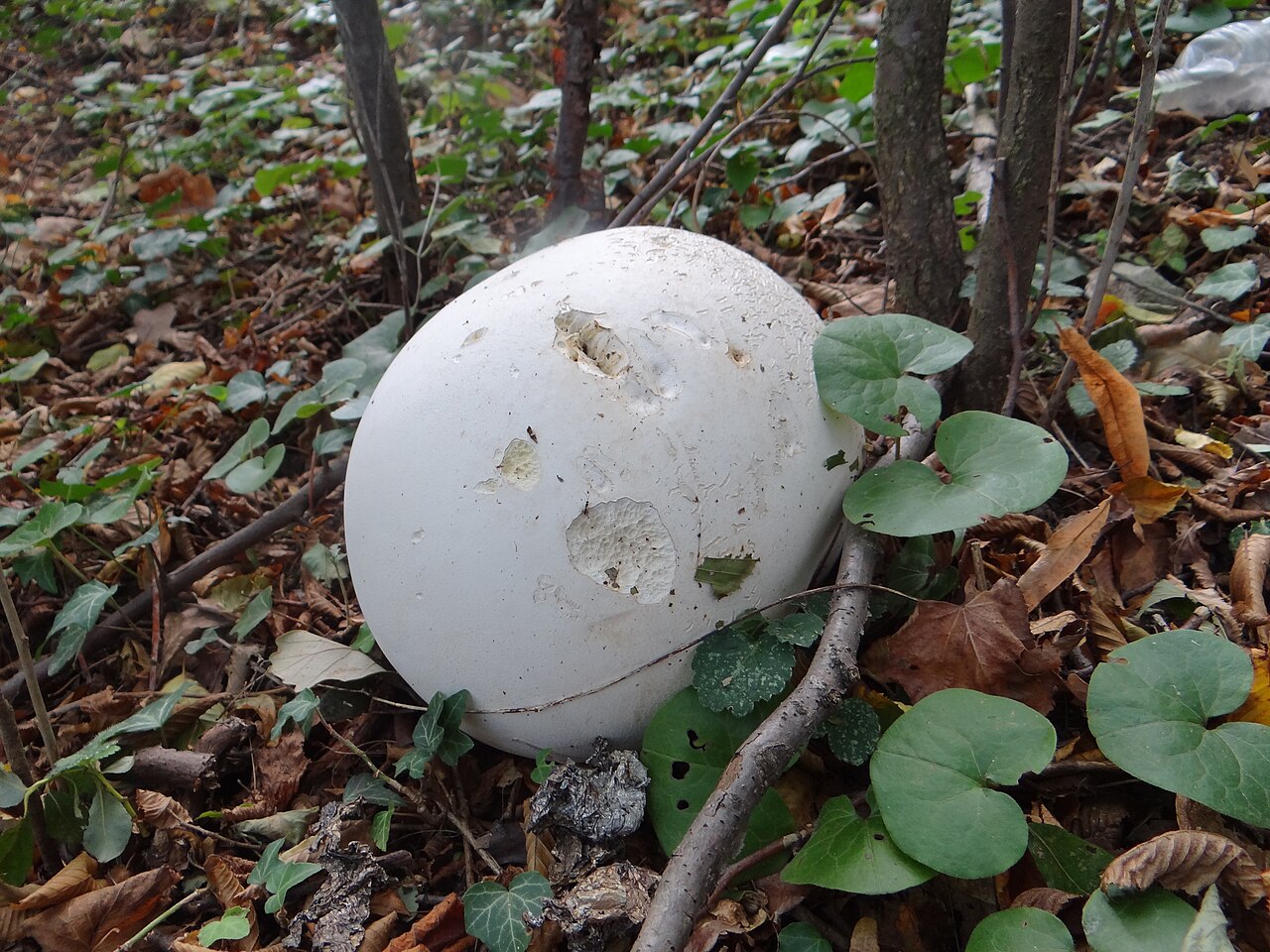
Photo: Jerzy Opioła · CC BY-SA 4.0 · Photo source · License
.jpg)
Description
A very large white spherical puffball without a visible stem, often ball-sized or larger.
Identification features
The young interior is pure white and uniform; with age it becomes yellow, olive, and powdery.
Identification checklist
Check the entire fruitbody for identification. A very large white spherical puffball without a visible stem, often ball-sized or larger. The young interior is pure white and uniform; with age it becomes yellow, olive, and powdery. Typical habitat: Meadows, pasture, gardens, parks, and woodland edges on nutrient-rich soil.
Detailed features
- Cap
- Fruitbody large, about 20–50 cm tall and wide, round to somewhat elongated, white and smooth when young, without a true stem.
- Hymenophore
- The interior is entirely gleba: initially white, later yellow-green, and finally brown spore powder.
- Stem
- No true stem.
- Flesh
- Young interior is completely white and firm; as it matures it becomes yellow-green, soft, then powdery.
- Smell
- Mild when young; may become unpleasant when old.
- Spore print
- Brown.
Habitat
Meadows, pasture, gardens, parks, and woodland edges on nutrient-rich soil.
Fruiting period
June, July, August, September, October
Ecology
- Trophic mode
- Saprotrophic
- Substrate
- Grassland
- Notes
- Grows on nutrient-rich meadows, pastures, gardens, and parks.
How to separate similar species
Compare especially with these similar species: Calvatia utriformis, Scleroderma citrinum, Amanita species (young). Check the combination of cap shape and colour, spore-bearing surface, stem, flesh changes and habitat. A single feature or photograph is not enough; if the key characters do not match the description, do not treat the identification as confirmed.
Similar species
- Calvatia utriformis
Usually smaller, with a more distinct sterile base and a more patterned or warty surface.
- Common earthball (Scleroderma citrinum) DANGEROUS
Has a thick yellow-brown skin and dark interior; toxic.
- Amanita species (young) DANGEROUS
A young amanita already shows developing structures when cut; a young giant puffball is homogeneously white inside.
Conservation
- Protected species
- Yes
- Red list
- R – rare species
- Notes
- The species is legally protected in Slovenia under the regulation on protected wild fungi. On the Slovenian Red List: R – rare species.