Species details
Chicken of the woods
Laetiporus sulphureus
Conditional / expert preparation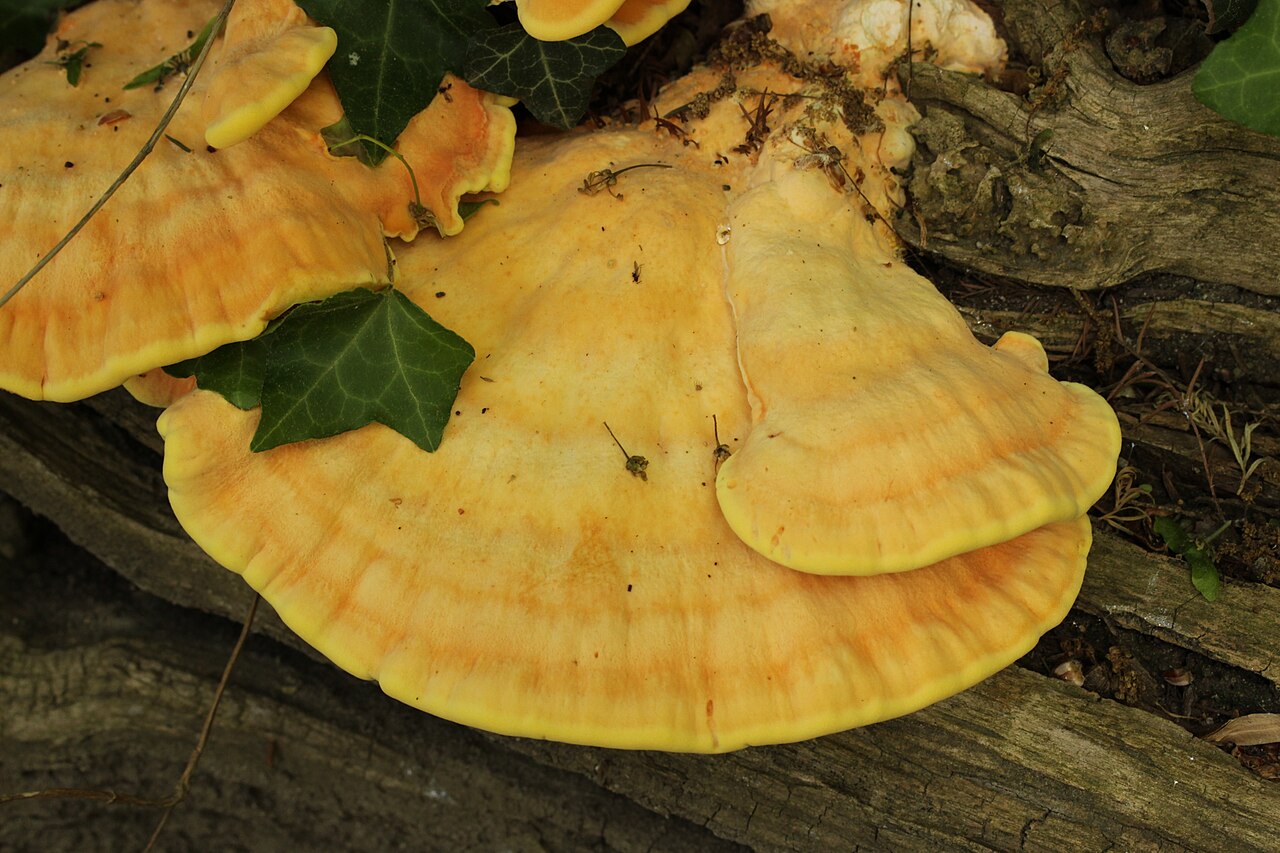
Photo: Björn S... · CC BY-SA 2.0 · Photo source · License
.jpg)
Description
Striking sulphur-yellow to orange shelf-like fruit bodies in large overlapping clusters.
Identification features
The underside has fine yellow pores; young flesh is soft and juicy, old flesh becomes crumbly and tough.
Identification checklist
Check the entire fruitbody for identification. Striking sulphur-yellow to orange shelf-like fruit bodies in large overlapping clusters. The underside has fine yellow pores; young flesh is soft and juicy, old flesh becomes crumbly and tough. Typical habitat: On living or dead hardwoods, especially oak, willow, fruit trees, and chestnut.
Detailed features
- Cap
- Individual brackets are about 10–30 cm or more, 1–5 cm thick, yellow to orange, often fused into tiered clusters.
- Hymenophore
- The underside is yellow and pored; tubes are short, about 2–5 mm.
- Stem
- A true stem is usually absent; fruitbodies attach laterally to wood.
- Flesh
- Young flesh is white to yellowish, juicy and soft; old flesh becomes hard and brittle.
- Smell
- Not distinctive.
- Spore print
- Whitish.
Habitat
On living or dead hardwoods, especially oak, willow, fruit trees, and chestnut.
Fruiting period
May, June, July, August, September, October
Ecology
- Trophic mode
- Saprotrophic
- Host trees
- Oak (Quercus), Sweet chestnut (Castanea)
- Substrate
- Living wood, Dead wood
- Notes
- Grows on living and dead wood, especially deciduous trees; often on fruit trees.
How to separate similar species
Compare especially with these similar species: Laetiporus montanus, Meripilus giganteus. Check the combination of cap shape and colour, spore-bearing surface, stem, flesh changes and habitat. A single feature or photograph is not enough; if the key characters do not match the description, do not treat the identification as confirmed.
Similar species
- Laetiporus montanus
A very close relative associated mainly with conifers; substrate is important for separation.
- Giant polypore (Meripilus giganteus)
Grey-brown to brown rather than sulphur-yellow, and blackens strongly when bruised.