Species details
Ashen chanterelle
Cantharellus cinereus
Traditionally edible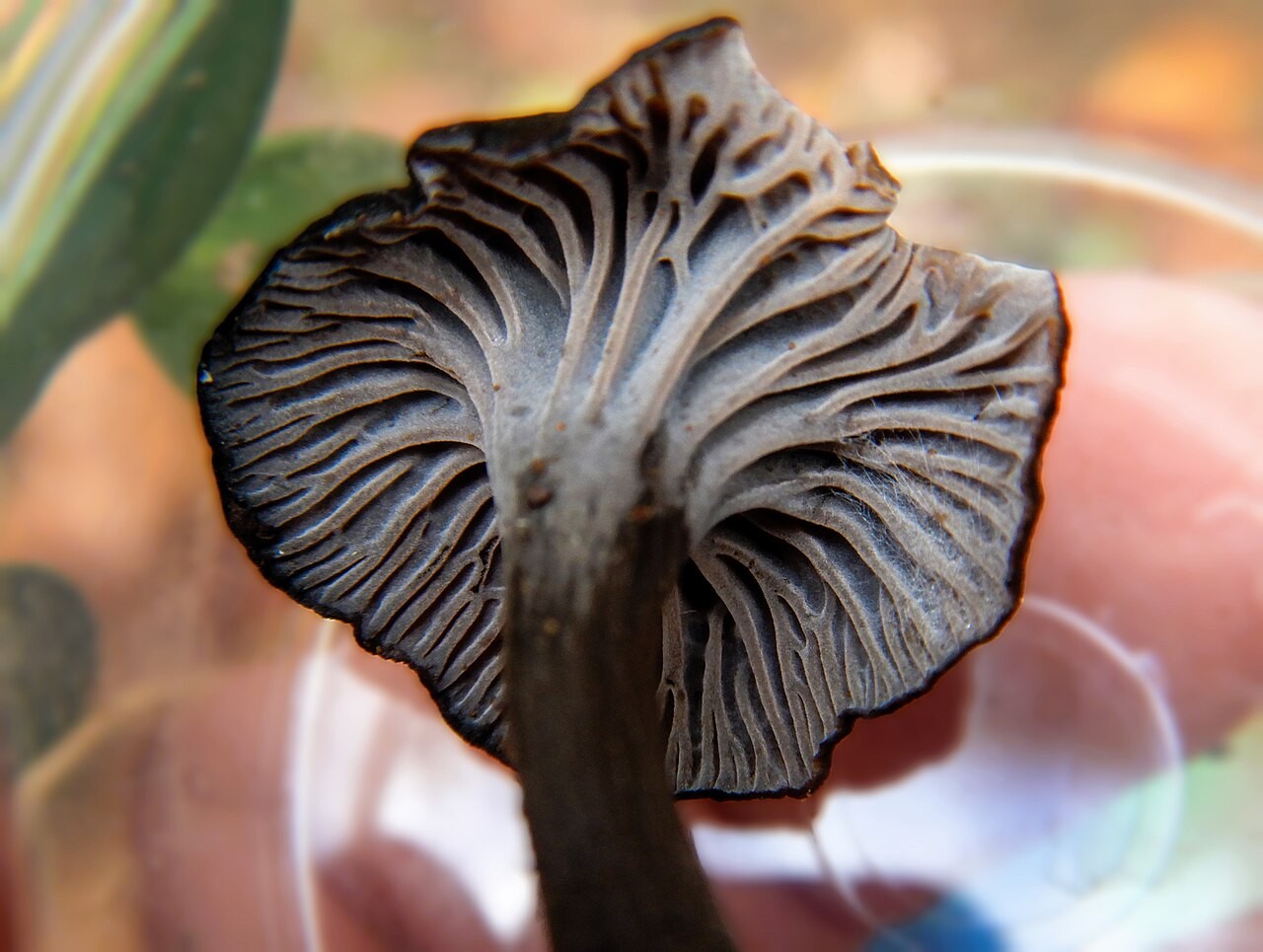
Photo: Paffka · CC BY-SA 3.0 · Photo source · License

Description
A small grey-brown hollow chanterelle with a funnel-shaped cap and ash-grey branched ridges.
Identification features
The cap is grey-brown, funnel-shaped, and wavy-edged. The fertile surface has sparse, thick, grey, branched ridges descending the hollow stem.
Identification checklist
Check the hollow fruitbody and true blunt, branched ridges underneath; black trumpet has a much smoother underside.
Detailed features
- Cap
- The cap is grey-brown, funnel-shaped, and wavy-edged.
- Hymenophore
- The fertile surface has sparse, thick, grey, branched ridges descending the hollow stem.
- Stem
- The stem is hollow, grey-brown, smooth and narrows toward the base.
- Flesh
- Greyish and thin, sometimes blackening in old fruitbodies.
- Smell
- Pleasant, often fruity and plum-like.
- Spore print
- Whitish.
Size
- Cap diameter
- 2–5 cm
- Stem height
- 3–6 cm
- Stem diameter
- 0,4–0,8 cm
Habitat
Grows in deciduous woodland, often in groups, mainly in summer and autumn.
Fruiting period
July, August, September, October
Ecology
- Trophic mode
- Mycorrhizal
- Host trees
- Beech (Fagus)
- Substrate
- Forest soil
- Notes
- Grows in deciduous woodland, often in groups, mainly in summer and autumn.
How to separate similar species
Black trumpet is similarly dark and hollow but lacks such prominent thick branched ridges. Examine the underside of the cap.
Similar species
Interesting facts
Did you know? Distinct grey forked ridges beneath the cap separate it from the Horn of Plenty.