Species details
Horn of plenty
Craterellus cornucopioides
Traditionally edible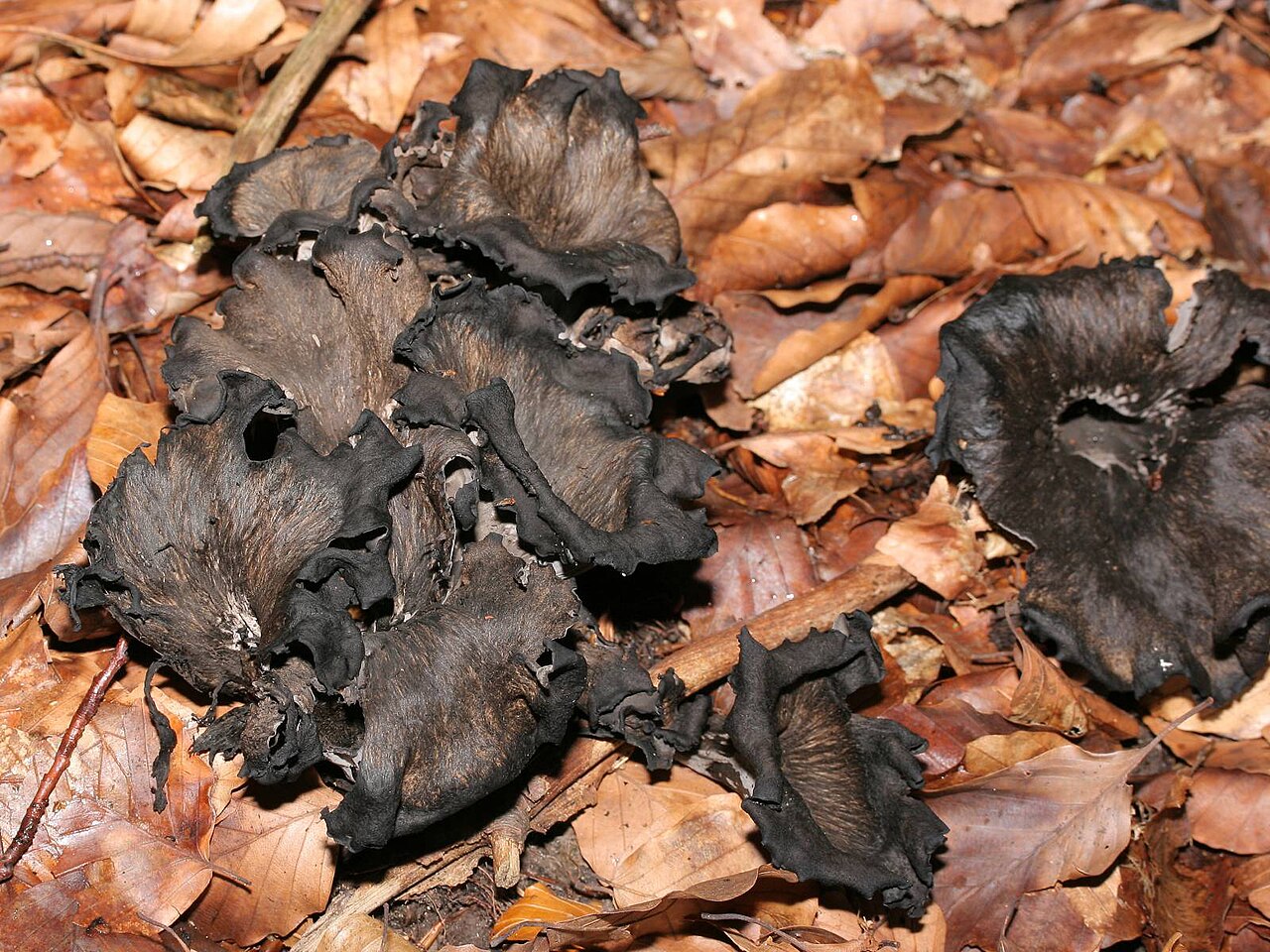
Photo: Kristian Peters · CC BY-SA 3.0 · Photo source · License

Description
A dark grey to black, thin-fleshed hollow trumpet without true gills.
Identification features
The outer underside is smooth to slightly wrinkled and paler. The stem is not clearly separate from the cap.
Identification checklist
The fruitbody is deeply funnel- to trumpet-shaped, grey-brown, dark grey, or nearly black, and hollow right to the base. The margin is wavy, while the outer fertile surface is ash-grey, smooth to finely wrinkled lengthwise, with no true gills.
Detailed features
- Cap
- 2–8 cm wide, deeply trumpet-shaped, grey-brown to almost black, with a wavy to curled margin and a hollow opening to the base.
- Hymenophore
- The outer fertile surface is ash-grey, initially smooth and later slightly longitudinally wrinkled; there are no true gills.
- Stem
- 2–6 cm, hollow and merging gradually into the cap, tapering towards the base.
- Flesh
- Grey to blackish, thin and somewhat tough.
- Spore print
- Whitish.
Size
- Cap diameter
- 2–8 cm
- Stem height
- 2–6 cm
- Stem diameter
- 0,5–1,5 cm
Habitat
In deciduous woodland, especially with beech and oak, often in large groups.
Fruiting period
July, August, September, October, November
Ecology
- Trophic mode
- Mycorrhizal
- Host trees
- Beech (Fagus), Oak (Quercus)
Distribution
- Notes
- A widespread European species of deciduous woodland, often growing in groups.
How to separate similar species
Ashen chanterelle has more pronounced, deeper vein-like folds on the outer surface. Trumpet chanterelle has a brownish cap and yellowish stem. In very old specimens it can be difficult to separate sound tissue from decay.
Similar species
- Craterellus cinereus
Interesting facts
Did you know? The whole fruitbody resembles a hollow trumpet; its dark colour makes it surprisingly difficult to spot on the forest floor.