Species details
Yellowing knight
Tricholoma scalpturatum
Conditional / expert preparation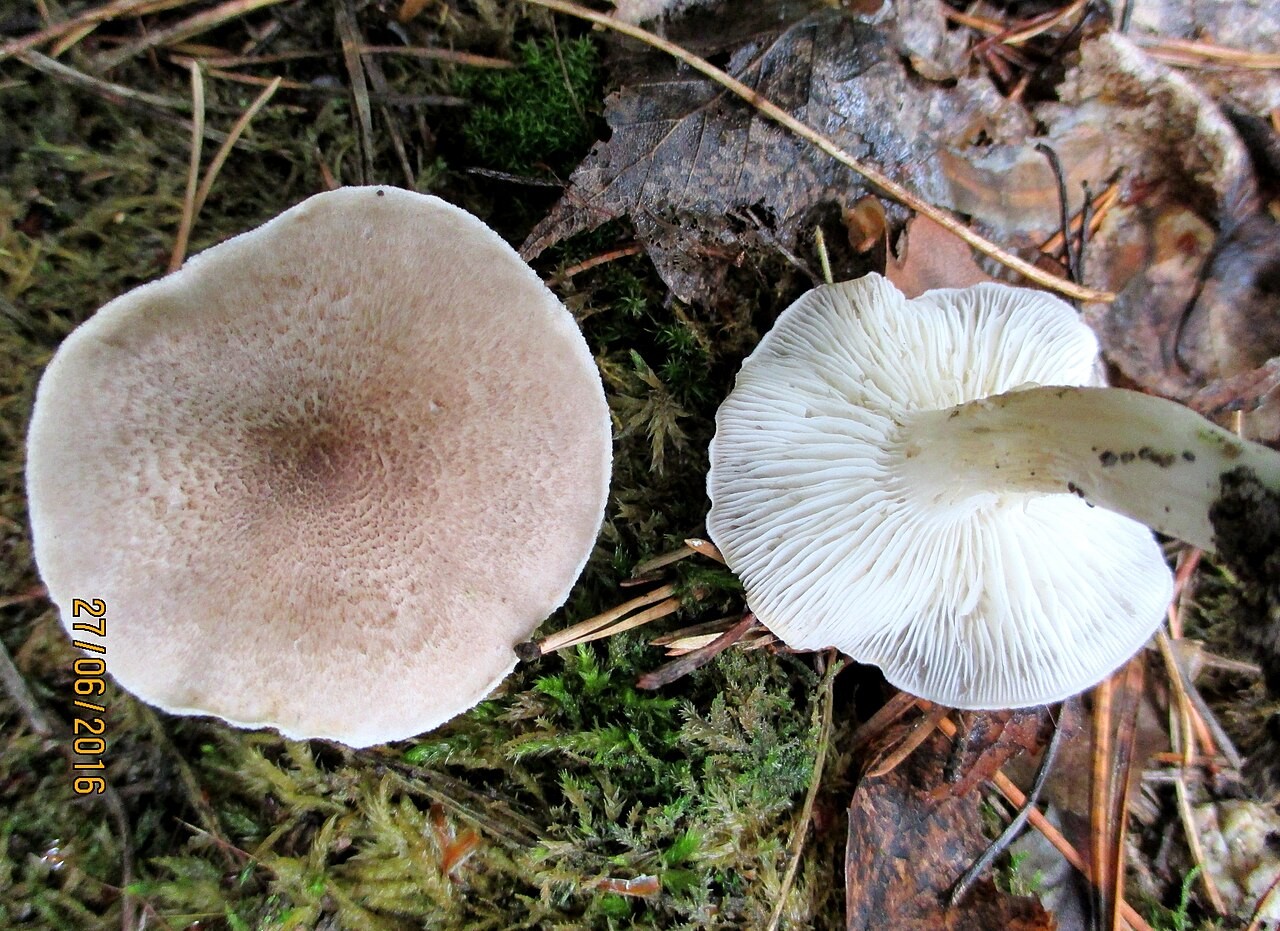
Photo: Igor (Igor_Yevdokimov) · CC BY-SA 3.0 · Photo source · License
_Qu%C3%A9l_718603.jpg)
Description
A grey finely fibrillose Tricholoma whose white gills and flesh characteristically develop yellow patches with age.
Identification features
The cap is grey to grey-brown, dry, and finely fibrillose-scaly. White gills later develop yellow patches. The slender white stem can also yellow; the smell is mealy.
Identification checklist
Check the finely grey-scaled cap, white spore print, mealy smell, and especially yellowing of gills and flesh in older specimens.
Detailed features
- Cap
- The cap is grey to grey-brown, dry, and finely fibrillose-scaly.
- Hymenophore
- White gills later develop yellow patches.
- Stem
- The slender white stem can also yellow; the smell is mealy.
- Flesh
- White, developing yellow patches with age.
- Smell
- Mealy smell.
- Spore print
- White.
Size
- Cap diameter
- 4–8 cm
- Stem height
- 3–8 cm
- Stem diameter
- 0,7–1 cm
Habitat
Grows in grass beside paths and in deciduous or mixed woodland, in summer and autumn, often in groups.
Fruiting period
July, August, September, October
Ecology
- Trophic mode
- Mycorrhizal
- Substrate
- Forest soil, Grassland
- Notes
- Grows in grass beside paths and in deciduous or mixed woodland, in summer and autumn, often in groups.
How to separate similar species
Poisonous T. pardinum is usually larger, more robust, and more strongly dark-scaled. Other grey Tricholoma are very similar and may require microscopy.
Similar species
Interesting facts
Did you know? White gills and flesh develop lemon-yellow spots with age.