Species details
Grey knight
Tricholoma terreum
Poisonous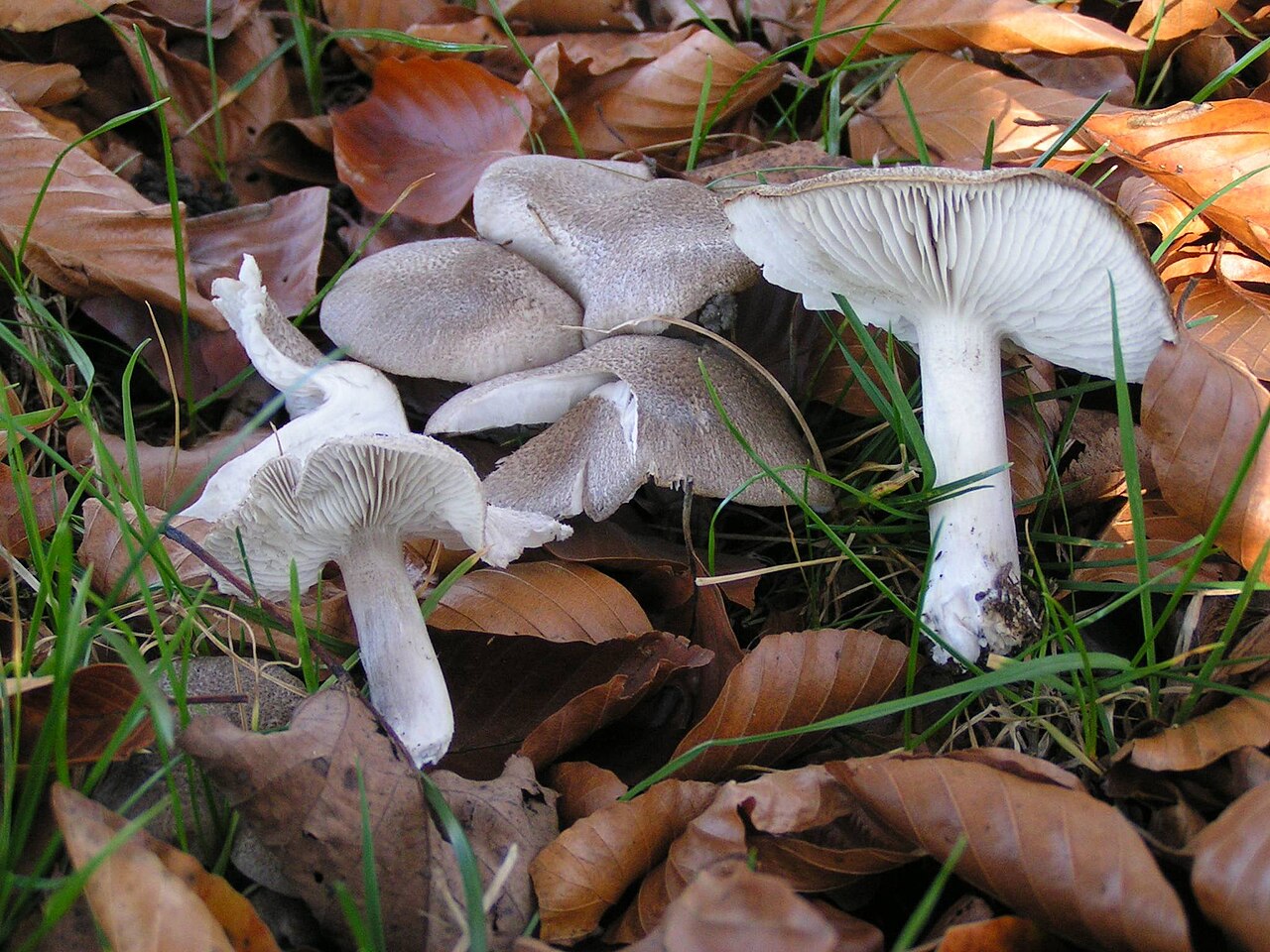
Photo: Eric Steinert · CC BY-SA 3.0 · Photo source · License

Description
A grey fibrous-scaly tricholoma with pale gills and no ring.
Identification features
The flesh is thin and brittle and the cap often cracked. Because of reports of potentially severe effects and difficult lookalikes, FungiTrail classifies it as toxic.
Identification checklist
The cap is grey to mouse-grey, conical at first and later flattened, with fine radial fibres or scales. The gills are white to grey and notched at the stem; the slender stem has no ring. It usually grows with pine.
Detailed features
- Cap
- 3–10 cm, mouse-grey to grey-brown, dry, finely silky-fibrous, often with a somewhat darker centre.
- Hymenophore
- Gills are initially white, later greyish to slightly yellowish, broad, crowded and sinuate at the stem.
- Stem
- Whitish to greyish, smooth, without a ring.
- Flesh
- White to greyish, relatively thin and brittle in the cap.
- Smell
- No strong characteristic smell.
- Spore print
- White.
Size
- Cap diameter
- 3–10 cm
Habitat
Mostly in pine woodland on sandy or calcareous soil.
Fruiting period
September, October, November, December
Ecology
- Trophic mode
- Mycorrhizal
- Host trees
- Pine (Pinus)
- Soil
- Calcareous
- Notes
- Mycorrhizal mainly with pines and other conifers; often on neutral to calcareous soils.
Distribution
- Notes
- Widespread in Europe in pine and other conifer woodland.
How to separate similar species
Tiger knight is larger and more robust with conspicuous dark 'tiger' scales and is poisonous. Other grey Tricholoma species are very similar and may require microscopic identification.
Similar species
- Tiger knight (Tricholoma pardinum) DANGEROUS
Tiger tricholoma is larger and more robust, with more conspicuous grey cap scales, and is poisonous.
Interesting facts
Did you know? Because of reports of possible muscle toxicity and identification risks, considerable caution is warranted; the app does not treat the species as safely edible.