Species details
Whitelaced shank
Megacollybia platyphylla
Conditional / expert preparation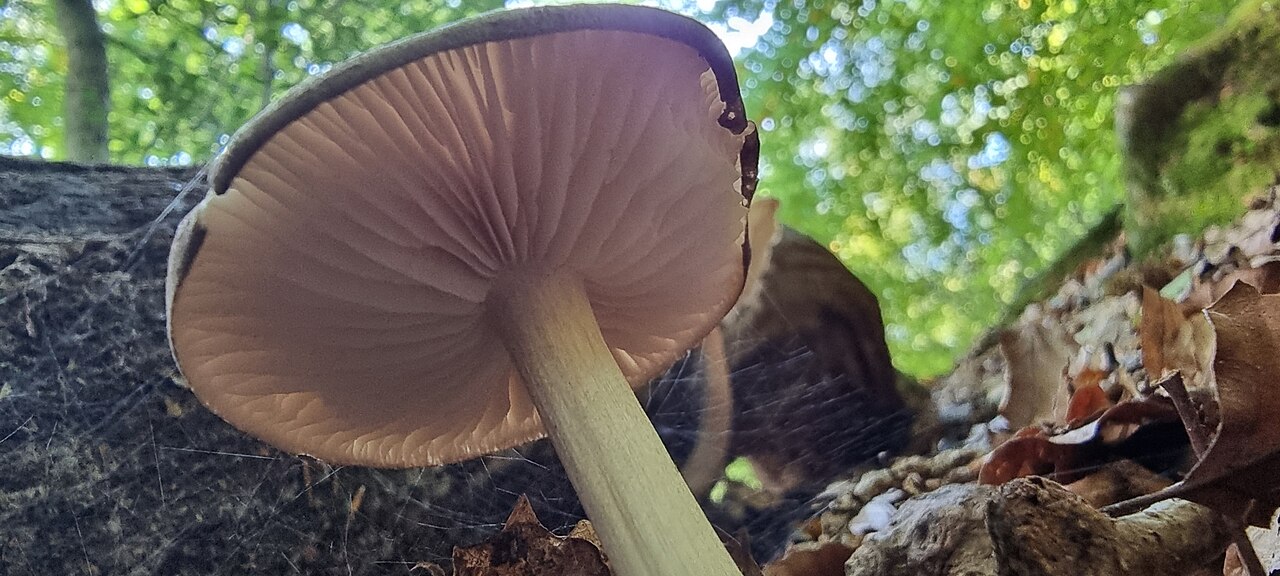
Photo: David Harbour · CC BY 4.0 · Photo source · License

Description
A large grey-brown thin-fleshed mushroom with very broad white gills and long white rhizomorphs at the base.
Identification features
The cap is radially streaked. Gills are white, very broad and widely spaced. The stem is whitish and fibrous, with characteristic long white cords at the base.
Identification checklist
Check the entire fruitbody for identification. A large grey-brown thin-fleshed mushroom with very broad white gills and long white rhizomorphs at the base. The cap is radially streaked. Gills are white, very broad and widely spaced. The stem is whitish and fibrous, with characteristic long white cords at the base. On decaying stumps, buried wood and rich humus soils; summer and autumn.
Detailed features
- Cap
- A large grey-brown thin-fleshed mushroom with very broad white gills and long white rhizomorphs at the base.
- Hymenophore
- The cap is radially fibrous. The gills are white, very broad and widely spaced. The stem is whitish and fibrous, with characteristic long white mycelial cords at the base.
- Flesh
- White, thin and rather brittle.
- Smell
- Strong unpleasant smell.
- Spore print
- White.
Size
- Cap diameter
- 5–15 cm
- Stem height
- 6–10 cm
- Stem diameter
- 1–1,5 cm
Habitat
On decaying stumps, buried wood and rich humus soils; summer and autumn.
Fruiting period
June, July, August, September, October
Ecology
- Trophic mode
- Saprotrophic
- Substrate
- Stumps, Buried wood, Forest soil
- Notes
- Saprotrophic species. On decaying stumps, buried wood and rich humus soils; summer and autumn.
How to separate similar species
Compare especially with: Pluteus cervinus. A single feature or photograph is not sufficient for reliable identification.
Similar species
- Deer shield (Pluteus cervinus)
P. cervinus has free gills that become pink with maturity and lacks the characteristic long white basal rhizomorphs.
Interesting facts
Did you know? Long white rhizomorphs at the base are a useful clue and may extend deep into rotten wood or humus.