Species details
Deer shield
Pluteus cervinus
Extra caution required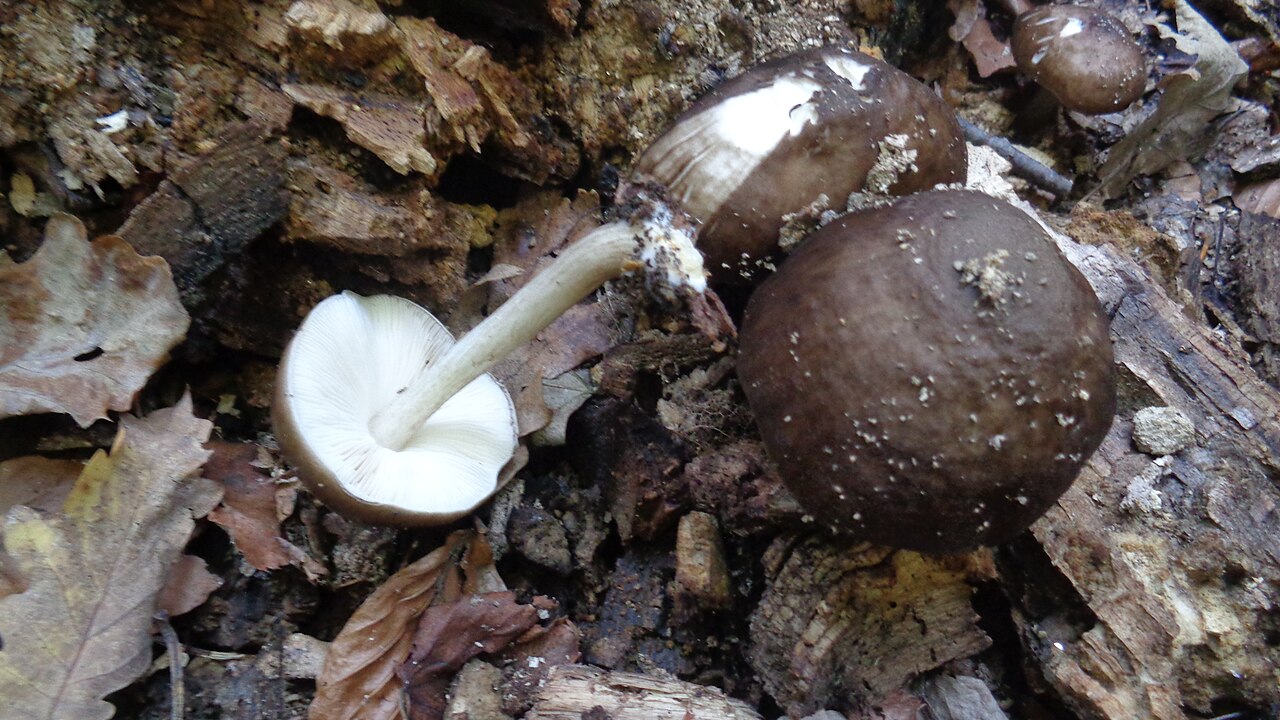
Photo: Aleksandar Đukić · CC BY-SA 4.0 · Photo source · License

Description
A brown wood-inhabiting mushroom with free gills that change from white to pink.
Identification features
Stem is whitish with brown longitudinal fibres, ringless; spore print is pink.
Identification checklist
Check the entire fruitbody for identification. A brown wood-inhabiting mushroom with free gills that change from white to pink. Stem is whitish with brown longitudinal fibres, ringless; spore print is pink. Typical habitat: On dead wood, stumps and buried hardwood.
Detailed features
- Cap
- 8–15 cm, convex to expanded, sometimes broadly umbonate, grey-brown to deer-brown, darker and radially fibrillose centrally.
- Hymenophore
- Gills are free; initially white, then pink and eventually brownish-pink.
- Stem
- 6–12 × 1–1.5 cm, whitish with longitudinal grey-brown fibres and no ring.
- Flesh
- White, delicate and brittle.
- Smell
- Faintly turnip- or radish-like.
- Spore print
- Ochre-pink.
Size
- Cap diameter
- 8–15 cm
- Stem height
- 6–12 cm
- Stem diameter
- 1–1,5 cm
Habitat
On dead wood, stumps and buried hardwood.
Fruiting period
April, May, June, July, August, September, October, November
Ecology
- Trophic mode
- Saprotrophic
- Substrate
- Dead wood, Stumps
- Notes
- A saprotroph on decayed hardwood and conifer wood, stumps, fallen trunks and sawdust.
How to separate similar species
Compare especially with these similar species: Entoloma species, Volvopluteus gloiocephalus. Check the combination of cap shape and colour, spore-bearing surface, stem, flesh changes and habitat. A single feature or photograph is not enough; if the key characters do not match the description, do not treat the identification as confirmed.
Similar species
- Pluteus salicinus
Willow shield has a greyer cap, often with greenish or bluish tones, and is especially associated with willow and alder.
- Volvopluteus gloiocephalus
Volvopluteus gloiocephalus grows on the ground and has a distinct volva at the stem base.
Interesting facts
Did you know? Free gills, a pink spore print and direct growth on wood form a very useful combination of characters.