Species details
Weeping bolete
Suillus plorans
Traditionally edible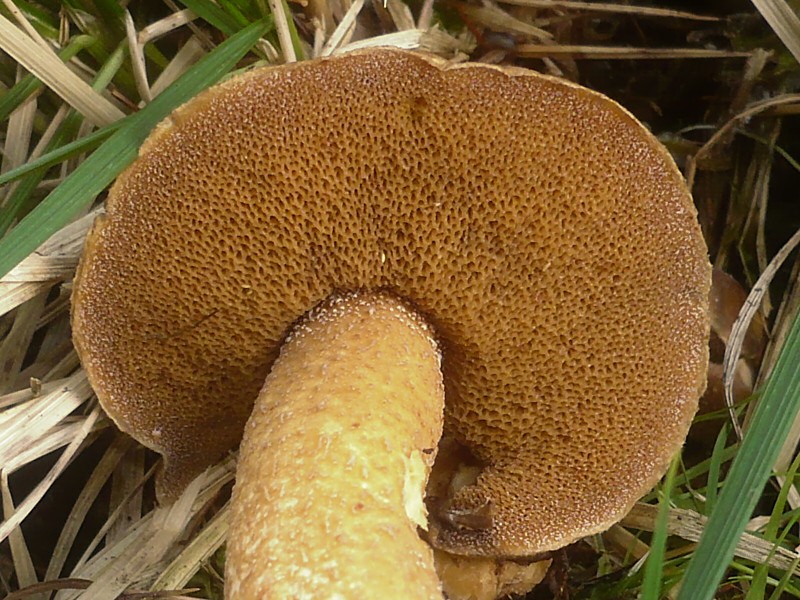
Photo: Suillus_plorans_211063.jpg : Gerhard Koller (Gerhard) derivative work: Ak ccm · CC BY-SA 3.0 · Photo source · License

Description
A yellow-brown to reddish-brown Suillus without a ring, characteristically associated with Swiss stone pine and other five-needle pines.
Identification features
The cap is yellowish to reddish-brown and sticky when wet. Pores are yellow to olive and may exude droplets. The pale ringless stem bears reddish to brown glandular dots.
Identification checklist
Check association with five-needle pine, absence of a ring, yellow pores, and reddish-brown glandular dots or droplets on the stem.
Detailed features
- Cap
- The cap is yellowish to reddish-brown and sticky when wet.
- Hymenophore
- Pores are yellow to olive and may exude droplets.
- Stem
- The pale ringless stem bears reddish to brown glandular dots.
- Smell
- No distinctive smell.
Habitat
Mycorrhizal mainly with Swiss stone pine and other five-needle pines in mountain conifer woodland, in summer and autumn.
Fruiting period
July, August, September, October
Ecology
- Trophic mode
- Mycorrhizal
- Host trees
- Pine (Pinus)
- Substrate
- Forest soil
- Notes
- Mycorrhizal mainly with Swiss stone pine and other five-needle pines in mountain conifer woodland, in summer and autumn.
How to separate similar species
Suillus placidus is usually much paler to almost white. Tree association is very important for both.
Similar species
- White slippery jack (Suillus placidus)
- Suillus sibiricus
Interesting facts
Did you know? Check association with five-needle pine, absence of a ring, yellow pores, and reddish-brown glandular dots or droplets on the stem.