Species details
White slippery jack
Suillus placidus
Traditionally edible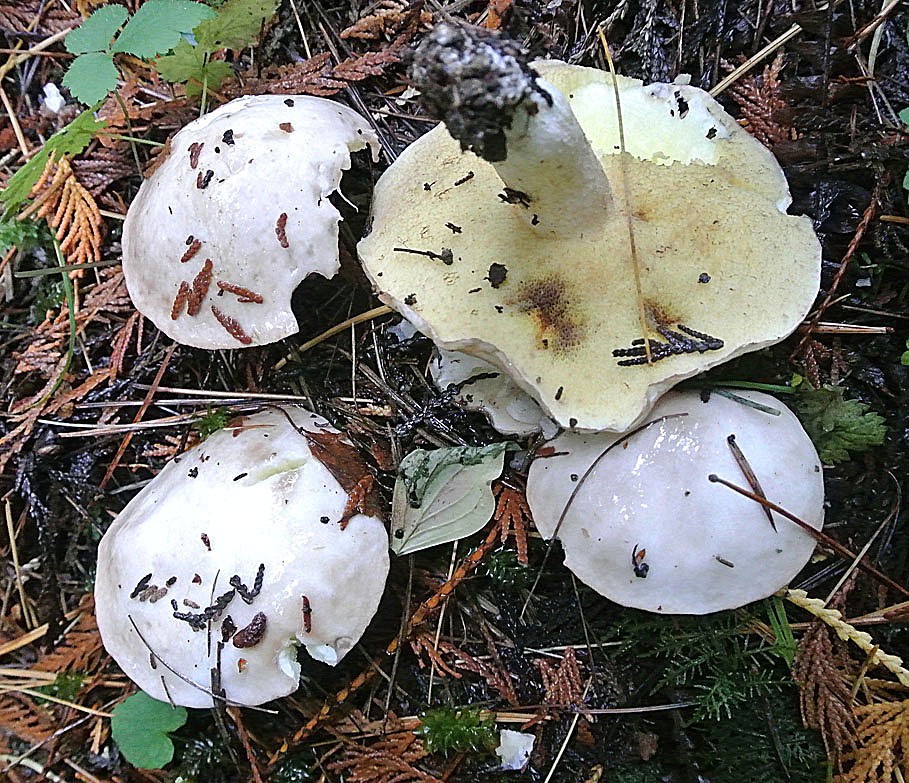
Photo: Dick Culbert from Gibsons, B.C., Canada · CC BY 2.0 · Photo source · License
.jpg)
Description
A pale whitish to yellowish Suillus without a ring, characteristically associated with five-needle pines.
Identification features
The cap is smooth, sticky, and white to yellowish. Pores start pale and become yellow to olive. The pale stem lacks a ring and is finely dotted near the top.
Identification checklist
Check the pale sticky cap, lack of a ring, yellow pores, and especially association with five-needle pines.
Detailed features
- Cap
- The cap is smooth, sticky, and white to yellowish.
- Hymenophore
- Pores start pale and become yellow to olive.
- Stem
- The pale stem lacks a ring and is finely dotted near the top.
- Smell
- No distinctive smell.
Habitat
Grows with five-needle pines such as Swiss stone pine and eastern white pine, from summer to autumn.
Fruiting period
July, August, September, October
Ecology
- Trophic mode
- Mycorrhizal
- Host trees
- Pine (Pinus)
- Substrate
- Forest soil
- Notes
- Grows with five-needle pines such as Swiss stone pine and eastern white pine, from summer to autumn.
How to separate similar species
Suillus plorans can be similar but is browner and has different glandular droplets on the stem. Tree association is very important.
Similar species
- Weeping bolete (Suillus plorans)
- Suillus bellinii
Interesting facts
Did you know? Check the pale sticky cap, lack of a ring, yellow pores, and especially association with five-needle pines.