Species details
Velvet roll-rim
Tapinella atrotomentosa
Inedible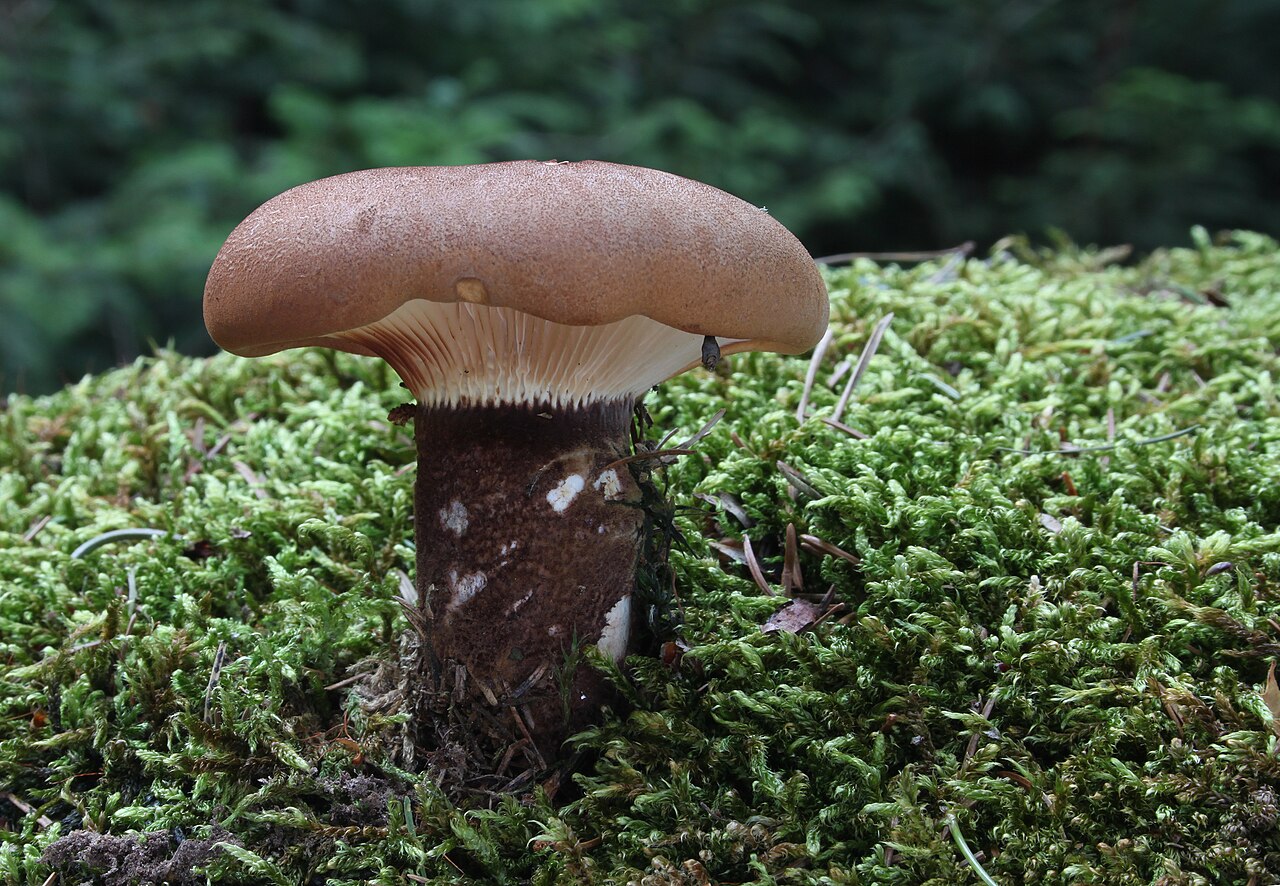
Photo: Holger Krisp · CC BY 3.0 · Photo source · License

Description
A large brown shell-shaped mushroom with a strongly rolled margin and a distinctive thick dark-brown to black velvety stem.
Identification features
Gills are yellow-ochre, run down the stem and can be partly peeled away. The stem is often lateral, very dark and densely velvety.
Identification checklist
The most important feature is the black-brown velvety stem combined with a large brown shell-shaped cap, strongly rolled margin and yellow-ochre decurrent gills. Confirm that it grows directly from wood or woody remains.
Detailed features
- Cap
- A large brown shell-shaped mushroom with a strongly inrolled margin and a characteristically thick, dark-brown to black velvety stem.
- Hymenophore
- The gills are yellow-ochre, run down the stem and can be partly peeled away. The stem is often lateral, very dark and densely velvety.
- Flesh
- Whitish to yellowish, tough and somewhat bitter.
- Smell
- No strong smell; sometimes faintly ink-like.
- Spore print
- Pale ochre.
Size
- Cap diameter
- 10–20 cm
- Stem height
- 2–5 cm
- Stem diameter
- 2–3 cm
Habitat
Saprotrophic on stumps, roots and dead wood, especially conifers; summer and autumn.
Fruiting period
July, August, September, October, November
Ecology
- Trophic mode
- Saprotrophic
- Host trees
- Pine (Pinus), Spruce (Picea)
- Substrate
- Stumps, Roots, Dead wood
- Notes
- Saprotrophic species. Saprotrophic on stumps, roots and dead wood, especially conifers; summer and autumn.
How to separate similar species
Brown roll-rim usually grows from soil as a mycorrhizal species and lacks the distinctly black velvety stem. If no wood is visible, consider a buried stump or roots.
Similar species
- Brown roll-rim (Paxillus involutus) DANGEROUS
P. involutus grows on soil, lacks the characteristic black velvety stem and is dangerously poisonous; its gills brown strongly when pressed.
Interesting facts
Did you know? The dark, densely velvety stem is the most reliable macroscopic clue.