Species details
Trooping funnel
Infundibulicybe geotropa
Conditional / expert preparation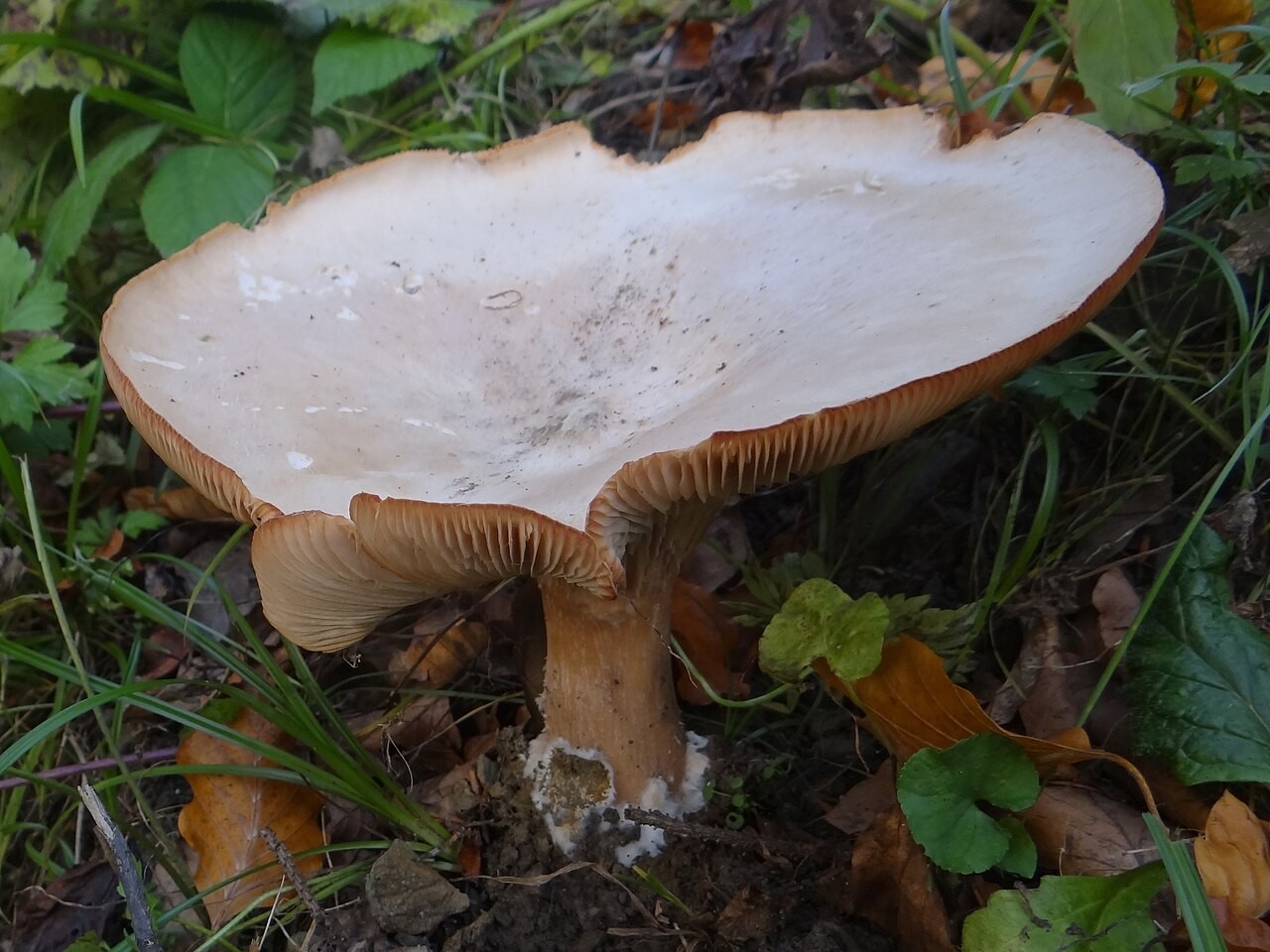
Photo: Jerzy Opioła · CC BY-SA 3.0 · Photo source · License
.JPG)
Description
A large whitish-brown funnel mushroom with a long stem, funnel-shaped cap, and often a persistent central boss.
Identification features
The cap is 5–15 cm wide, initially bossed and later strongly funnel-shaped. Gills are white to ochre, spaced, and slightly decurrent. Flesh is white with a strong characteristic smell.
Identification checklist
Check size, funnel cap with a residual boss, long stem narrowing upward, decurrent gills, and strong smell. Pale funnel mushrooms require very confident identification.
Detailed features
- Cap
- The cap is 5–15 cm wide, initially bossed and later strongly funnel-shaped.
- Hymenophore
- Gills are white to ochre, spaced, and slightly decurrent.
- Stem
- Flesh is white with a strong characteristic smell.
- Flesh
- Whitish, elastic and always dry.
- Smell
- Distinctly aromatic, often described as lavender- or bitter-almond-like.
- Spore print
- White.
Size
- Cap diameter
- 5–15 cm
- Stem height
- 8–15 cm
- Stem diameter
- 1,5–2,5 cm
Habitat
Grows in open woodland, clearings, and grassy woodland edges mainly in late autumn.
Fruiting period
October, November, December
Ecology
- Trophic mode
- Saprotrophic
- Substrate
- Forest soil, Grassland
- Notes
- Grows in open woodland, clearings, and grassy woodland edges mainly in late autumn.
How to separate similar species
Smaller pale funnel mushrooms can include dangerous species. Trooping funnel is larger and more robust, but size alone is insufficient.
Similar species
- Common funnel (Infundibulicybe gibba)
- Aspropaxillus giganteus
- Frosted funnel (Clitocybe phyllophila) DANGEROUS
Interesting facts
Did you know? Even in a strongly funnel-shaped mature cap, a small central umbo often remains.