Species details
Tinder fungus
Fomes fomentarius
Inedible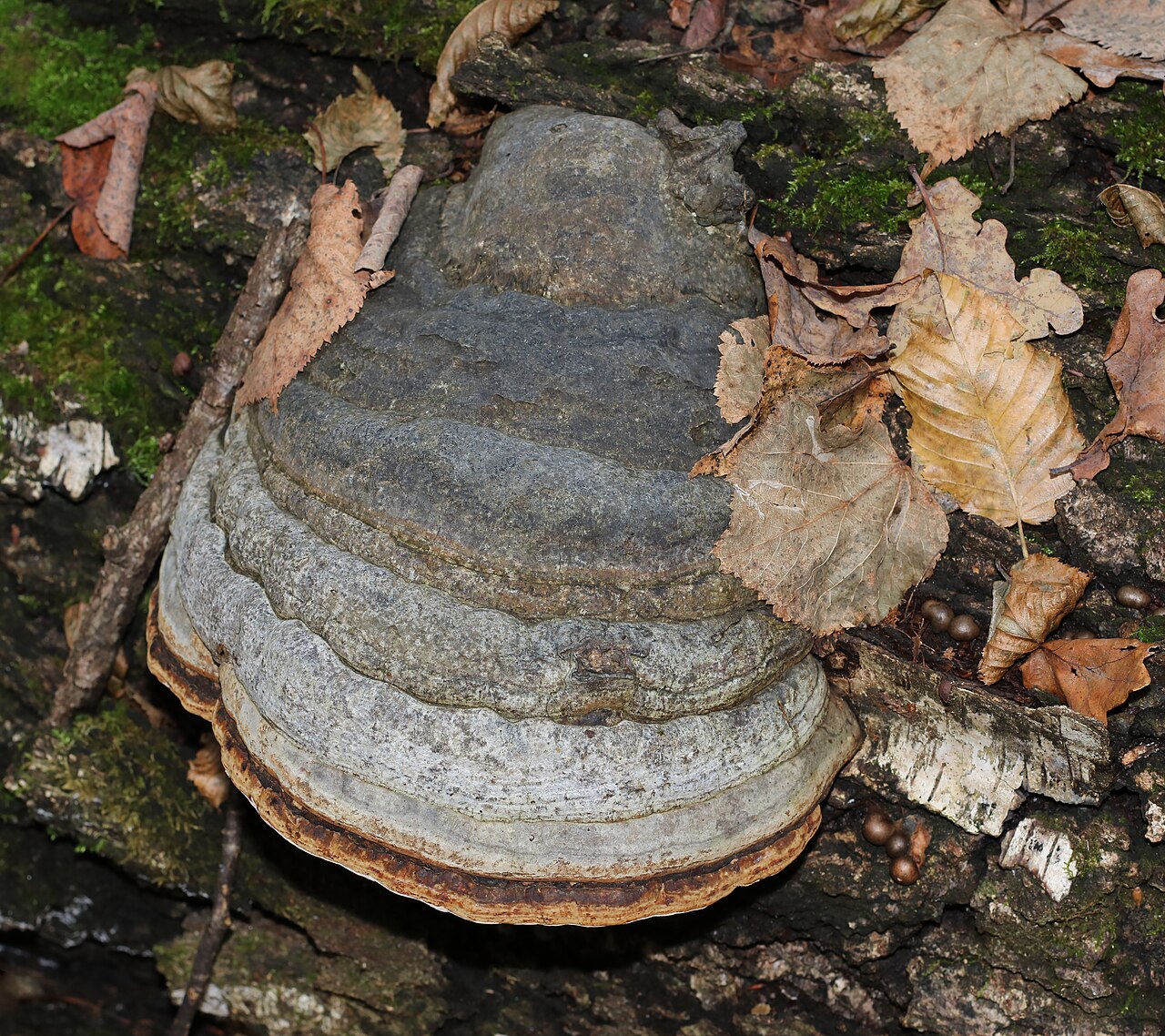
Photo: George Chernilevsky · CC BY 4.0 · Photo source · License

Description
A large hard hoof-shaped bracket with grey concentric zones, often on beech.
Identification features
The underside is finely pored and pale; the perennial bracket adds new tube layers.
Identification checklist
Check the entire fruitbody for identification. A large hard hoof-shaped bracket with grey concentric zones, often on beech. The underside is finely pored and pale; the perennial bracket adds new tube layers. Typical habitat: On weakened living and dead hardwood trunks, especially beech and birch.
Detailed features
- Cap
- 10–60 cm, perennial, hoof- to shelf-shaped, with grey to grey-brown concentric zones and a very hard crust.
- Hymenophore
- Underside finely poroid; tubes form successive annual layers and may reach about 3 cm in length.
- Stem
- No stem; the bracket is broadly attached to the trunk.
- Flesh
- Brown, corky to hard, with a characteristically softer trama layer beneath the crust.
- Smell
- No characteristic smell.
- Spore print
- Pale yellowish.
Size
- Cap diameter
- 10–60 cm
Habitat
On weakened living and dead hardwood trunks, especially beech and birch.
Fruiting period
January, February, March, April, May, June, July, August, September, October, November, December
Ecology
- Trophic mode
- Parasitic
- Host trees
- Beech (Fagus), Birch (Betula)
- Substrate
- Living wood, Dead wood
- Notes
- A parasite and wood-decayer of broadleaved trees, especially beech and birch; perennial brackets remain for several seasons.
How to separate similar species
Compare especially with these similar species: Ganoderma applanatum, Fomitopsis betulina. Check the combination of cap shape and colour, spore-bearing surface, stem, flesh changes and habitat. A single feature or photograph is not enough; if the key characters do not match the description, do not treat the identification as confirmed.
Similar species
- Artist's conk (Ganoderma applanatum)
Artist’s conk is flatter and its white pore surface bruises permanently brown when marked.
- Birch polypore (Fomitopsis betulina)
Birch polypore is usually smoother, paler, kidney-shaped and almost restricted to birch.
Interesting facts
Did you know? The perennial fruitbody adds a new tube layer each year, visible as successive annual layers in section.