Species details
Birch polypore
Fomitopsis betulina
Inedible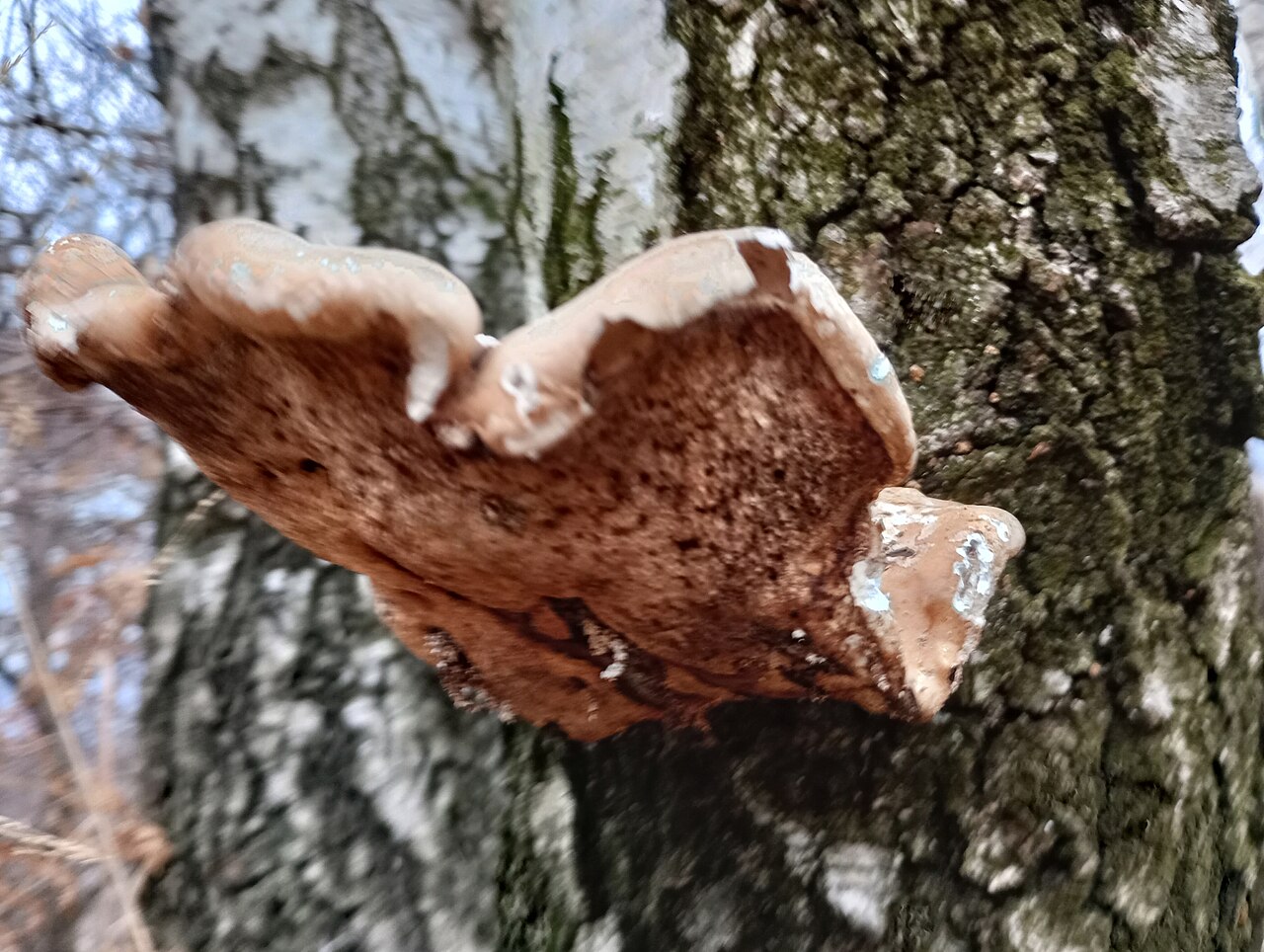
Photo: Filippo Ceragioli · CC BY-SA 4.0 · Photo source · License

Description
A white to pale brown kidney-shaped bracket found almost exclusively on birch.
Identification features
The underside is white and finely pored, margin rounded; young flesh is corky-soft, later hard.
Identification checklist
Check the entire fruitbody for identification. A white to pale brown kidney-shaped bracket found almost exclusively on birch. The underside is white and finely pored, margin rounded; young flesh is corky-soft, later hard. Typical habitat: On dead or dying birch trunks and branches.
Detailed features
- Cap
- 4–20 cm, round to kidney-shaped and thick, initially whitish, later pale grey-brown to darker; surface smooth and margin rounded.
- Hymenophore
- Underside white and finely poroid; the white tube layer can be separated relatively easily from the flesh.
- Stem
- No true stem; the bracket is attached to birch by a short stem-like base.
- Flesh
- White, soft and corky when young, later tough.
- Smell
- No distinctive smell.
- Spore print
- White.
Size
- Cap diameter
- 4–20 cm
Habitat
On dead or dying birch trunks and branches.
Fruiting period
January, February, March, April, May, June, July, August, September, October, November, December
Ecology
- Trophic mode
- Parasitic
- Host trees
- Birch (Betula)
- Substrate
- Living wood, Dead wood
- Notes
- Almost characteristically tied to birch, acting as a parasite and later wood-decayer; old brackets can be found year-round.
How to separate similar species
Compare especially with these similar species: Fomes fomentarius. Check the combination of cap shape and colour, spore-bearing surface, stem, flesh changes and habitat. A single feature or photograph is not enough; if the key characters do not match the description, do not treat the identification as confirmed.
Similar species
- Tinder fungus (Fomes fomentarius)
Tinder fungus is usually harder, perennial and hoof-shaped with stronger concentric zoning.
- Red-belted conk (Fomitopsis pinicola)
Red-belted conk often has a darker zoned cap with an orange-red marginal band and occurs on several kinds of wood.
Interesting facts
Did you know? Its strong association with birch is one of the most useful field characters.