Species details
Artist's conk
Ganoderma applanatum
Inedible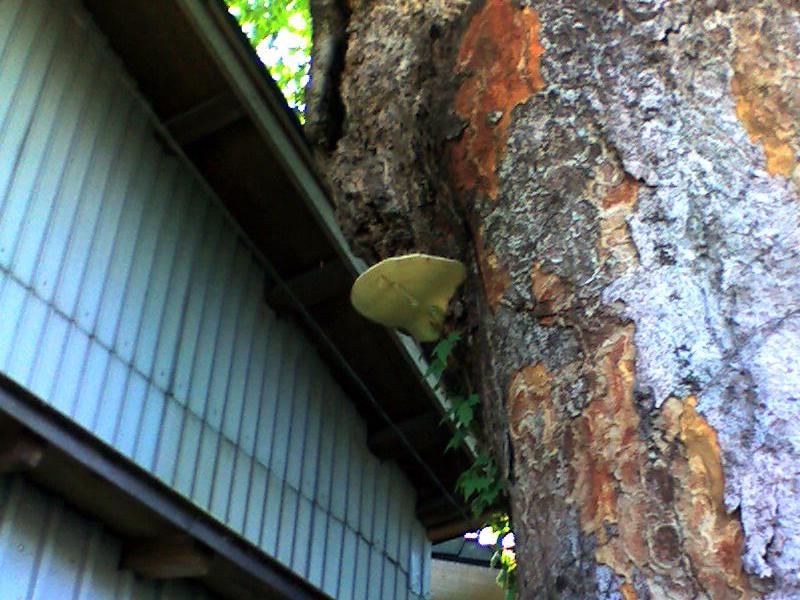
Photo: Pieria · Public Domain · Photo source · License

Description
A large perennial brown bracket with a white pore surface that bruises brown when touched.
Identification features
The pore surface can be 'drawn' on because pressure leaves permanent dark marks.
Identification checklist
Check the entire fruitbody for identification. A large perennial brown bracket with a white pore surface that bruises brown when touched. The pore surface can be 'drawn' on because pressure leaves permanent dark marks. Typical habitat: On stumps and trunks of many hardwoods in parks and woodland.
Detailed features
- Cap
- 15–60 cm, perennial, very broad and flattened shelf-like bracket, brown to cinnamon-brown with wrinkled concentric zones.
- Hymenophore
- Underside white to cream with very small round pores; even light pressure leaves a brown mark.
- Stem
- No stem; broadly attached to wood.
- Flesh
- Reddish to dark brown, corky and very hard in old fruitbodies.
- Smell
- Mild mushroom smell.
- Spore print
- Brown.
Size
- Cap diameter
- 15–60 cm
Habitat
On stumps and trunks of many hardwoods in parks and woodland.
Fruiting period
January, February, March, April, May, June, July, August, September, October, November, December
Ecology
- Trophic mode
- Saprotrophic
- Host trees
- Beech (Fagus), Oak (Quercus), Poplar / aspen (Populus), Willow (Salix)
- Substrate
- Dead hardwood, Living wood
- Notes
- Grows on dead or damaged wood of many broadleaved trees, especially beech and oak; brackets are perennial.
How to separate similar species
Compare especially with these similar species: Fomes fomentarius, Ganoderma australe. Check the combination of cap shape and colour, spore-bearing surface, stem, flesh changes and habitat. A single feature or photograph is not enough; if the key characters do not match the description, do not treat the identification as confirmed.
Similar species
- Tinder fungus (Fomes fomentarius)
Tinder fungus is more hoof-shaped with a different hard grey crust; its pore surface is less distinctly “drawable”.
- Ganoderma australe
Ganoderma australe is macroscopically very similar; reliable separation can be difficult and often requires microscopic characters.
Interesting facts
Did you know? The fresh white pore surface can be “drawn” on: pressure stains it permanently brown, hence the name artist’s conk.