Species details
St George's mushroom
Calocybe gambosa
Extra caution required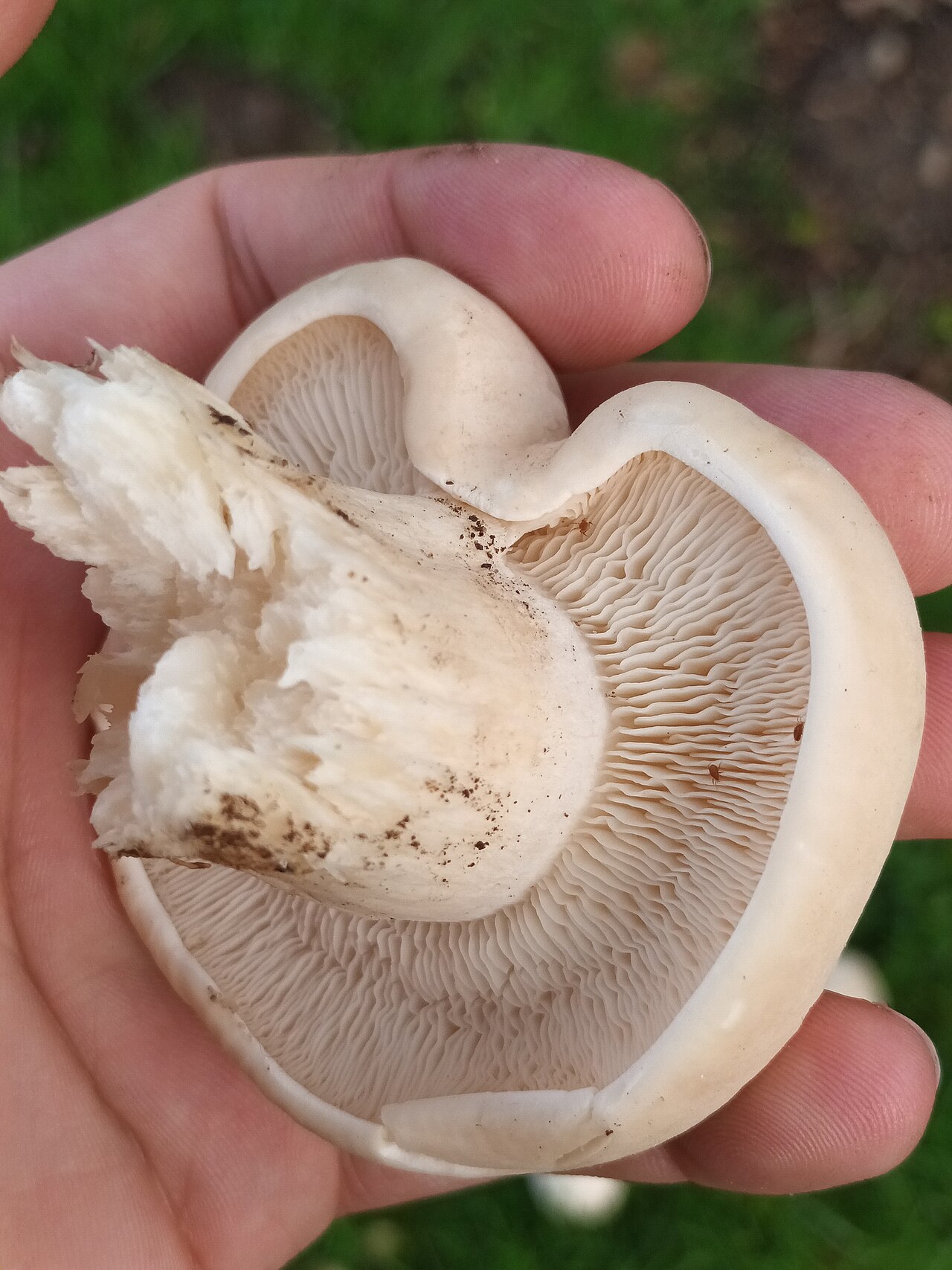
Photo: Stuart · CC0 · Photo source · License

Description
A firm whitish spring mushroom with crowded gills and a strong mealy smell.
Identification features
The cap is initially convex and later irregular, while the gills remain pale. The deadly fibrecap may fruit at the same time.
Identification checklist
It appears mainly in spring in grassland, pasture, path edges, and fairy rings. The cap is white to cream, thick and fleshy; the gills are very crowded, narrow, and pale, with a stout stem. A strong smell of fresh flour is characteristic.
Detailed features
- Cap
- 3–10 cm, fleshy, initially convex then flattening; whitish to cream-ochre, dry, sometimes cracking with age.
- Hymenophore
- Gills are white to cream, very crowded and narrow.
- Stem
- 4–7 × 1–2 cm, whitish, stout and solid, without a ring.
- Flesh
- White, thick and firm, without conspicuous colour change.
- Smell
- Very characteristic strong smell of fresh flour.
- Spore print
- White.
Size
- Cap diameter
- 3–10 cm
- Stem height
- 4–7 cm
- Stem diameter
- 1–2 cm
Habitat
In meadows, pastures, woodland edges, and scrub, often in rings.
Fruiting period
March, April, May, June
Ecology
- Trophic mode
- Saprotrophic
- Substrate
- Grassland
- Notes
- Grows in meadows, pastures, parks, orchards and woodland edges, often in arcs or fairy rings.
Distribution
- Notes
- A widespread European spring species of open grassy habitats.
How to separate similar species
Deadly fibrecap may fruit at the same time; it has a more fibrous, often pointed cap and reddens when damaged. Livid entoloma develops pink gills at maturity and usually appears later.
Similar species
- Deadly fibrecap (Inosperma erubescens) DANGEROUS
Deadly fibrecap has a radially fibrous cap, reddens with age and is dangerously poisonous; St George’s mushroom has a strong mealy smell.
Interesting facts
Did you know? It is a characteristic spring species; the English name St George’s mushroom refers to its appearance around St George’s Day.