Species details
Slimy spike-cap
Gomphidius glutinosus
Traditionally edible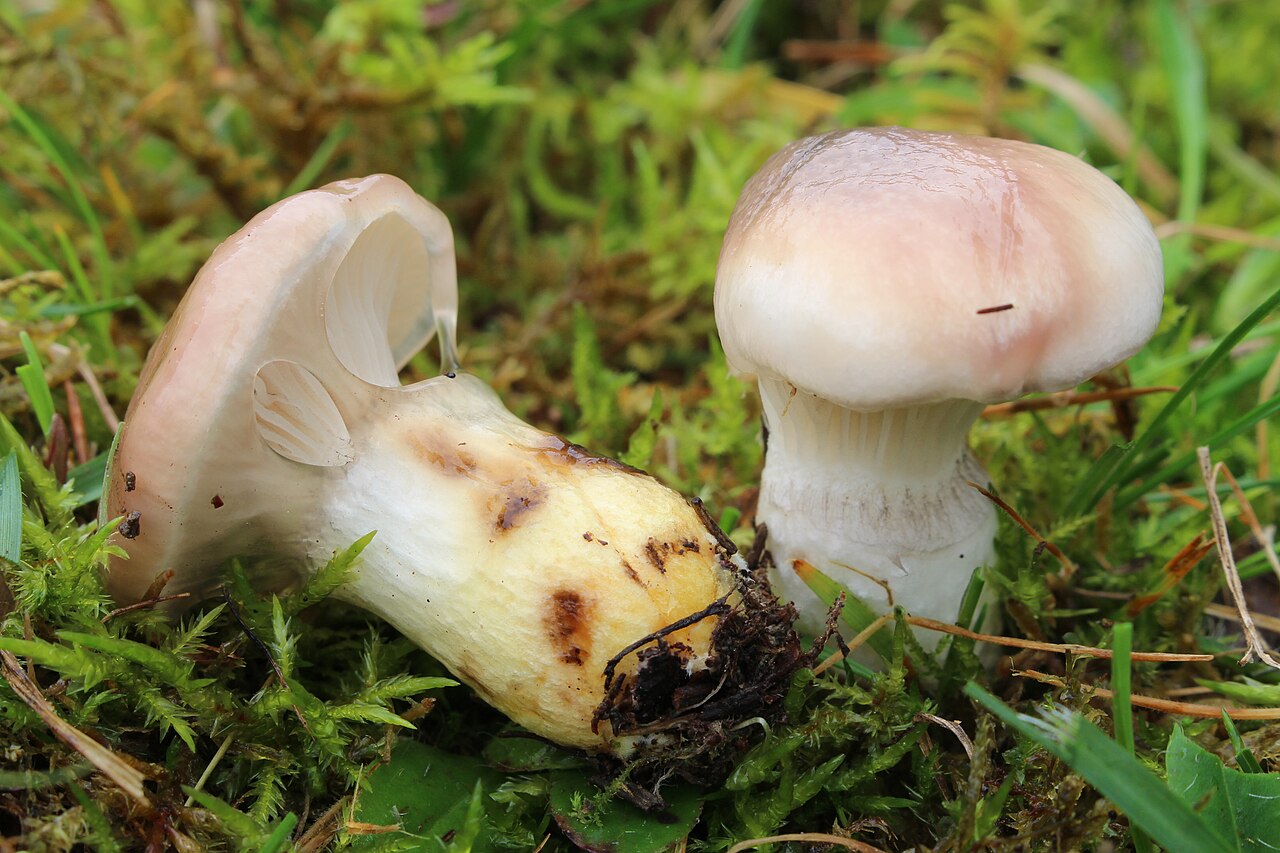
Photo: Holger Krisp · CC BY 3.0 · Photo source · License

Description
A fleshy grey-brown mushroom with a very slimy cap and thick, distant gills that run down the stem and darken with age.
Identification features
Young fruitbodies have a slimy veil; the stem is pale, often distinctly yellow at the base, and the spore print is very dark.
Identification checklist
Check the entire fruitbody for identification. A fleshy grey-brown mushroom with a very slimy cap and thick, distant gills that run down the stem and darken with age. Young fruitbodies have a slimy veil; the stem is pale, often distinctly yellow at the base, and the spore print is very dark. Typical habitat: Mainly in spruce and other coniferous woodland on the ground near its mycorrhizal hosts, in summer and autumn.
Detailed features
- Cap
- A fleshy grey-brown mushroom with a very slimy cap and thick, widely spaced gills that run down the stem and darken with age.
- Hymenophore
- Young fruitbodies have a slimy veil; the stem is pale, often distinctly yellow at the base, and the spore print is very dark.
- Flesh
- Whitish, soft and fleshy.
- Smell
- No distinctive smell.
- Spore print
- Dark sepia-brown.
Size
- Cap diameter
- 5–12 cm
- Stem height
- 3–10 cm
- Stem diameter
- 1–2 cm
Habitat
Mainly in spruce and other coniferous woodland on the ground near its mycorrhizal hosts, in summer and autumn.
Fruiting period
July, August, September, October, November
Ecology
- Trophic mode
- Mycorrhizal
- Host trees
- Spruce (Picea)
- Substrate
- Forest soil
- Notes
- Mycorrhizal species. Mainly in spruce and other coniferous woodland on the ground near its mycorrhizal hosts, in summer and autumn.
How to separate similar species
Compare especially with these similar species: Gomphidius maculatus, Gomphidius roseus, Chroogomphus rutilus. Check the entire fruitbody, spore-bearing surface, stem, texture, changes after bruising and habitat. A single feature or photograph is not enough for reliable identification.
Similar species
- Gomphidius maculatus
- Gomphidius roseus
- Copper spike (Chroogomphus rutilus)
C. rutilus is copper-brown and characteristically associated with pines; G. glutinosus is greyer, much slimier and often with spruce.
Interesting facts
Did you know? Despite having gills, the Slimy Spike belongs to the Boletales and is more closely related to boletes than to typical agarics.