Species details
Copper spike
Chroogomphus rutilus
Traditionally edible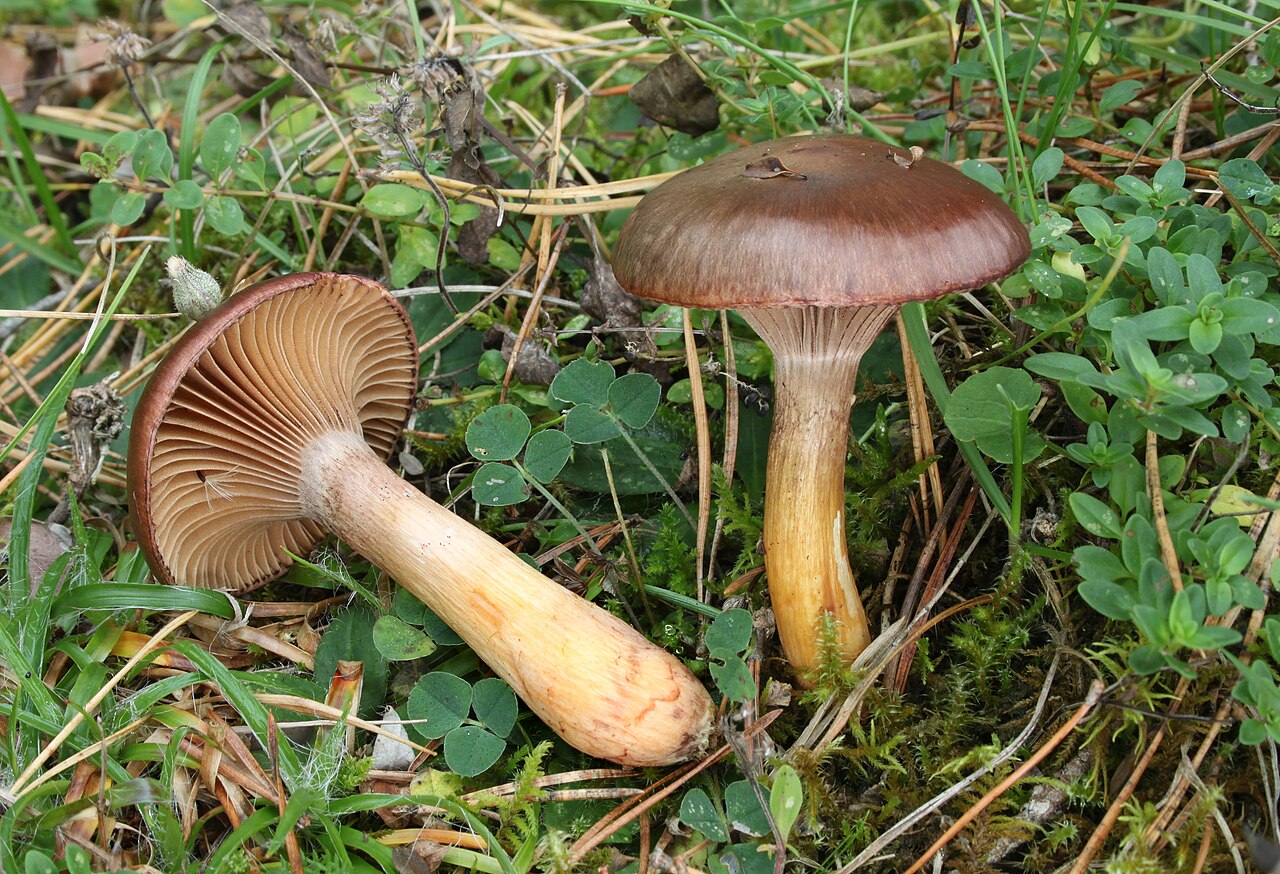
Photo: Holger Krisp · CC BY 3.0 · Photo source · License

Description
A copper to reddish-brown mushroom associated with pines, with thick widely spaced gills running far down the stem.
Identification features
The cap is smooth, sticky when wet and often bell-shaped when young. Gills begin ochre-pink and darken with maturity; the stem base is often distinctly yellow.
Identification checklist
Check for a smooth copper-brown cap, very thick widely spaced gills running far down the stem, a yellow stem base and nearby pines. Mature gills and spore print become very dark.
Detailed features
- Cap
- A coppery to reddish-brown mushroom associated with pines, with thick, widely spaced gills that run far down the stem.
- Hymenophore
- The cap is smooth, sticky when wet and often bell-shaped in young fruitbodies. The gills are initially ochre-pink and later darken; the stem base is often distinctly yellow.
- Flesh
- Yellowish and firm, more strongly golden-yellow at the stem base.
- Smell
- No distinctive smell.
- Spore print
- Blackish-brown.
Size
- Cap diameter
- 3–10 cm
- Stem height
- 4–8 cm
- Stem diameter
- 0,8–1,5 cm
Habitat
A mycorrhizal species closely associated with pines; in pine and mixed woodland from summer to autumn.
Fruiting period
July, August, September, October, November
Ecology
- Trophic mode
- Mycorrhizal
- Host trees
- Pine (Pinus)
- Substrate
- Forest soil
- Notes
- Mycorrhizal species. A mycorrhizal species closely associated with pines; in pine and mixed woodland from summer to autumn.
How to separate similar species
Slimy spike is greyer to violet-grey, usually much more slimy and shows different colour changes, although it also occurs with conifers. Compare cap, gills, stem base and tree association together.
Similar species
- Slimy spike-cap (Gomphidius glutinosus)
G. glutinosus is grey to purplish-brown, much slimier and typically associated with spruce; C. rutilus is copper-brown and grows with pines.
- Chroogomphus helveticus
Interesting facts
Did you know? Despite its gills, the species belongs to the Boletales; association with pines is an important field clue.