Species details
Salmon milkcap
Lactarius salmonicolor
Extra caution required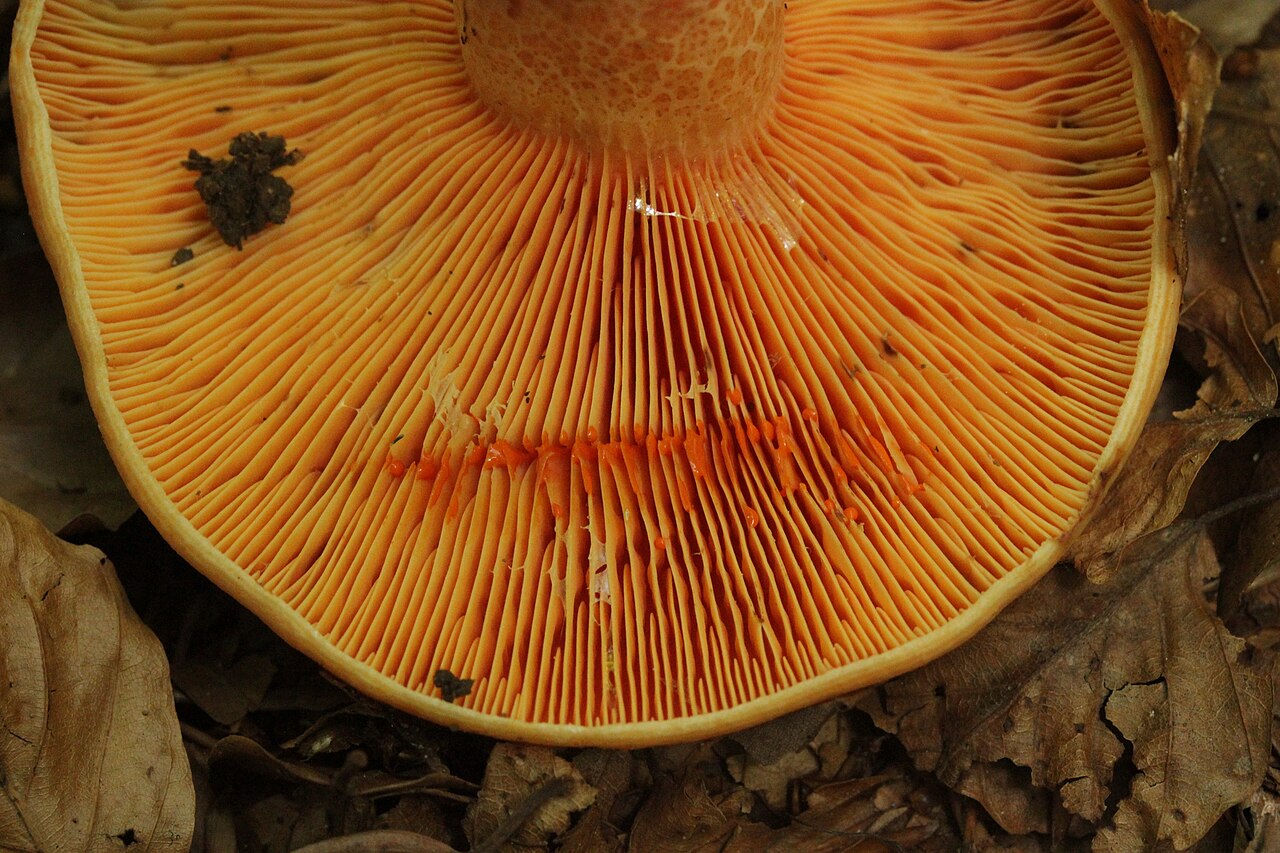
Photo: Holger Krisp · CC BY 3.0 · Photo source · License
.JPG)
Description
A salmon-orange milkcap with orange latex and faint cap zoning, associated with fir.
Identification features
Flesh and latex remain orange and green only weakly; the stem often has pits.
Identification checklist
Check the entire fruitbody for identification. A salmon-orange milkcap with orange latex and faint cap zoning, associated with fir. Flesh and latex remain orange and green only weakly; the stem often has pits. Typical habitat: Exclusively or mainly under fir in mountain and mixed woodland.
Detailed features
- Cap
- 5–12 cm, orange-yellow to salmon-orange, initially flat with a strongly inrolled margin, later centrally depressed; often without strong zoning.
- Hymenophore
- Gills are narrow, crowded and similarly coloured to the cap; injury releases orange latex.
- Stem
- 3–7 × 1–2 cm, cylindrical, hollow, salmon-orange, sometimes with slightly darker pits.
- Flesh
- Ochre-orange, brittle and firm; latex carrot-orange to red-orange, usually without strong greening.
- Smell
- Pleasant, indistinct.
- Spore print
- Pale ochre.
Size
- Cap diameter
- 5–12 cm
- Stem height
- 3–7 cm
- Stem diameter
- 1–2 cm
Habitat
Exclusively or mainly under fir in mountain and mixed woodland.
Fruiting period
August, September, October, November
Ecology
- Trophic mode
- Mycorrhizal
- Host trees
- Fir (Abies)
- Substrate
- Forest soil
- Notes
- A mycorrhizal species closely associated with firs.
How to separate similar species
Compare especially with these similar species: Lactarius deterrimus, Lactarius deliciosus, Lactarius sanguifluus. Check the combination of cap shape and colour, spore-bearing surface, stem, flesh changes and habitat. A single feature or photograph is not enough; if the key characters do not match the description, do not treat the identification as confirmed.
Similar species
- Saffron milk cap (Lactarius deliciosus)
Usually grows with pines and has more obvious concentric zoning on the cap.
- False saffron milkcap (Lactarius deterrimus)
Mainly associated with spruce and often greens more strongly after injury.