Species details
Rosy bolete
Rubroboletus rhodoxanthus
Poisonous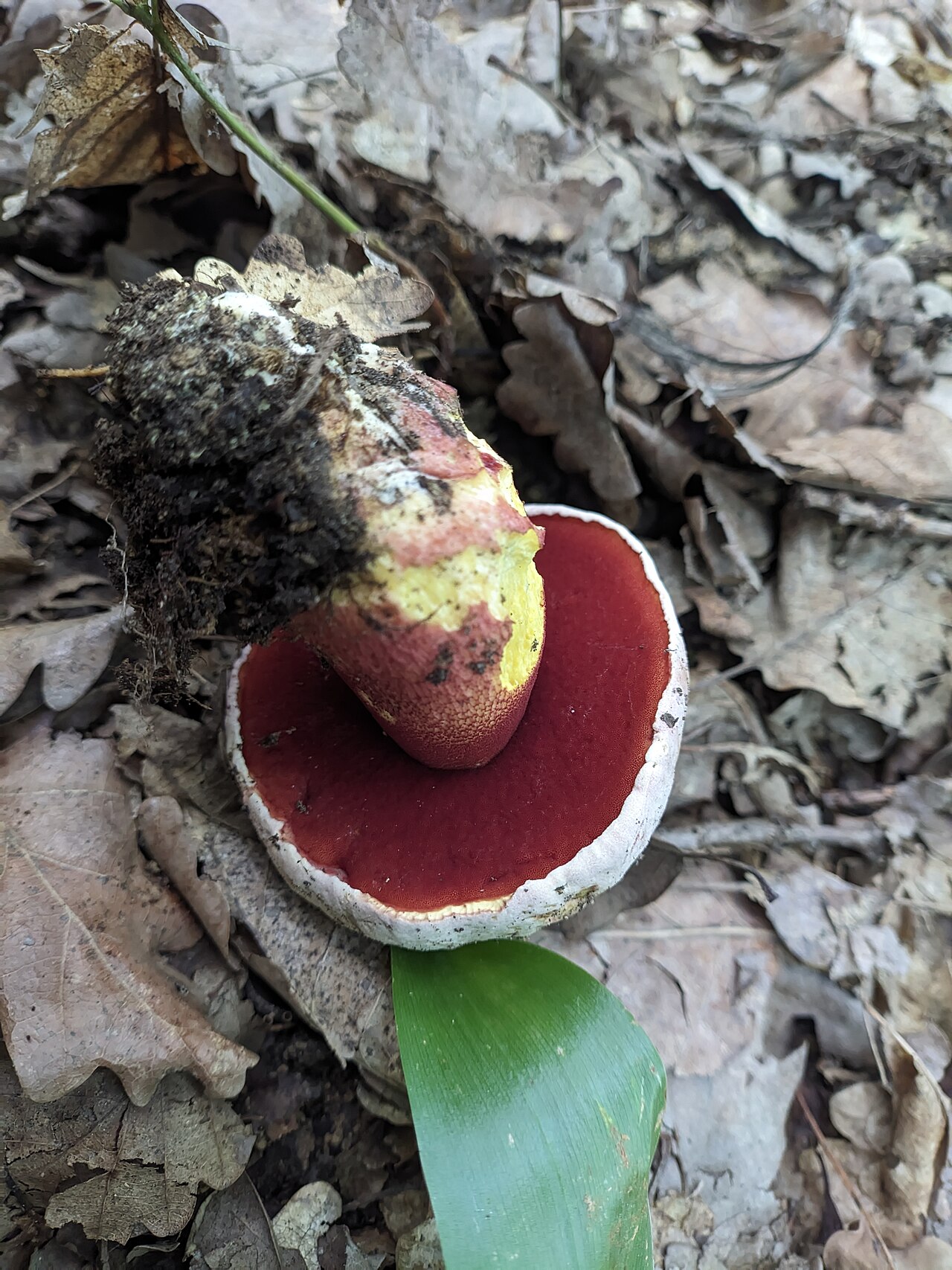
Photo: Brozkeff · CC BY 4.0 · Photo source · License

Description
A rare colourful bolete with a pale to pinkish cap, yellow young pores and a strongly red stem.
Identification features
The stem has a pronounced red net; cap flesh usually blues rapidly when cut.
Identification checklist
Check the entire fruitbody for identification. A rare colourful bolete with a pale to pinkish cap, yellow young pores and a strongly red stem. The stem has a pronounced red net; cap flesh usually blues rapidly when cut. Typical habitat: Warm deciduous woodland on calcareous soils, especially with oak and beech.
Detailed features
- Cap
- 8–20 cm, hemispherical to convex, pale with pink tones, thick-fleshed and smooth.
- Hymenophore
- Small crowded pores are red when mature and darken on bruising.
- Stem
- 5–15 × 3–8 cm, stout, with a dense crimson-red reticulum over a yellow ground.
- Flesh
- Yellow; turning blue-green when cut, especially in the cap.
- Smell
- Indistinct.
- Spore print
- Olive-brown.
Size
- Cap diameter
- 8–20 cm
- Stem height
- 5–15 cm
- Stem diameter
- 3–8 cm
Habitat
Warm deciduous woodland on calcareous soils, especially with oak and beech.
Fruiting period
June, July, August, September, October
Ecology
- Trophic mode
- Mycorrhizal
- Host trees
- Oak (Quercus), Beech (Fagus)
- Substrate
- Forest soil
- Soil
- Calcareous
- Notes
- A warmth-loving mycorrhizal species of broadleaved woodland, especially on calcareous soils.
How to separate similar species
Compare especially with these similar species: Rubroboletus satanas, Rubroboletus legaliae, Suillellus luridus. Check the combination of cap shape and colour, spore-bearing surface, stem, flesh changes and habitat. A single feature or photograph is not enough; if the key characters do not match the description, do not treat the identification as confirmed.
Similar species
- Satan's bolete (Rubroboletus satanas) DANGEROUS
Satan’s bolete usually has a greyer-white cap and a more massive stem; both are problematic as food.
- Le Gal's bolete (Rubroboletus legaliae) DANGEROUS
Rubroboletus legaliae often has a variable grey-pink cap and a characteristic chicory- or hay-like smell.
Interesting facts
Did you know? A pale pink cap and a strong red reticulum on the yellow stem are useful field characters.