Species details
Red cage fungus
Clathrus ruber
Inedible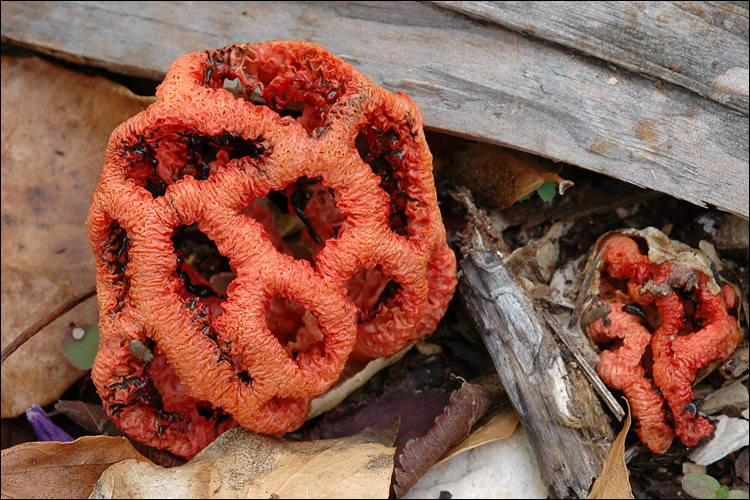
Photo: Amadej Trnkoczy · CC BY-SA 3.0 · Photo source · License

Description
An unusual red to orange fungus forming a hollow lattice cage with a strong unpleasant smell.
Identification features
It develops from a white egg-like structure; dark slimy gleba on the inner cage attracts insects.
Identification checklist
Check the entire fruitbody for identification. An unusual red to orange fungus forming a hollow lattice cage with a strong unpleasant smell. It develops from a white egg-like structure; dark slimy gleba on the inner cage attracts insects. Typical habitat: Warm gardens, parks, compost, mulch and Mediterranean areas; increasingly found farther north.
Detailed features
- Cap
- After the white egg-like volva splits, a 5–12 cm wide hollow spherical lattice develops, vivid pink-red to red.
- Hymenophore
- Olive-black slimy gleba coats the inner surface of the red lattice and smells strongly.
- Stem
- No true stem; the lattice stands on remnants of the egg-like volva.
- Flesh
- Soft and spongy, initially pale, later reddish to darker.
- Smell
- Very strong carrion smell.
- Spore print
- Olive-brown.
Habitat
Warm gardens, parks, compost, mulch and Mediterranean areas; increasingly found farther north.
Fruiting period
May, June, July, August, September, October, November
Ecology
- Trophic mode
- Saprotrophic
- Substrate
- Soil, Forest soil
- Soil
- Moist
- Notes
- Grows on moist, organic-rich soil, especially in warmer areas, gardens and broadleaved habitats.
How to separate similar species
Compare especially with these similar species: Phallus impudicus, Clathrus archeri. Check the combination of cap shape and colour, spore-bearing surface, stem, flesh changes and habitat. A single feature or photograph is not enough; if the key characters do not match the description, do not treat the identification as confirmed.
Similar species
- Clathrus archeri
Devil’s fingers develops several separate red arms rather than a closed spherical lattice.
- Common stinkhorn (Phallus impudicus)
Common stinkhorn has a long white spongy stem with a pitted head, not a red lattice.
Conservation
- Protected species
- Yes
- Red list
- R – rare species
- Notes
- The species is legally protected in Slovenia under the regulation on protected wild fungi. On the Slovenian Red List: R – rare species.
Interesting facts
Did you know? Like other stinkhorns, it uses strong odour to attract insects that disperse the sticky spores.