Species details
Common stinkhorn
Phallus impudicus
Inedible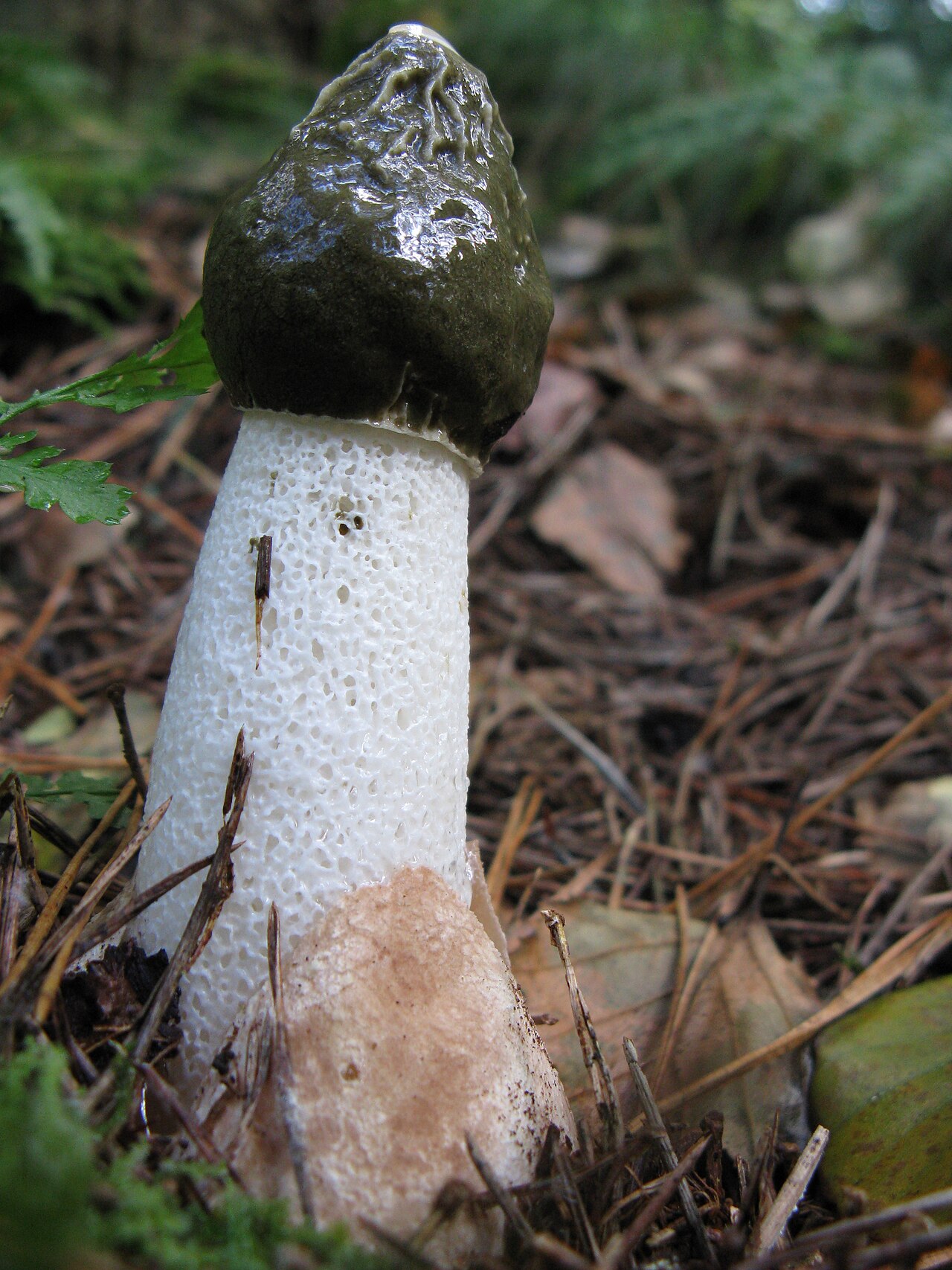
Photo: Dohduhdah · Public Domain · Photo source · License

Description
A distinctive foul-smelling fungus that rapidly grows from a white 'egg' into a tall white stalk with dark olive spore slime.
Identification features
The smell attracts flies that disperse spores; the head is honeycombed and coated in gleba.
Identification checklist
Check the entire fruitbody for identification. A distinctive foul-smelling fungus that rapidly grows from a white 'egg' into a tall white stalk with dark olive spore slime. The smell attracts flies that disperse spores; the head is honeycombed and coated in gleba. Typical habitat: Gardens, parks, woodland edges, mulch and humus-rich soils.
Detailed features
- Cap
- Head 4–5 cm, bell-shaped and honeycomb-pitted, initially covered by olive-green, strongly fetid gleba.
- Hymenophore
- The spore mass is slimy gleba on the pitted head surface and is dispersed by insects.
- Stem
- 8–20 × 3–4 cm, white, spongy, hollow and rapidly elongating from the egg-like volva.
- Flesh
- White; firmer in the egg stage, later foamy and porous.
- Smell
- The mature fruitbody has a very strong carrion smell.
- Spore print
- Olive-greenish spore mass.
Size
- Cap diameter
- 4–5 cm
- Stem height
- 8–20 cm
- Stem diameter
- 3–4 cm
Habitat
Gardens, parks, woodland edges, mulch and humus-rich soils.
Fruiting period
May, June, July, August, September, October, November
Ecology
- Trophic mode
- Saprotrophic
- Substrate
- Forest soil
- Notes
- A saprotroph on forest soil and organic-rich sites under broadleaved and coniferous trees, from summer to late autumn.
How to separate similar species
Compare especially with these similar species: Mutinus caninus, Phallus hadriani. Check the combination of cap shape and colour, spore-bearing surface, stem, flesh changes and habitat. A single feature or photograph is not enough; if the key characters do not match the description, do not treat the identification as confirmed.
Similar species
- Red cage fungus (Clathrus ruber)
Red cage stinkhorn develops a red spherical lattice from the egg, not a white spongy stem with a pitted head.
- Dog stinkhorn (Mutinus caninus)
Dog stinkhorn is much smaller; the fertile tip is narrower and clearly demarcated, often orange to reddish beneath the gleba.
Interesting facts
Did you know? The smell is functional: it attracts flies that disperse spores while visiting the slimy gleba.