Species details
Poison pie
Hebeloma crustuliniforme
Poisonous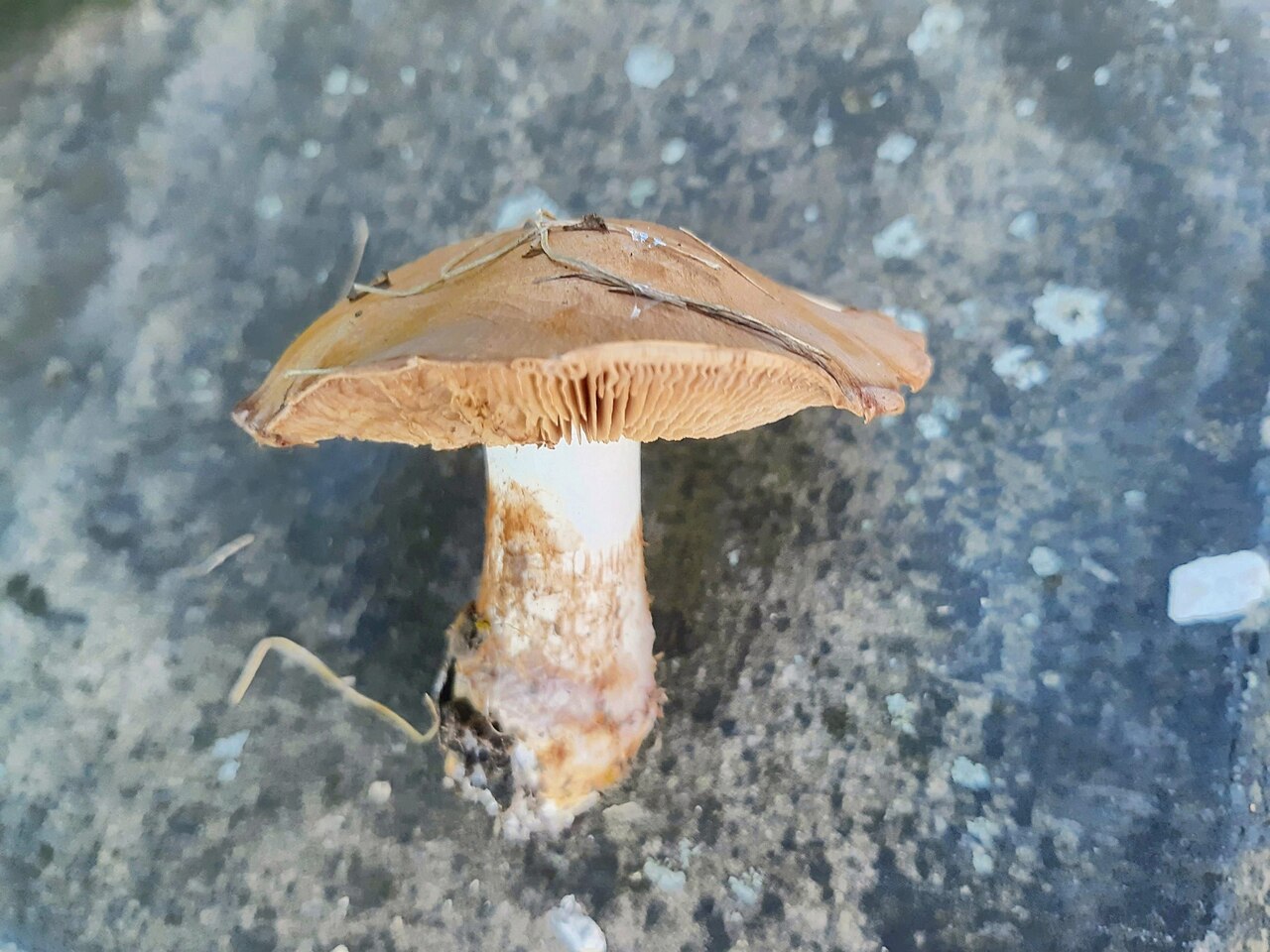
Photo: Rob Norris · CC0 · Photo source · License

Description
An ochre-brown hebeloma with a pale margin, radish smell, and droplets on the gills.
Identification features
Gills are pale when young, later clay-brown and spotted; the stem is whitish and mealy-pruinose.
Identification checklist
Check the entire fruitbody for identification. An ochre-brown hebeloma with a pale margin, radish smell, and droplets on the gills. Gills are pale when young, later clay-brown and spotted; the stem is whitish and mealy-pruinose. Typical habitat: Woodland, parks, gardens, and roadside trees, often in groups.
Detailed features
- Cap
- 4–8 cm, whitish to pale ochre, fleshy and cushion-shaped, with a long-inrolled margin; slightly sticky when wet.
- Hymenophore
- Gills initially pale and often conspicuously beaded with droplets, later darker and brown-spotted.
- Stem
- 4–8 × 1–1.5 cm, whitish, cylindrical and solid, finely scaly near the top.
- Flesh
- White to whitish and firm.
- Smell
- Unpleasant and distinctly radish-like.
- Taste
- Do not taste.
- Spore print
- Rusty brown.
Size
- Cap diameter
- 4–8 cm
- Stem height
- 4–8 cm
- Stem diameter
- 1–1,5 cm
Habitat
Woodland, parks, gardens, and roadside trees, often in groups.
Fruiting period
August, September, October, November, December
Ecology
- Trophic mode
- Mycorrhizal
- Substrate
- Forest soil, Grassland
- Notes
- Occurs with various trees in woods, parks and woodland edges, often in groups or rings.
How to separate similar species
Compare especially with these similar species: Hebeloma sinapizans, Hebeloma laterinum, Cortinarius species. Check the combination of cap shape and colour, spore-bearing surface, stem, flesh changes and habitat. A single feature or photograph is not enough; if the key characters do not match the description, do not treat the identification as confirmed.
Similar species
- Blue spot knight (Tricholoma columbetta)
The dove tricholoma has a white spore print, lacks weeping brown-spotted gills, and often has a bluish stem base.
- Hebeloma sinapizans
The related Hebeloma is often larger and differs in stem details; the genus is difficult to identify macroscopically.