Species details
Blue spot knight
Tricholoma columbetta
Extra caution required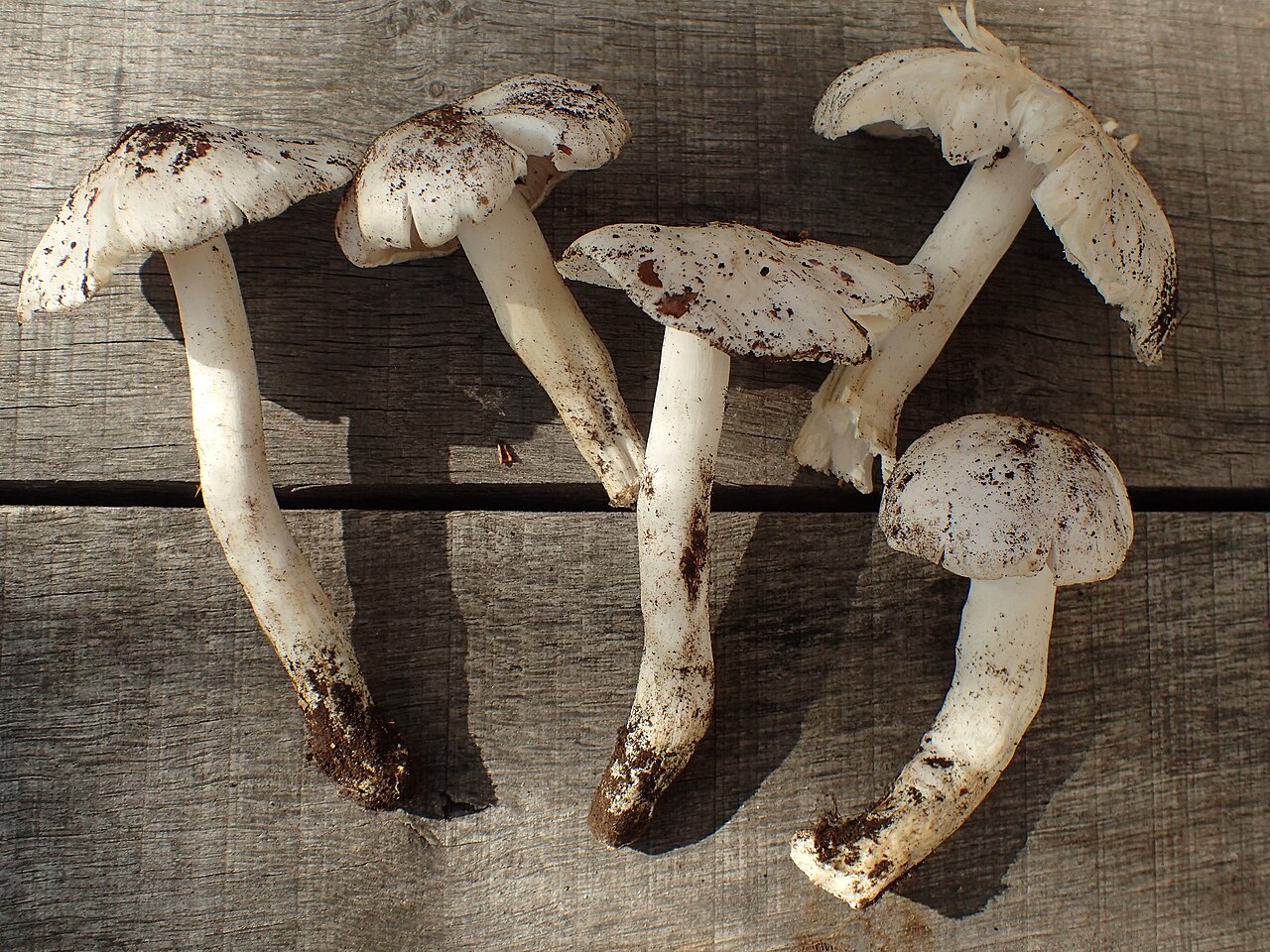
Photo: Adrien BENOIT à la GUILLAUME · CC BY-SA 4.0 · Photo source · License
_01.jpg)
Description
A white to ivory knight with a silky-fibrous cap and often blue-green stains at the base.
Identification features
Gills are white, the cap margin may be wavy, and the flesh has a mild mealy smell.
Identification checklist
Check the entire fruitbody for identification. A white to ivory knight with a silky-fibrous cap and often blue-green stains at the base. Gills are white, the cap margin may be wavy, and the flesh has a mild mealy smell. Typical habitat: Deciduous and mixed woodland, mainly under beech, oak, and birch.
Detailed features
- Cap
- 5–10 cm, snow-white, shiny and silky with radial fibres; may show faint reddish, bluish or violet patches.
- Hymenophore
- Gills white, crowded, thin, and notched at the stem.
- Stem
- 5–10 × 1–2 cm, white and silky-fibrous, often broader toward the base; the base may be bluish.
- Flesh
- White and firm.
- Smell
- Indistinct, sometimes faintly mealy.
- Spore print
- White.
Size
- Cap diameter
- 5–10 cm
- Stem height
- 5–10 cm
- Stem diameter
- 1–2 cm
Habitat
Deciduous and mixed woodland, mainly under beech, oak, and birch.
Fruiting period
August, September, October, November
Ecology
- Trophic mode
- Mycorrhizal
- Substrate
- Forest soil
- Notes
- Mycorrhizal mainly with deciduous trees; occurs in deciduous and mixed woodland.
How to separate similar species
Compare especially with these similar species: Tricholoma album, Tricholoma stiparophyllum, Clitocybe phyllophila. Check the combination of cap shape and colour, spore-bearing surface, stem, flesh changes and habitat. A single feature or photograph is not enough; if the key characters do not match the description, do not treat the identification as confirmed.
Similar species
- Frosted funnel (Clitocybe phyllophila) DANGEROUS
The deadly white funnel lacks the characteristic silky-fibrous tricholoma cap and has differently attached gills.
- White knight (Tricholoma album)
Usually duller white to cream and often unpleasantly scented; a bluish base is not characteristic.