Species details
Olive amanita
Amanita submembranacea
Conditional / expert preparation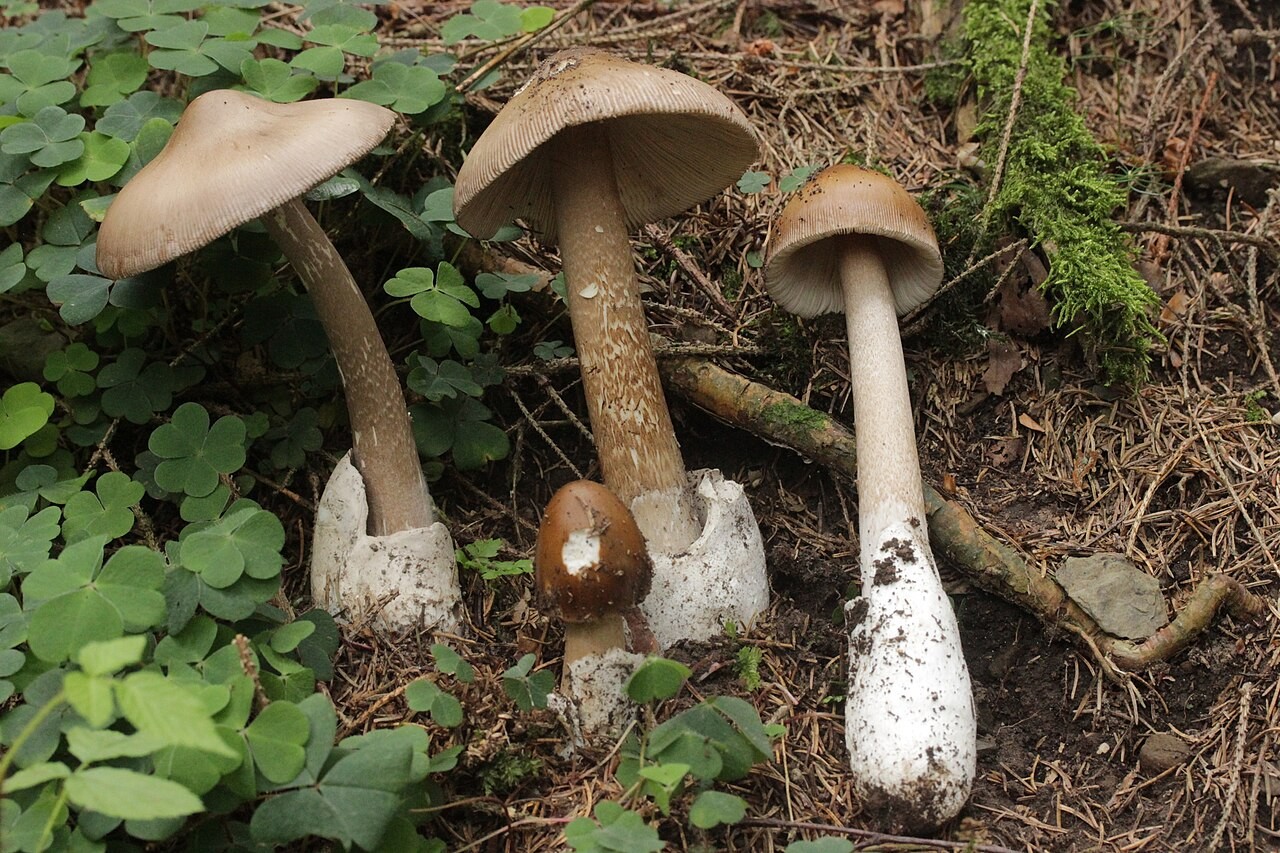
Photo: Björn S... · CC BY-SA 2.0 · Photo source · License
.jpg)
Description
An olive- to grey-brown grisette with a strongly striate cap margin, no ring, and a greyish membranous volva around the stem base.
Identification features
The cap is silky smooth, olive-brown to grey-olive, and distinctly radially striate. Gills are white to cream. The slender stem lacks a ring and sits in a membranous volva that greys with age.
Identification checklist
Expose the whole stem including its base. Check the absence of a ring, strongly striate cap margin, and characteristic greyish membranous volva.
Detailed features
- Cap
- The cap is silky smooth, olive-brown to grey-olive, and distinctly radially striate.
- Hymenophore
- Gills are white to cream.
- Stem
- The slender stem lacks a ring and sits in a membranous volva that greys with age.
- Flesh
- White, brittle and without a distinctive smell.
- Smell
- No distinctive smell.
- Spore print
- White.
Size
- Cap diameter
- 4–8 cm
- Stem height
- 5–12 cm
- Stem diameter
- 0,9–1,2 cm
Habitat
Mainly in montane conifer woodland on acidic soils with spruce, fir, pine, and larch, from summer into autumn.
Fruiting period
June, July, August, September, October
Ecology
- Trophic mode
- Mycorrhizal
- Host trees
- Spruce (Picea), Pine (Pinus), Fir (Abies), Larch (Larix)
- Substrate
- Forest soil
- Soil
- Acidic
- Notes
- Mainly in montane conifer woodland on acidic soils with spruce, fir, pine, and larch, from summer into autumn.
How to separate similar species
Grisettes are very similar to one another. Reliable identification is not possible without the entire stem base and clear veil characters; young Amanita from other groups may be dangerous.
Similar species
Interesting facts
Did you know? It lacks a ring; the greyish membranous volva and strongly striate cap margin are key characters.