Species details
Grey-zoned ringless amanita
Amanita battarrae
Conditional / expert preparation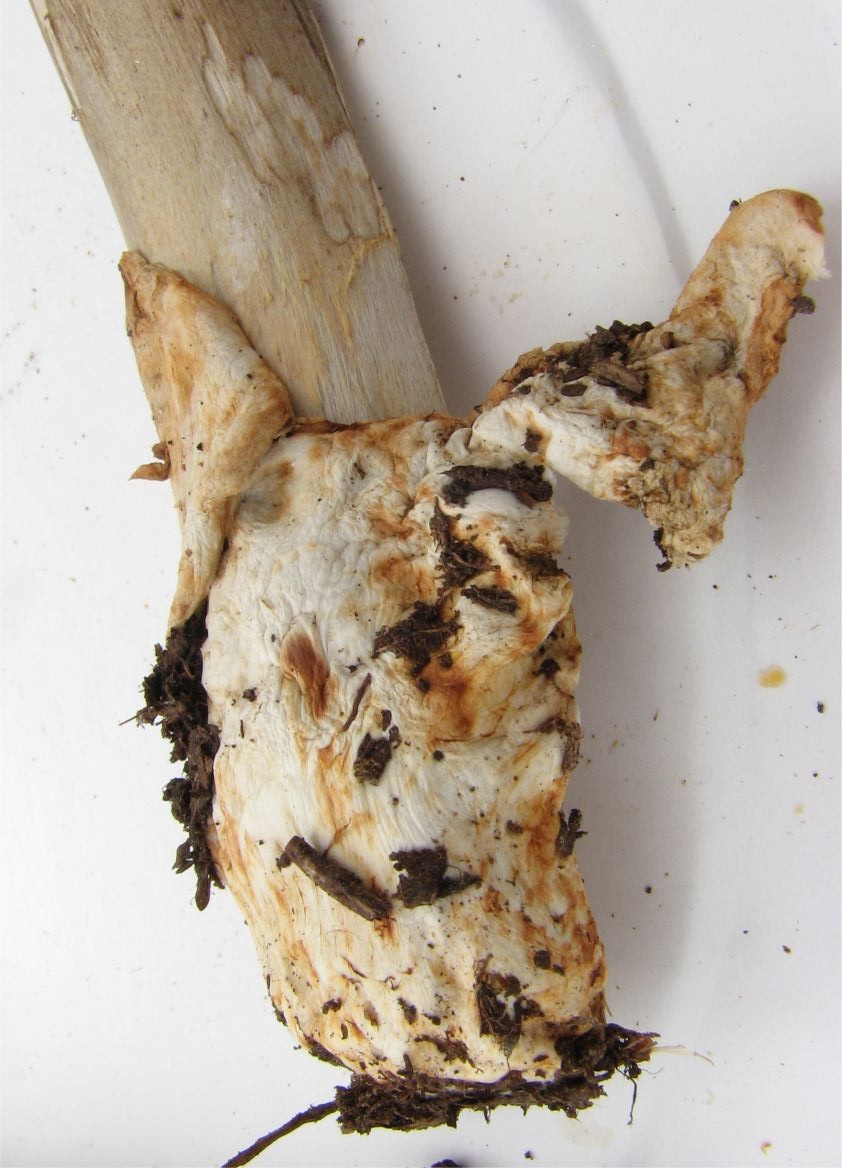
Photo: This image was created by user Irene Andersson (irenea) at Mushroom Observer , a source for mycological images. You can contact this user here . · CC BY-SA 3.0 · Photo source · License
_Bon_54495.jpg)
Description
A grey-brown grisette with a strongly striate cap margin, no ring, and a sack-like volva around the stem base.
Identification features
The cap is grey- to olive-brown, often with a darker zone. Gills are white and free. The slender stem lacks a ring and sits in a grey-white volva.
Identification checklist
Expose the whole fruitbody. Check the absence of a ring, strongly striate margin, and the form of the volva at the base.
Detailed features
- Cap
- The cap is grey- to olive-brown, often with a darker zone.
- Hymenophore
- Gills are white and free.
- Stem
- The slender stem lacks a ring and sits in a grey-white volva.
- Flesh
- White and brittle.
- Smell
- No distinctive smell.
- Spore print
- White.
Size
- Cap diameter
- 3–10 cm
- Stem height
- 6–10 cm
- Stem diameter
- 0,5–1,5 cm
Habitat
Mycorrhizal mainly in coniferous woodland on acidic soils, from summer to late autumn.
Fruiting period
June, July, August, September, October, November
Ecology
- Trophic mode
- Mycorrhizal
- Host trees
- Spruce (Picea), Pine (Pinus)
- Substrate
- Forest soil
- Soil
- Acidic
- Notes
- Mycorrhizal mainly in coniferous woodland on acidic soils, from summer to late autumn.
How to separate similar species
Grisettes are very similar, and young Amanita from other groups can be dangerous. Identification is unreliable without the complete stem base.
Similar species
Interesting facts
Did you know? Like other grisettes it lacks a ring and has a strongly striate cap margin.