Species details
Grey-veiled Amanita
Amanita porphyria
Poisonous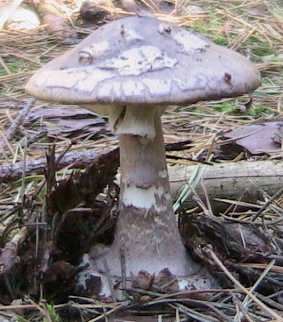
Photo: Knutux · Public Domain · Photo source · License

Description
A grey-brown to purplish-brown Amanita with a smooth cap, greyish ring and bulbous base.
Identification features
The bulbous base is marginate; it often smells of raw potatoes.
Identification checklist
Check the entire fruitbody for identification. A grey-brown to purplish-brown Amanita with a smooth cap, greyish ring and bulbous base. The bulbous base is marginate; it often smells of raw potatoes. Typical habitat: Acidic coniferous and mixed woodland, especially with spruce and pine.
Detailed features
- Cap
- 5–8 cm, quickly expanding to nearly flat, violet-grey to grey-brown, mostly smooth.
- Hymenophore
- Gills white, crowded and broad; initially slightly attached, later free.
- Stem
- 7–10 × 0.7–1.5 cm, white to grey-violet mottled, with a ring; base with a large bulb and stepped rim.
- Flesh
- White and brittle.
- Smell
- Strong smell of raw potato or radish.
- Taste
- Do not taste.
- Spore print
- White.
Size
- Cap diameter
- 5–8 cm
- Stem height
- 7–10 cm
- Stem diameter
- 0,7–1,5 cm
Habitat
Acidic coniferous and mixed woodland, especially with spruce and pine.
Fruiting period
July, August, September, October
Ecology
- Trophic mode
- Mycorrhizal
- Host trees
- Spruce (Picea)
- Substrate
- Forest soil
- Soil
- Acidic
- Notes
- Found especially in upland spruce woodland on moist acidic soils, but it can also occur with broadleaved trees.
How to separate similar species
Compare especially with these similar species: Amanita citrina, Amanita pantherina. Check the combination of cap shape and colour, spore-bearing surface, stem, flesh changes and habitat. A single feature or photograph is not enough; if the key characters do not match the description, do not treat the identification as confirmed.
Similar species
- False death cap (Amanita citrina) DANGEROUS
False death cap is usually yellowish or greenish, while this species is grey- to violet-brown.
- Panther cap (Amanita pantherina) DANGEROUS
Panther cap usually has white warts on a brown cap and a differently shaped rimmed bulb.
Interesting facts
Did you know? The strong raw-potato smell is characteristic, but should always be assessed together with bulb shape, ring and cap colour.