Species details
Green brittlegill
Russula aeruginea
Conditional / expert preparation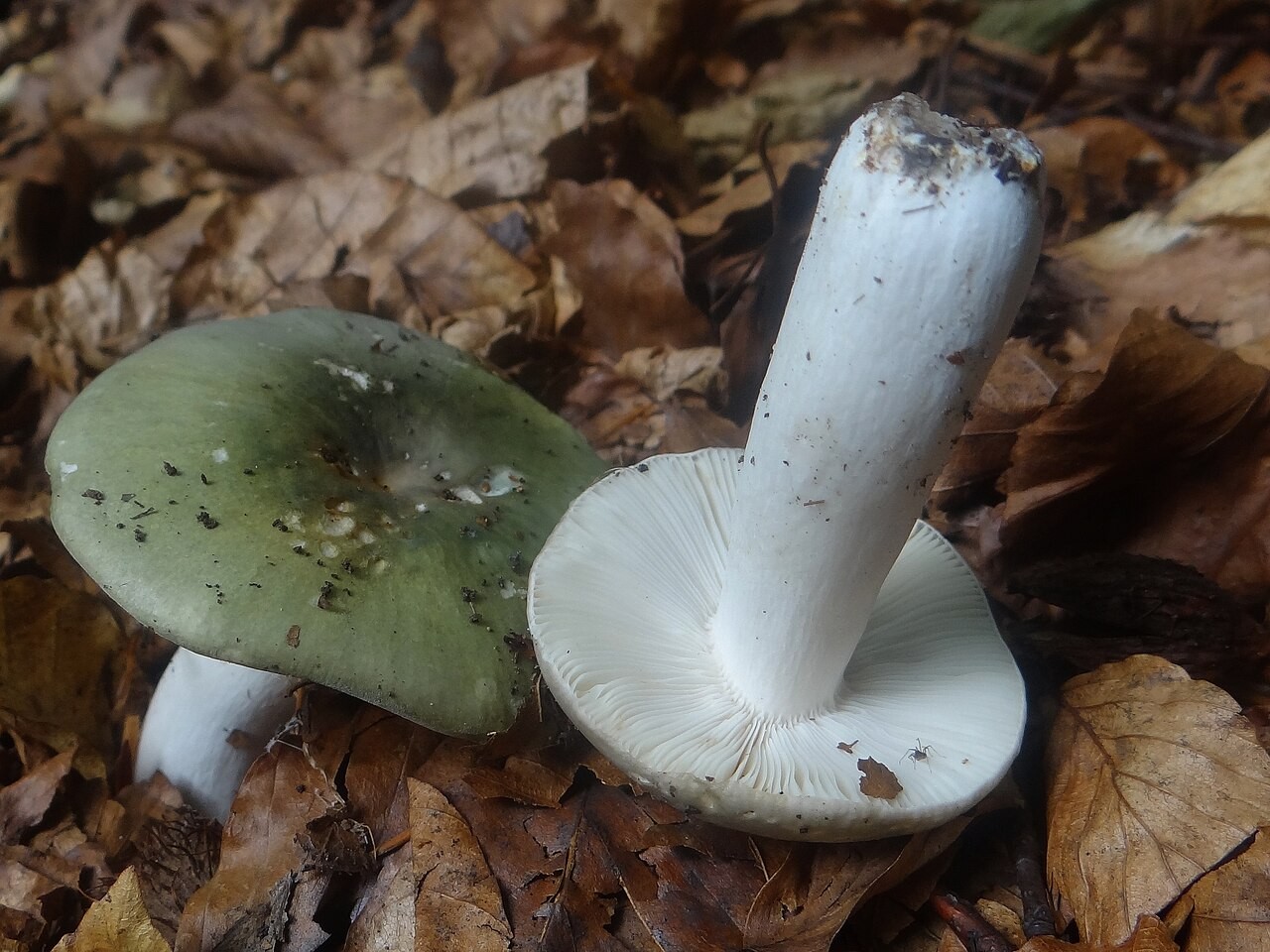
Photo: Jerzy Opioła · CC BY-SA 3.0 · Photo source · License

Description
A medium-sized green Russula with white to cream gills, a white stem, and sometimes acrid flesh.
Identification features
The cap is green to olive-green, smooth, and shiny. Gills are white to slightly yellowish, crowded, and may brown where damaged. The stem is white and firm.
Identification checklist
Check brittle Russula texture, absence of ring and volva, white to cream gills, and spruce habitat. Green colour alone is not sufficient.
Detailed features
- Cap
- The cap is green to olive-green, smooth, and shiny.
- Hymenophore
- Gills are white to slightly yellowish, crowded, and may brown where damaged.
- Stem
- The stem is white and firm.
- Smell
- No distinctive smell.
- Spore print
- White to cream.
Size
- Cap diameter
- 4–8 cm
- Stem height
- 4–6 cm
- Stem diameter
- 0,8–1,5 cm
Habitat
Grows mainly under spruce on acidic soils, from early summer to late autumn.
Fruiting period
June, July, August, September, October, November
Ecology
- Trophic mode
- Mycorrhizal
- Host trees
- Spruce (Picea)
- Substrate
- Forest soil
- Soil
- Acidic
- Notes
- Grows mainly under spruce on acidic soils, from early summer to late autumn.
How to separate similar species
Green Russula can be confused with one another, and inexperienced collectors may even mistake them for death cap. Amanita has a different structure, often a ring and volva.
Similar species
- Green-cracking russula (Russula virescens)
- Greasy green brittlegill (Russula heterophylla)
- Death cap (Amanita phalloides) DANGEROUS
The Death Cap is deadly poisonous; it often has a ring and sac-like volva. Always inspect the entire stem.
Interesting facts
Did you know? Check brittle Russula texture, absence of ring and volva, white to cream gills, and spruce habitat. Green colour alone is not sufficient.