Species details
Goat’s-foot polypore
Scutiger pes-caprae
Traditionally edible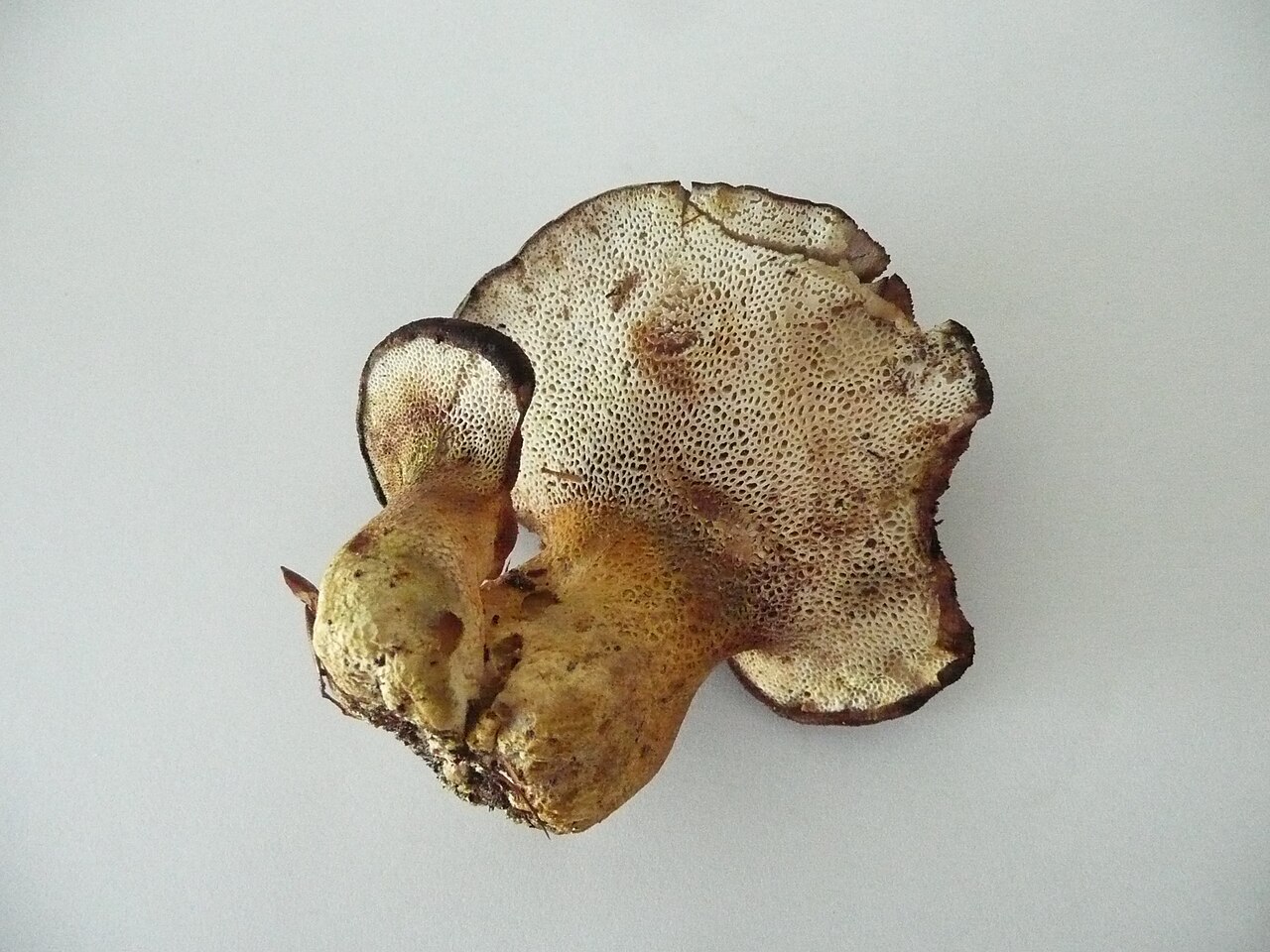
Photo: Ryane Snow (snowman) · CC BY-SA 3.0 · Photo source · License

Description
An irregular fan- to shell-shaped mushroom with a coarsely dark-brown scaly cap, lateral stem and large angular pores.
Identification features
The pore surface is white to yellowish with broad angular pores running down the stem. The stem is short, often lateral and darker toward the base.
Identification checklist
Check the entire fruitbody for identification. An irregular fan- to shell-shaped mushroom with a coarsely dark-brown scaly cap, lateral stem and large angular pores. The pore surface is white to yellowish with broad angular pores running down the stem. The stem is short, often lateral and darker toward the base. On woodland soil under deciduous and coniferous trees, especially in mixed woodland; in autumn.
Detailed features
- Cap
- An irregular fan- to shell-shaped fungus with a coarsely dark-brown scaly cap, lateral stem and large angular pores.
- Hymenophore
- The pore surface is white to yellowish with broad angular pores running down the stem.
- Stem
- The stem is short, often lateral, and darker toward the base.
- Flesh
- White to yellowish, firm but not markedly tough.
- Smell
- Pleasant, mild smell.
- Spore print
- White.
Size
- Cap diameter
- 7–12 cm
- Stem height
- 2–5 cm
- Stem diameter
- 1,5–2,5 cm
Habitat
On woodland soil under deciduous and coniferous trees, especially in mixed woodland; in autumn.
Fruiting period
September, October
Ecology
- Trophic mode
- Mycorrhizal
- Substrate
- Forest soil
- Notes
- Mycorrhizal species. On woodland soil under deciduous and coniferous trees, especially in mixed woodland; in autumn.
How to separate similar species
Compare especially with: Cerioporus squamosus, Albatrellus ovinus. A single feature or photograph is not sufficient for reliable identification.
Similar species
Interesting facts
Did you know? Although it has a pore surface, it grows on the ground and is mycorrhizal rather than a typical wood-growing polypore.