Species details
Dryad's saddle
Cerioporus squamosus
Conditional / expert preparation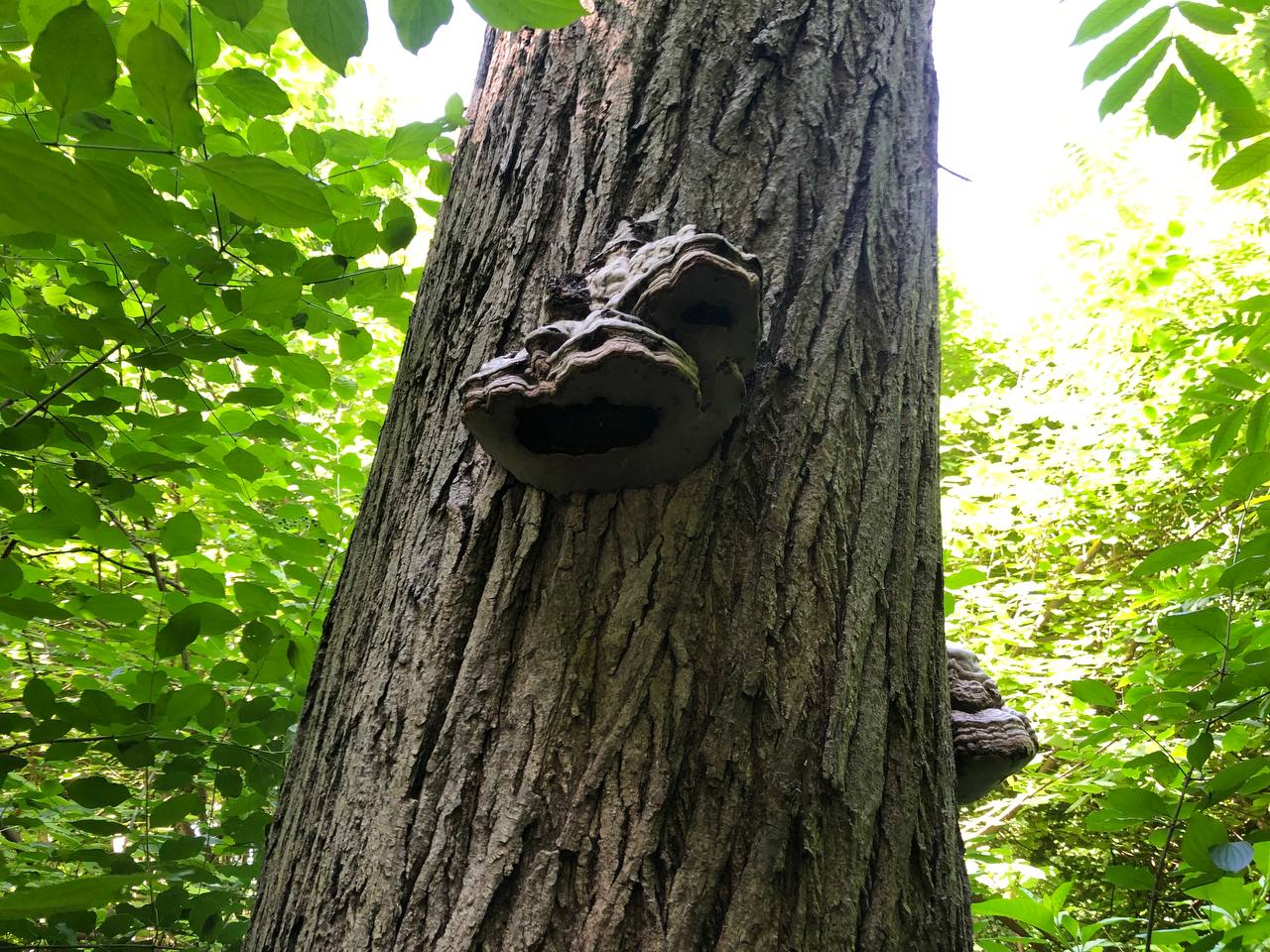
Photo: Mrshaxas · CC BY-SA 4.0 · Photo source · License
.jpg)
Description
A large fan-shaped bracket with a pale cap covered in large brown scales.
Identification features
The underside has large angular pores and a lateral stem; only very young tender specimens are eaten in some traditions.
Identification checklist
Check the entire fruitbody for identification. A large fan-shaped bracket with a pale cap covered in large brown scales. The underside has large angular pores and a lateral stem; only very young tender specimens are eaten in some traditions. Typical habitat: On living or dead hardwoods, often maple, willow, elm and beech.
Detailed features
- Cap
- 5–50 cm, round to fan-shaped, pale ochre to light brown, with large flattened dark scales.
- Hymenophore
- Underside white with large elongated to angular pores.
- Stem
- 2–8 × 1–5 cm, short and often lateral, white to pale brown, blackish-velvety at the base.
- Flesh
- White, firm to pliable when young, becoming tough with age.
- Smell
- Characteristically cucumber- and flour-like.
- Spore print
- White.
Size
- Cap diameter
- 5–50 cm
- Stem height
- 2–8 cm
- Stem diameter
- 1–5 cm
Habitat
On living or dead hardwoods, often maple, willow, elm and beech.
Fruiting period
April, May, June, July, August, September
Ecology
- Trophic mode
- Saprotrophic
- Host trees
- Beech (Fagus), Willow (Salix), Walnut (Juglans), Horse chestnut (Aesculus)
- Substrate
- Living wood, Dead wood, Stumps
- Notes
- A wood-decayer and often rot agent of broadleaved trees, growing on trunks and stumps in woodland, parks and settlements.
How to separate similar species
Compare especially with these similar species: Laetiporus sulphureus. Check the combination of cap shape and colour, spore-bearing surface, stem, flesh changes and habitat. A single feature or photograph is not enough; if the key characters do not match the description, do not treat the identification as confirmed.
Similar species
- Tuberous polypore (Polyporus tuberaster)
Tuberous polypore is smaller, has more erect pointed scales and often a tuberous or sclerotial base.
- Chicken of the woods (Laetiporus sulphureus)
Chicken of the woods lacks dark scales and instead has bright yellow to orange soft brackets.
Interesting facts
Did you know? Very large fan-shaped caps with strong dark scales can be conspicuous from a distance.