Species details
Glistening inkcap
Coprinellus micaceus
Extra caution required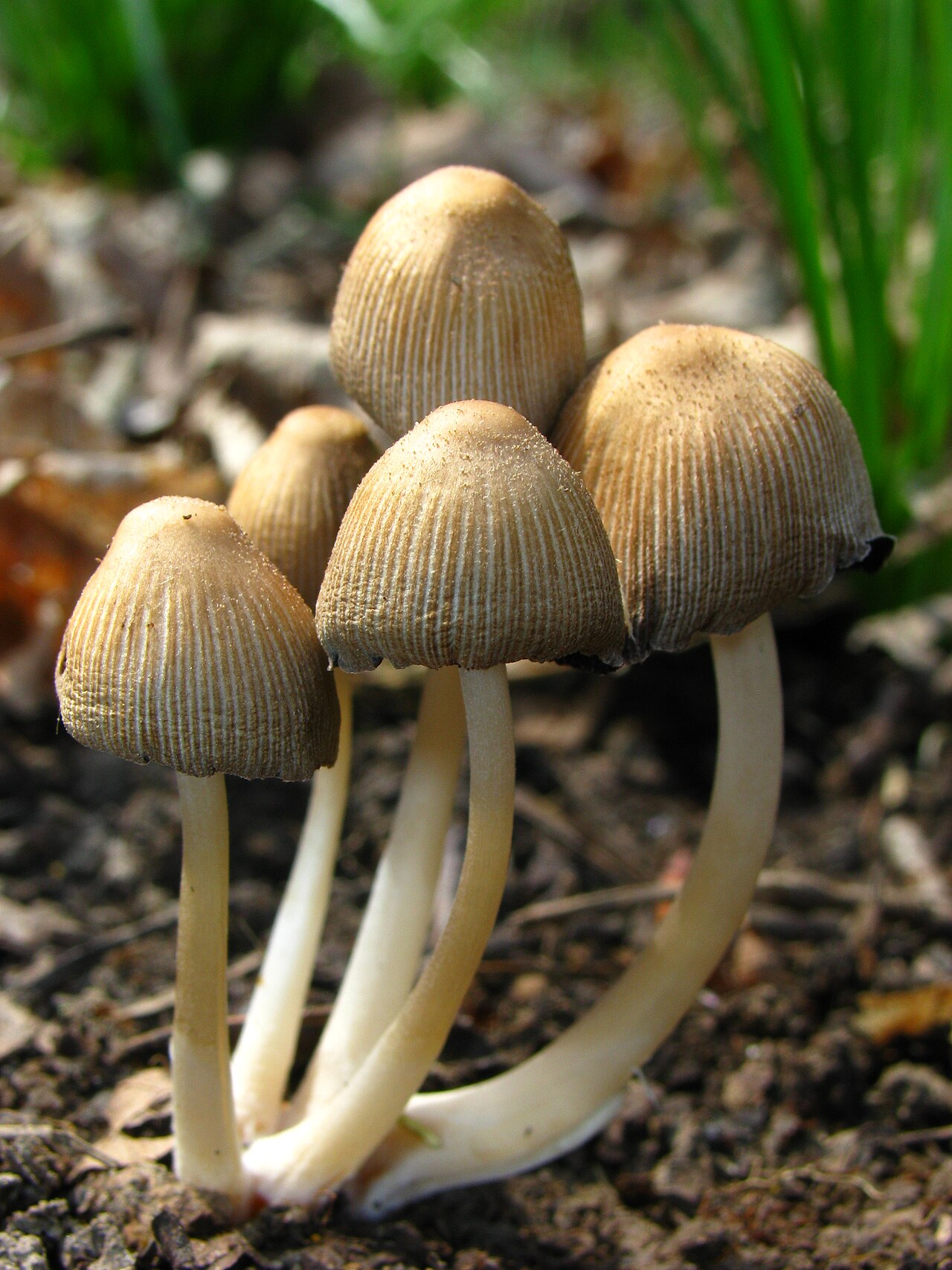
Photo: Dan Molter (shroomydan) · CC BY-SA 3.0 · Photo source · License

Description
A brownish inkcap with tiny glistening granules on young caps, often clustered around wood.
Identification features
The cap is radially grooved; gills blacken with maturity and may deliquesce.
Identification checklist
Check the entire fruitbody for identification. A brownish inkcap with tiny glistening granules on young caps, often clustered around wood. The cap is radially grooved; gills blacken with maturity and may deliquesce. Typical habitat: Around stumps, buried wood and hardwood roots in parks and woodland.
Detailed features
- Cap
- Up to 5 cm wide, initially egg-shaped, later opening conically, ochre-brown, radially striate and dusted when young with glittering veil granules.
- Hymenophore
- Gills initially white, then grey and black at maturity; old gills may partly deliquesce.
- Stem
- Up to 10 cm, white, cylindrical and smooth, slightly thickened at the base; no ring.
- Flesh
- White and thin.
- Smell
- No distinctive smell.
- Spore print
- Black.
Size
- Cap diameter
- 1–5 cm
- Stem height
- 3–10 cm
Habitat
Around stumps, buried wood and hardwood roots in parks and woodland.
Fruiting period
April, May, June, July, August, September, October, November
Ecology
- Trophic mode
- Saprotrophic
- Substrate
- Dead wood, Stumps, Buried wood
- Notes
- A saprotroph growing in dense clusters on dead, dying or buried wood.
How to separate similar species
Compare especially with these similar species: Coprinellus disseminatus, Coprinopsis atramentaria. Check the combination of cap shape and colour, spore-bearing surface, stem, flesh changes and habitat. A single feature or photograph is not enough; if the key characters do not match the description, do not treat the identification as confirmed.
Similar species
- Fairy inkcap (Coprinellus disseminatus)
Fairy inkcap is much smaller, grows in huge dense colonies and does not deliquesce in the same way.
- Common inkcap (Coprinopsis atramentaria) DANGEROUS
Common inkcap is larger, grey and lacks the characteristic mica-like granules; it is dangerous with alcohol.
Interesting facts
Did you know? The glittering granules on young caps are veil remnants and are often washed away by rain.