Species details
Fairy inkcap
Coprinellus disseminatus
Extra caution required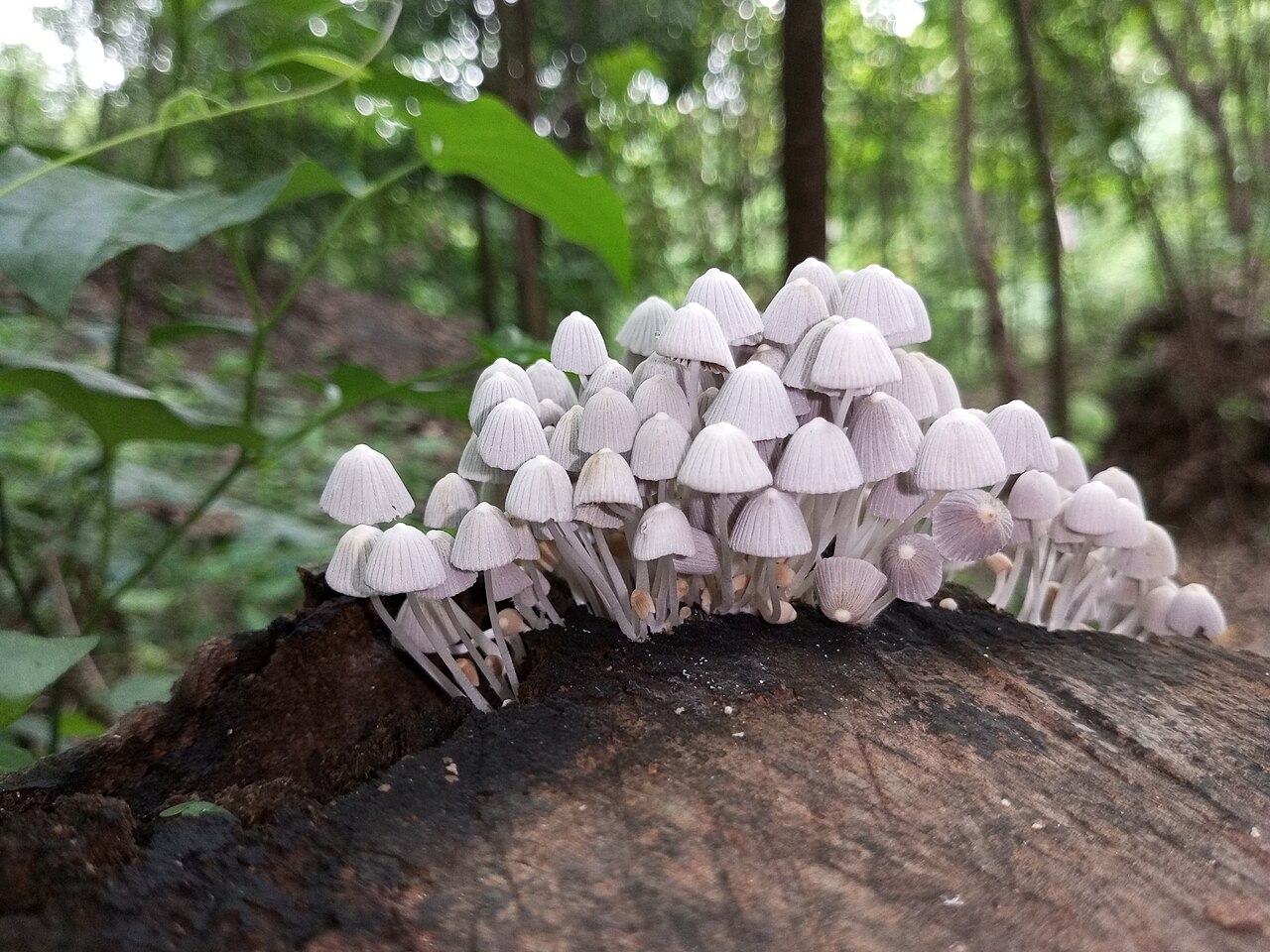
Photo: Nativeplants garden · CC BY-SA 4.0 · Photo source · License

Description
A very small grey-brown inkcap growing in massive groups on decaying or buried wood.
Identification features
The cap is strongly pleated, bell-shaped and only a few centimetres wide; it deliquesces less than many inkcaps.
Identification checklist
Check the entire fruitbody for identification. A very small grey-brown inkcap growing in massive groups on decaying or buried wood. The cap is strongly pleated, bell-shaped and only a few centimetres wide; it deliquesces less than many inkcaps. Typical habitat: On stumps, dead roots and buried wood, often in hundreds of fruitbodies.
Detailed features
- Cap
- 1–2 cm, bell-shaped, yellowish-white to grey-brown, strongly radially pleated and finely downy when young.
- Hymenophore
- Gills initially white, then grey and finally dark brown to nearly black; they normally do not deliquesce.
- Stem
- Up to 5 cm long and 0.2 cm thick, very slender, hollow, white to greyish and translucent.
- Flesh
- White and very thin.
- Smell
- No distinctive smell.
- Spore print
- Dark brown to nearly black.
Size
- Cap diameter
- 1–2 cm
- Stem height
- 1–5 cm
- Stem diameter
- 0,1–0,2 cm
Habitat
On stumps, dead roots and buried wood, often in hundreds of fruitbodies.
Fruiting period
April, May, June, July, August, September, October, November
Ecology
- Trophic mode
- Saprotrophic
- Substrate
- Stumps, Dead wood
- Notes
- A saprotroph on stumps and dead wood and at the bases of dying trees, forming very dense colonies.
How to separate similar species
Compare especially with these similar species: Coprinellus micaceus, Parasola plicatilis. Check the combination of cap shape and colour, spore-bearing surface, stem, flesh changes and habitat. A single feature or photograph is not enough; if the key characters do not match the description, do not treat the identification as confirmed.
Similar species
- Glistening inkcap (Coprinellus micaceus)
Glistening inkcap is larger, ochre-brown and young caps carry glittering veil granules.
- Pleated inkcap (Parasola plicatilis)
Pleated inkcap usually grows singly or in small numbers on grassy soil, not in huge clusters on wood.
Interesting facts
Did you know? The fruitbodies are very short-lived; a large colony can appear and collapse in about a day.