Species details
Field parasol
Macrolepiota excoriata
Traditionally edible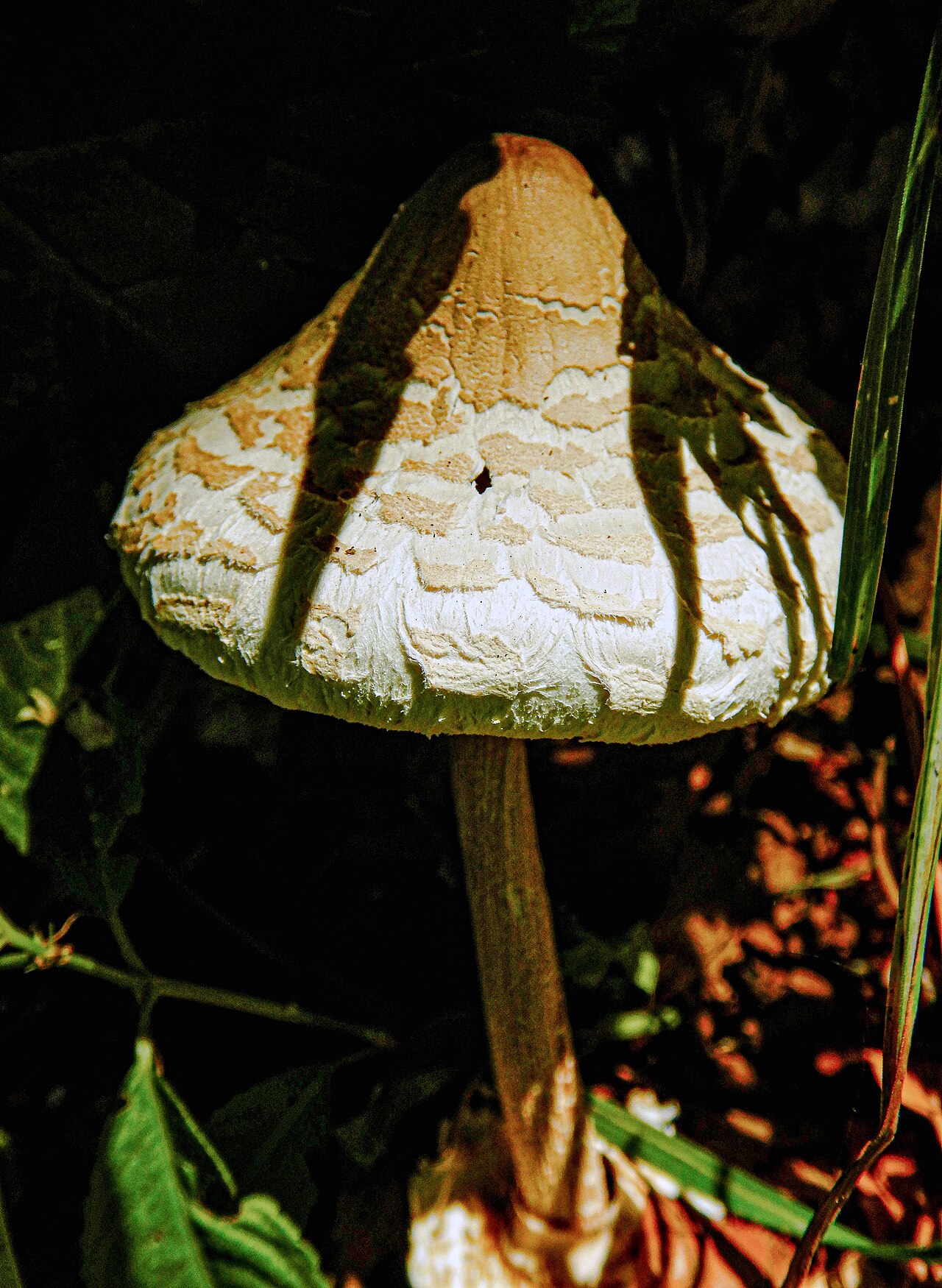
Photo: Albarubescens · CC BY-SA 4.0 · Photo source · License

Description
A medium-sized parasol with a whitish cap, ochre-brown appressed scales, a smooth pale stem and a movable ring.
Identification features
The young cap is egg-shaped, then conical and finally parasol-shaped with a blunt central boss. Gills are white, crowded, broad and free. The stem is tall, slender, smooth and enlarged at the base; older stems become hollow.
Identification checklist
Check the medium-sized whitish cap with ochre-brown appressed scales, white free gills, smooth pale stem, enlarged base and movable ring. The grassland or field habitat is also important. Always examine the complete stem base.
Detailed features
- Cap
- A medium-sized parasol mushroom with a whitish cap, ochre-brown appressed scales, a smooth pale stem and a movable ring.
- Hymenophore
- Gills are white, crowded, broad and free.
- Stem
- The stem is tall, slender, smooth and enlarged at the base; older stems become hollow.
- Flesh
- White and tender in the cap, firmer and fibrous in the stem.
- Smell
- Pleasant smell.
- Spore print
- White.
Size
- Cap diameter
- 8–15 cm
- Stem height
- 15–25 cm
- Stem diameter
- 0,6–1,2 cm
Habitat
In grass on fields and meadows and along woodland edges, singly or in groups; late summer and autumn.
Fruiting period
August, September, October
Ecology
- Trophic mode
- Saprotrophic
- Substrate
- Grassland, Soil
- Notes
- Saprotrophic species. In grass on fields and meadows and along woodland edges, singly or in groups; late summer and autumn.
How to separate similar species
Slender parasol has a more pointed central boss and a more brown-patterned stem. True parasol is usually larger and has a pronounced snakeskin stem pattern. Chlorophyllum species can be dangerous lookalikes, so with uncertain specimens check the whole base, ring, colour changes and spore print.
Similar species
- Macrolepiota mastoidea
- Parasol mushroom (Macrolepiota procera)
- Leucoagaricus nympharum
- Chlorophyllum species
Interesting facts
Did you know? Unlike the parasol mushroom, this species is characteristically associated with open grassy habitats.